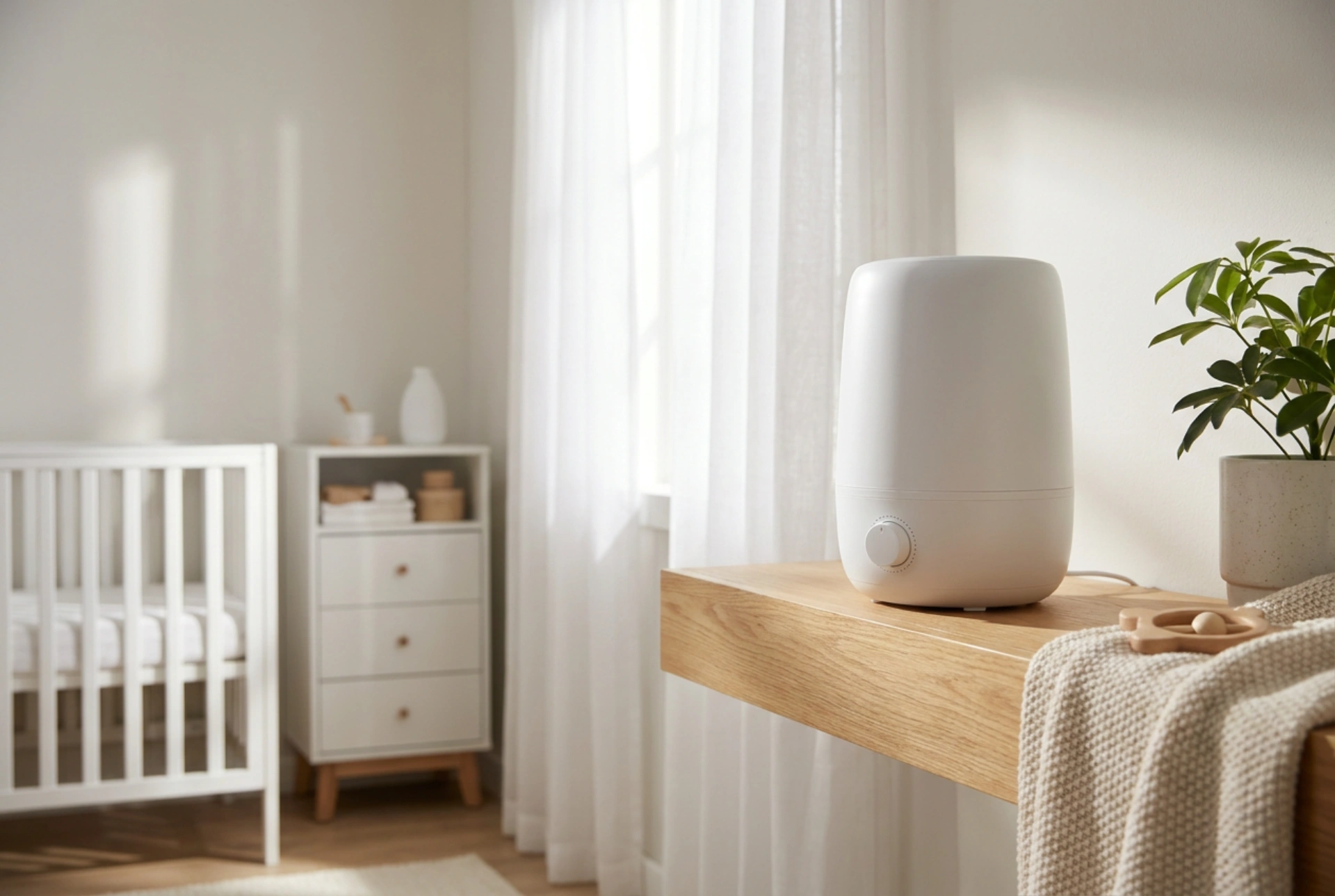


Maintaining the correct relative humidity in a child's nursery is essential for respiratory health and skin barrier integrity, but doing it incorrectly can introduce airborne pathogens and mineral dust. By understanding the thermodynamic properties of indoor air and the physical mechanisms of different humidification technologies, parents can create a stable, healthy environment without compromising air quality.
Understanding Relative Humidity: The Physics of Nursery Comfort
Relative humidity (RH) is the ratio of the current amount of water vapour in the air to the maximum amount of water vapour the air can hold at a given temperature, expressed as a percentage. In a child's room, the target relative humidity should always be maintained between 40% and 60%. Within this optimal window, the human respiratory tract functions at its best. Mucous membranes stay hydrated, allowing the microscopic cilia to effectively trap and expel inhaled pathogens and dust particles.
When relative humidity falls below 40%, especially during the winter heating season, cold outdoor air is brought inside and heated. Because warm air has a higher capacity to hold water vapour than cold air, heating it causes the relative humidity to plunge, often below 20%. This dry air rapidly evaporates moisture from the eyes, skin, and respiratory tract, leading to irritation, dry coughs, and increased susceptibility to viral infections. Conversely, allowing the relative humidity to exceed 60% creates a microclimate highly conducive to the proliferation of dust mites and the germination of mold spores, both of which are potent allergens for developing immune systems.
Choosing the Right Technology: Evaporation vs. Ultrasound
How moisture is introduced into the air depends on the physical mechanism of the humidifier. The two most common household technologies are evaporative and ultrasonic humidification, each with distinct physical behaviors.
- Evaporative Humidifiers: These devices rely on natural evaporation. A fan draws dry indoor air through a saturated wick filter. As air passes through, liquid water transitions to gas (water vapour). This method is thermodynamically self-regulating; as the air's relative humidity rises, the rate of evaporation naturally slows down. Crucially, because evaporation occurs at a molecular level, minerals and microorganisms present in the reservoir water remain trapped in the wick rather than being discharged into the air.
- Ultrasonic Humidifiers: These units utilize a piezoelectric transducer that vibrates at an ultrasonic frequency (often around 1.5 to 2 MHz). This rapid vibration creates capillary waves on the water's surface, breaking the liquid into a fine mist of micro-droplets which are then blown into the room. While highly efficient and quiet, ultrasonic devices do not vaporize water; instead, they aerosolize it. This means any mineral, chemical, or pathogen present in the liquid water is projected directly into the indoor air as particulate matter.
Water Chemistry and the Danger of Mineral Aerosols
Using untreated tap water in an ultrasonic humidifier can significantly degrade indoor air quality. Tap water contains dissolved minerals, primarily calcium carbonate and magnesium carbonate. When an ultrasonic device aerosolizes this water, the droplets evaporate in the air, leaving behind these dissolved minerals as a fine white dust. Physically, this dust consists of inhalable particulate matter (PM2.5), which can bypass the upper respiratory system and penetrate deep into a child's lungs, causing respiratory inflammation.
To prevent this, ultrasonic humidifiers must only be filled with distilled or highly demineralized water. For evaporative humidifiers, standard tap water can be used because the minerals remain on the wick filter. However, these minerals will eventually crystallize as scale, reducing the filter's capillary action and requiring regular replacement of the wick.
Strict Hygiene and Maintenance Protocol
Any standing water at room temperature is highly susceptible to biological colonization. Bacteria, such as Pseudomonas, and various fungal species can form a slimy biofilm on the internal surfaces of a humidifier within 48 hours. When the device is turned on, these pathogens can be dispersed into the child's room. To prevent this, a strict, chemical-based cleaning protocol must be followed.
First, the water tank must be emptied daily, rinsed, and dried. Once a week, the unit requires descaling and disinfecting. To descale, use a mild acidic solution, such as food-grade citric acid or white vinegar, to dissolve calcium carbonate deposits. Let it sit for 20 minutes to break down the scale, then scrub gently with a soft brush and rinse. For disinfection, use a diluted solution of hydrogen peroxide or an oxygen-based bleaching agent to destroy any biological biofilms. Never use volatile chlorine-based disinfectants, as their residues can off-gas and cause severe respiratory tract irritation when the humidifier is restarted.