

Managing indoor air quality requires a systematic understanding of physics and airborne particulate behaviour rather than relying on decorative trends. Implementing targeted mechanical filtration, moisture control, and electrostatic surface cleaning allows you to permanently reduce dust, allergens, and gaseous pollutants at their source.
The Physics of Airborne Dust and Mechanical Filtration
Suspended particulate matter, categorised as PM10 and PM2.5 based on aerodynamic diameter in micrometres, behaves according to fluid dynamics inside a closed room. Larger particles settle relatively quickly due to gravitational sedimentation, but smaller particles remain suspended for hours, driven by weak thermal currents and Brownian motion. Traditional sweeping or dry dusting merely displaces these micro-particles, sending them back into your breathing zone.
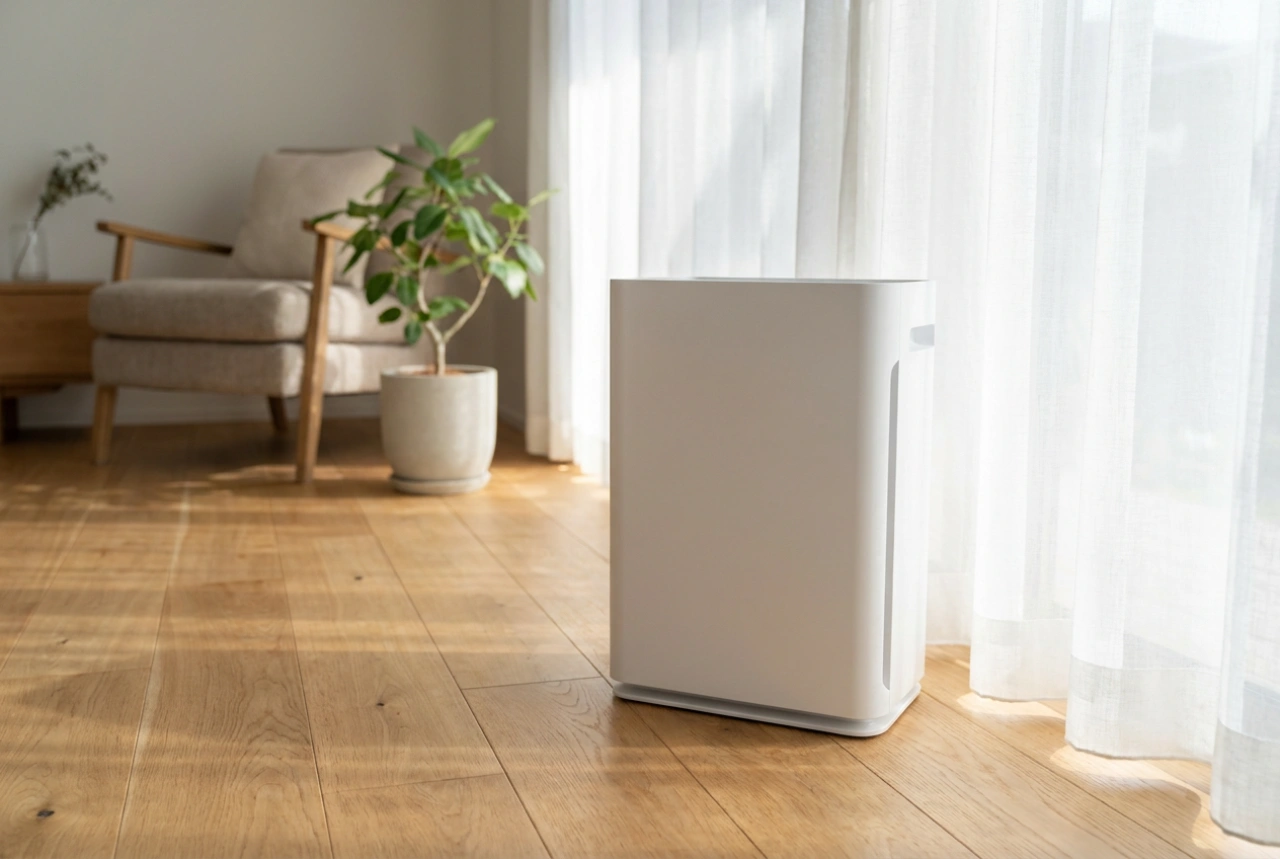
To capture these particles effectively, mechanical filtration is required. High-Efficiency Particulate Air (HEPA) filters, specifically those rated H13 or H14, rely on three distinct physical mechanisms to trap particles as air passes through the fibrous mat:
- Impaction: Larger particles, unable to follow the curving airstream around the glass fibres due to their inertia, collide directly with the fibres and get trapped.
- Interception: Medium-sized particles following the airflow pass close enough to a fibre to make contact and adhere to it.
- Diffusion: The smallest particles (under 0.1 micrometres) move in erratic, zig-zag patterns due to collisions with gas molecules. This slow, chaotic path increases the probability that they will touch and stick to a filter fibre.
For optimal air purification, locate your filtration device in areas of maximum air circulation, ensuring there are no physical obstructions within one metre of the intake vents. This ensures a consistent volumetric flow rate and prevents stagnant zones where air fails to circulate.
Adsorption of Gaseous Pollutants and Volatile Organic Compounds
While mechanical filters excel at capturing solid particles, they are entirely ineffective against gaseous pollutants, such as formaldehyde, benzene, and other volatile organic compounds (VOCs) emitted by synthetic furniture, adhesives, and paints. These gas molecules are too small to be trapped by physical fibers.
To eliminate gases, you must employ chemical adsorption, typically utilising an activated carbon filter. Activated carbon is treated with oxygen to open up millions of microscopic pores between the carbon atoms, vastly increasing its surface area. One gram of activated carbon can have a surface area exceeding 3,000 square metres.
As gaseous pollutants pass through the carbon bed, they are drawn into these pores and held by intermolecular forces (specifically, van der Waals forces). Over time, these pores become saturated, rendering the filter ineffective. Unlike physical dust filters, carbon filters cannot be vacuumed clean; they must be replaced entirely according to the manufacturer's specified schedule to prevent desorption, where captured gases are released back into the air as the ambient temperature rises.
The Thermodynamics of Air Exchange and Humidity Control
Mechanical filtration must be paired with strategic ventilation to maintain optimal oxygen and carbon dioxide levels. The most effective way to exchange indoor air without losing thermal energy is through short, intense cross-ventilation. Opening opposing windows fully for five to ten minutes creates a pressure differential that rapidly forces stale air out and pulls fresh air in. Keeping windows slightly tilted for hours is highly inefficient; it cools the surrounding walls, leading to localised temperature drops that promote water vapour condensation and subsequent mould growth.
Controlling relative humidity (RH) is critical for airborne particle management. Aim to maintain indoor RH strictly between 40% and 60%. If humidity drops below 40%, the air becomes dry, causing organic dust particles to lose mass, become lighter, and remain suspended in the air longer. Conversely, if humidity rises above 60%, it creates an ideal microclimate for dust mites to reproduce and mould spores to germinate on organic substrates like drywall and wood.
Surface Dynamics and Electrostatic Dust Control
Air purification is not achieved solely through active filtration; it also depends on how you manage surfaces where dust settles. When cleaning surfaces, avoid dry cloths or feather dusters, which generate static electricity that initially attracts dust but ultimately flings it back into the room's air currents.
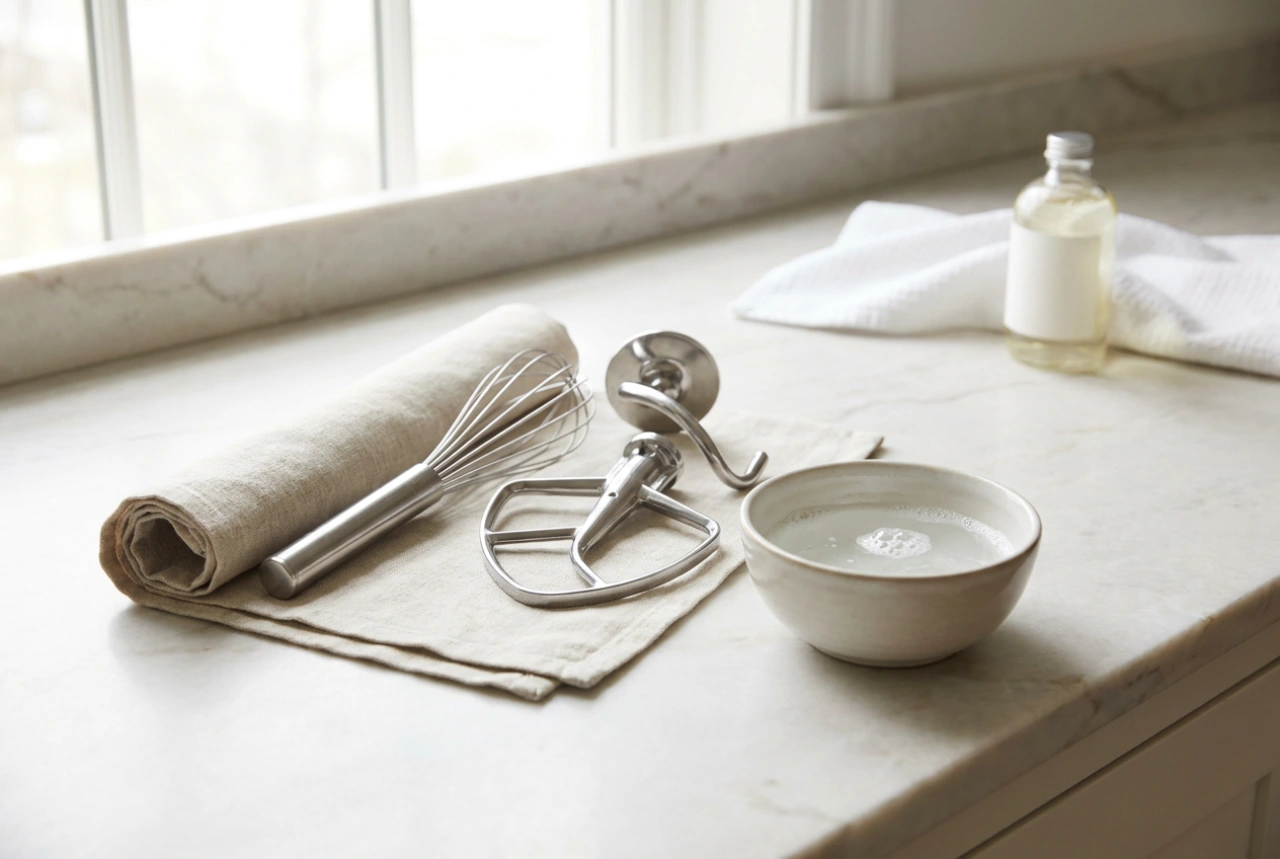
Instead, utilise high-density microfiber cloths dampened slightly with clean water or a mild surfactant solution. Microfibers feature wedge-shaped polyester and nylon fibres that physically scoop up and lock in dust particles through capillary action and natural electrostatic charge, preventing them from becoming airborne. Always clean from the highest surfaces to the lowest, allowing gravity to assist in bringing dislodged particles down to where they can be systematically wiped away.