

Maximizing the cooling efficiency of a tower fan while maintaining a safe household environment requires an understanding of fluid dynamics, electrical safety, and indoor air quality. Correct placement, routine mechanical maintenance, and proper handling of remote control batteries prevent common hazards such as motor strain, dust redistribution, and electrical short circuits.
Aerodynamics and Strategic Room Placement
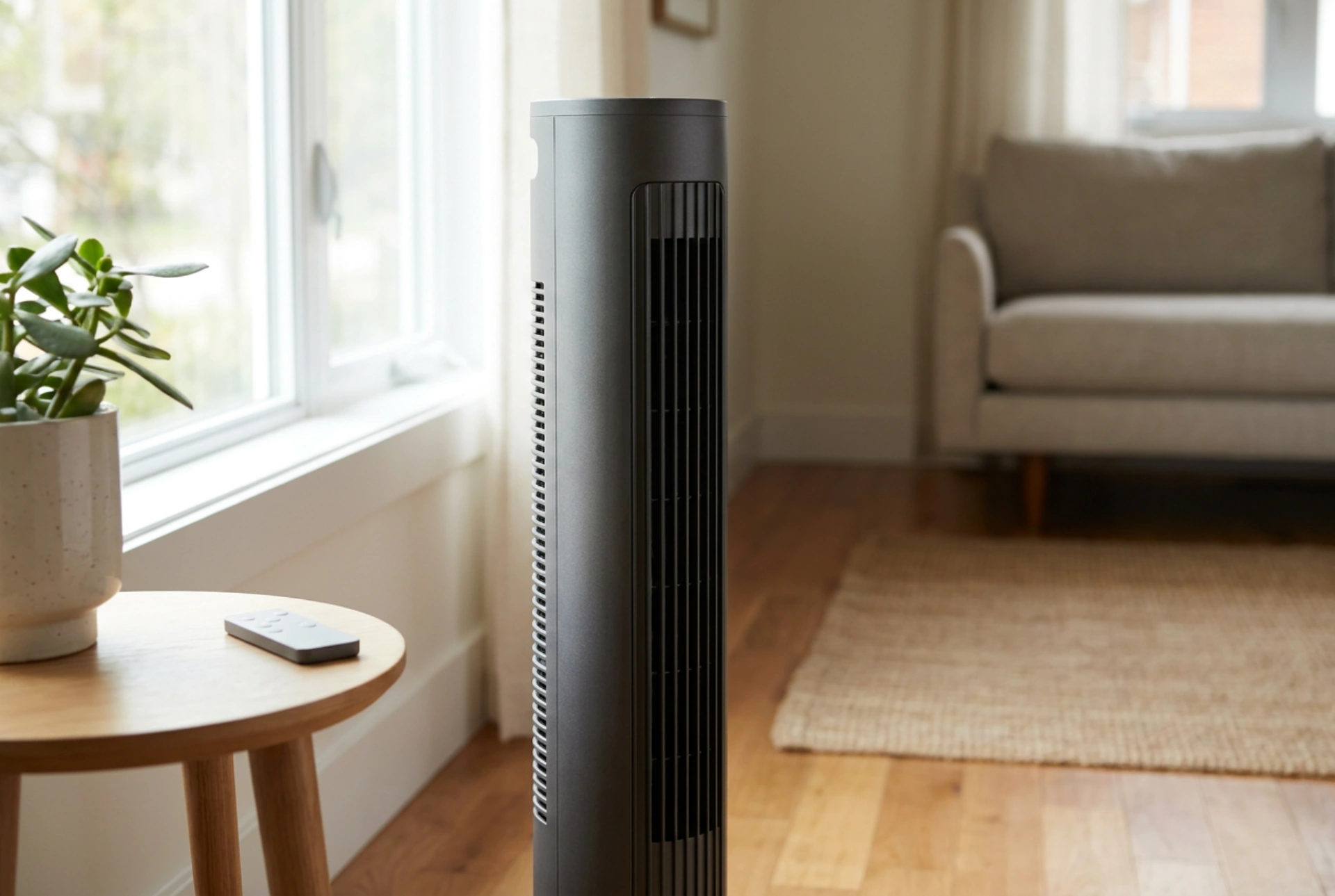
To optimize air circulation without introducing hazards, placement must be calculated based on the principles of convection and airflow barriers. Tower fans utilize a vertical impeller (tangential blower) that draws air from the rear and ejects it through a narrow front grille. This design creates a laminar airflow pattern that is highly directional.
Place the fan at least 30 to 50 centimeters away from walls, curtains, or furniture. Obstructions block the intake grille, forcing the motor to work harder, which causes inductive heating and accelerates component wear. Furthermore, positioning the unit near lightweight fabrics poses a risk of the suction pulling the material into the intake, stalling the impeller. For maximum cooling efficiency, position the fan near an open window or door to pull in cooler exterior air, rather than simply recirculating warm, stagnant indoor air.
Preventing Dust Accumulation and Motor Overload
Because tower fans draw air close to the floor, they act as low-level vacuum systems, collecting dust, pet dander, and microscopic debris. Over time, these particles adhere to the curved blades of the internal impeller due to static electricity and moisture. This accumulation unbalances the impeller, leading to increased friction, mechanical vibration, and noise.
To maintain air hygiene and protect the motor, regular cleaning is essential. Always disconnect the power cord before cleaning. Use a vacuum cleaner with a brush attachment or a canister of compressed air to clear the intake and exhaust grilles. If dust remains deeply embedded, use a long, thin microfiber duster designed for narrow crevices. Never spray water or liquid cleaning agents directly into the housing, as moisture can bypass the protective casing, reach the control board, and cause a short circuit or rust the motor spindle.
Remote Control Management and Battery Safety
Most modern tower fans feature infrared (IR) remote controls powered by small lithium button cells (such as CR2025 or CR2032) or standard AAA alkaline batteries. While convenient, these power sources require specific handling to prevent chemical leaks and accidental ingestion.
Button batteries pose a severe chemical burn risk if swallowed by children or pets. Ensure the remote control battery compartment is securely locked with its screw mechanism, or store the remote on a high shelf when not in use. Additionally, avoid mixing old and new batteries, as this causes voltage imbalances that lead to rapid degradation and leakage of corrosive potassium hydroxide. If the fan is stored away during winter, always remove the batteries from the remote to prevent chemical corrosion of the contacts.
Electrical Safety and Cable Management
Tower fans operate on standard household alternating current. Because these units often oscillate to distribute air, the physical movement must not put tension on the power cable. Ensure the cord has enough slack to accommodate the full rotation angle of the fan without pulling on the wall outlet or the internal strain relief bushing.
Never run the power cord under rugs, carpets, or furniture. Covering the cable traps the heat generated by electrical resistance, creating a silent fire hazard. Additionally, heavy foot traffic over a concealed cord can damage the copper conductors inside the insulation, leading to arcing. Inspect the power cord regularly for physical damage, kinks, or exposed copper wire, and immediately discontinue use if any degradation is found.