

Managing indoor air humidity is not merely a matter of comfort; it is a precise thermodynamic balancing act between temperature, water vapour pressure, and air exchange. Maintaining relative humidity within the optimal range of 40% to 60% requires an understanding of how air holds moisture and how to measure these changes accurately.
The Physics of Relative Humidity and the Dew Point
Relative humidity is the ratio of the partial pressure of water vapour in the air to the equilibrium vapour pressure of water at a given temperature. Because warm air has a higher capacity to hold water vapour than cold air, heating cold outdoor air as it enters a building automatically lowers its relative humidity, even if no moisture has physically left the room. This explains why indoor air becomes exceptionally dry during winter heating seasons.
To control this environment, one must monitor the dew point—the temperature at which air becomes fully saturated with water vapour and begins to condense into liquid water. If warm, humidified indoor air comes into contact with cold exterior walls or window panes that are below the dew point, condensation will form. This surface moisture can damage building materials and encourage structural mould growth, making precise measurement and temperature management essential.
Evaporation Methods: Steam, Ultrasonic, and Wicking
Increasing indoor humidity can be achieved through three primary physical mechanisms, each with distinct thermodynamic properties:
- Thermal Evaporation: Water is heated to its boiling point, converting liquid into steam. This process requires significant thermal energy but ensures the output is sterile, as the boiling process kills pathogens and leaves minerals behind in the boiling chamber.
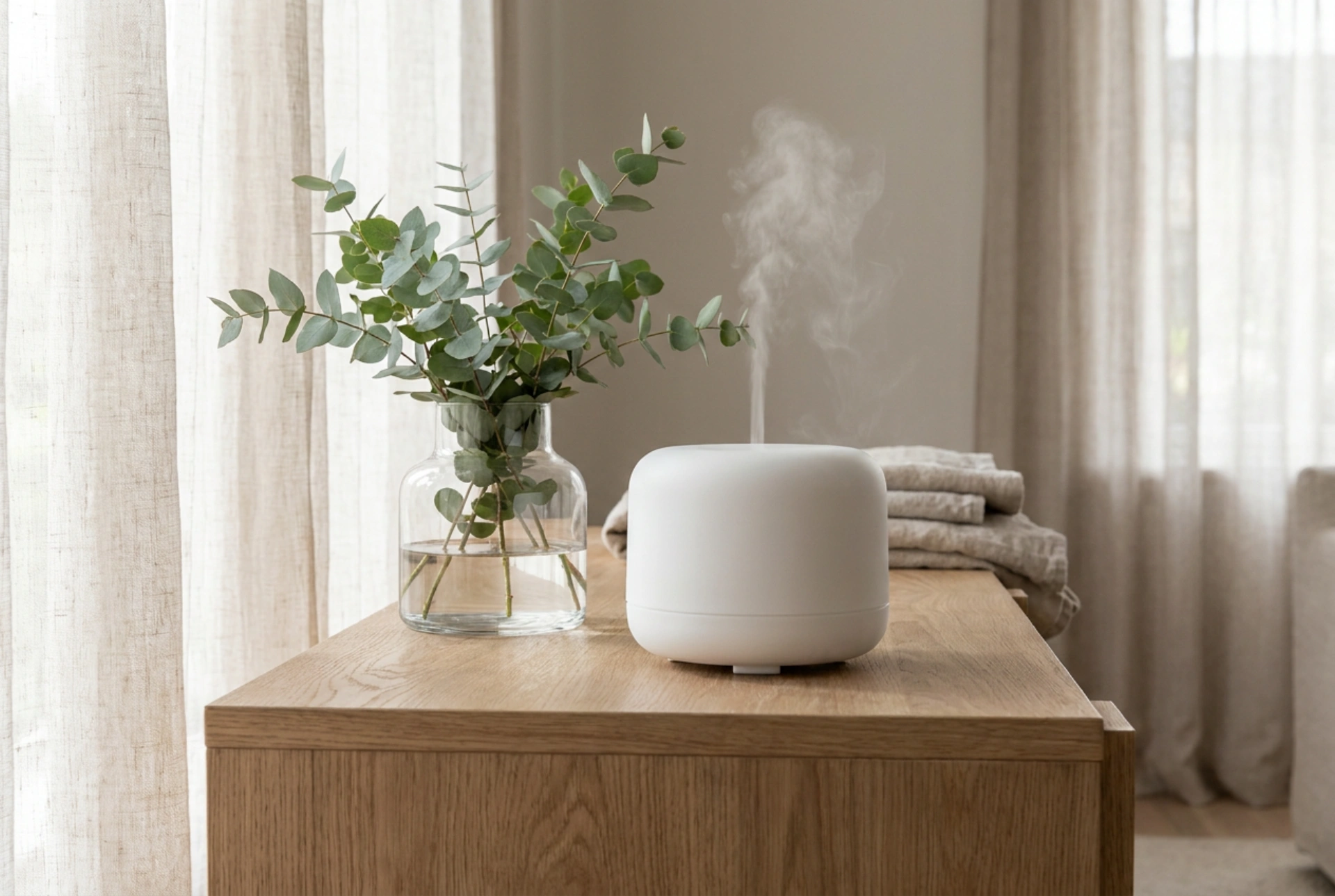
- Ultrasonic Nebulisation: A piezoelectric transducer vibrates at ultrasonic frequencies, creating micro-droplets of liquid water that are propelled into the air as a fine mist. While energy-efficient, this mechanical process disperses everything suspended in the water, including calcium and magnesium ions, which can deposit as fine white mineral dust unless distilled or demineralised water is used.
- Natural Evaporative Wicking: Dry air is drawn through a wet, porous filter matrix. The water evaporates naturally from the surface, absorbing latent heat from the air and slightly lowering the room temperature. This method is inherently self-regulating; as the ambient humidity rises, the rate of evaporation naturally slows down, preventing over-saturation.
Measuring Humidity with Precision
To effectively manage these physical systems, reliable diagnostic tools are necessary. Digital hygrometers typically utilise capacitive or resistive polymer sensors. These sensors feature a thin strip of moisture-absorbing material that changes its electrical capacitance or resistance based on the surrounding relative humidity. For maximum accuracy, place hygrometers on interior walls at breathing height, away from direct sunlight, draughts, radiators, or the immediate output of a humidifier, as microclimates can distort readings.
Hygroscopic Buffering and Building Materials
Unpainted wood, clay plaster, and natural fibre textiles act as passive humidity buffers due to their hygroscopic nature. When indoor humidity is high, these materials absorb water vapour directly from the air. Conversely, when the air dries out, they release the stored moisture back into the room. Leveraging these material properties can significantly stabilise indoor conditions, reducing the reliance on active electrical appliances.
Strategic Air Exchange and Ventilation
Ventilation is the primary method for reducing humidity when it exceeds safe thresholds. However, winter ventilation must be timed carefully. Opening windows briefly but fully allows dry, cold outdoor air to replace humid indoor air without cooling down the thermal mass of the walls and furniture. Once the window is closed, this fresh air warms up rapidly, lowering the relative humidity to a stable, comfortable level without wasting significant heating energy.