

Maximising the efficiency of a small built-in refrigerator requires an understanding of thermodynamics and airflow dynamics. Due to the confined nature of integrated kitchen cabinetry, these appliances demand precise physical management to maintain optimal cooling zones and prevent energy waste.
Understanding Cabinetry Ventilation and Heat Exchange
Unlike freestanding units that dissipate heat from all sides, an integrated refrigerator relies on a dedicated ventilation path. The appliance extracts heat from its interior and expels it through the condenser coils at the back. For this process to function efficiently, cool air must enter through a plinth vent at the bottom, rise behind the appliance, and escape through an exhaust grille at the top.
When this pathway is obstructed by dust or poor installation, the compressor must work harder to expel heat. This constant overload raises the internal temperature, increases electricity consumption, and accelerates mechanical wear. To maintain this heat-exchange cycle, ensure that both the lower intake and upper exhaust vents remain completely unobstructed. Vacuuming the bottom plinth twice a year removes dust layers that can reduce airflow speed by up to thirty percent.
Convection Currents and Temperature Zoning
In a small refrigerator, packing items too tightly disrupts the natural convection currents that maintain uniform temperatures. Cold air naturally sinks to the bottom, while warmer air rises. Understanding these microclimates is key to food preservation.
- The Top Shelves: The warmest zone (around 5°C to 8°C), ideal for pre-cooked meals, dairy products, and preserves that do not require intense cooling.
- The Middle Shelves: Maintaining a steady 4°C, this area is optimal for eggs and packaged dairy items.
- The Lowest Glass Shelf: Positioned directly above the crisper drawer, this is the coldest zone (around 2°C), perfect for raw meat and fish to prevent bacterial growth.
- The Crisper Drawer: This zone maintains higher relative humidity, preventing fresh vegetables from drying out.
To facilitate these zones, avoid blocking the air vents at the back of the liner. Leaving a two-centimetre gap between food containers and the rear wall prevents frost formation on packaging and allows cold air to circulate freely.
The Principle of Thermal Mass
In small-capacity refrigerators, opening the door causes a rapid exchange of cold internal air for warm, humid room air. This sudden temperature spike forces the compressor to cycle on to restore equilibrium. You can mitigate this effect by utilising the principle of thermal mass.
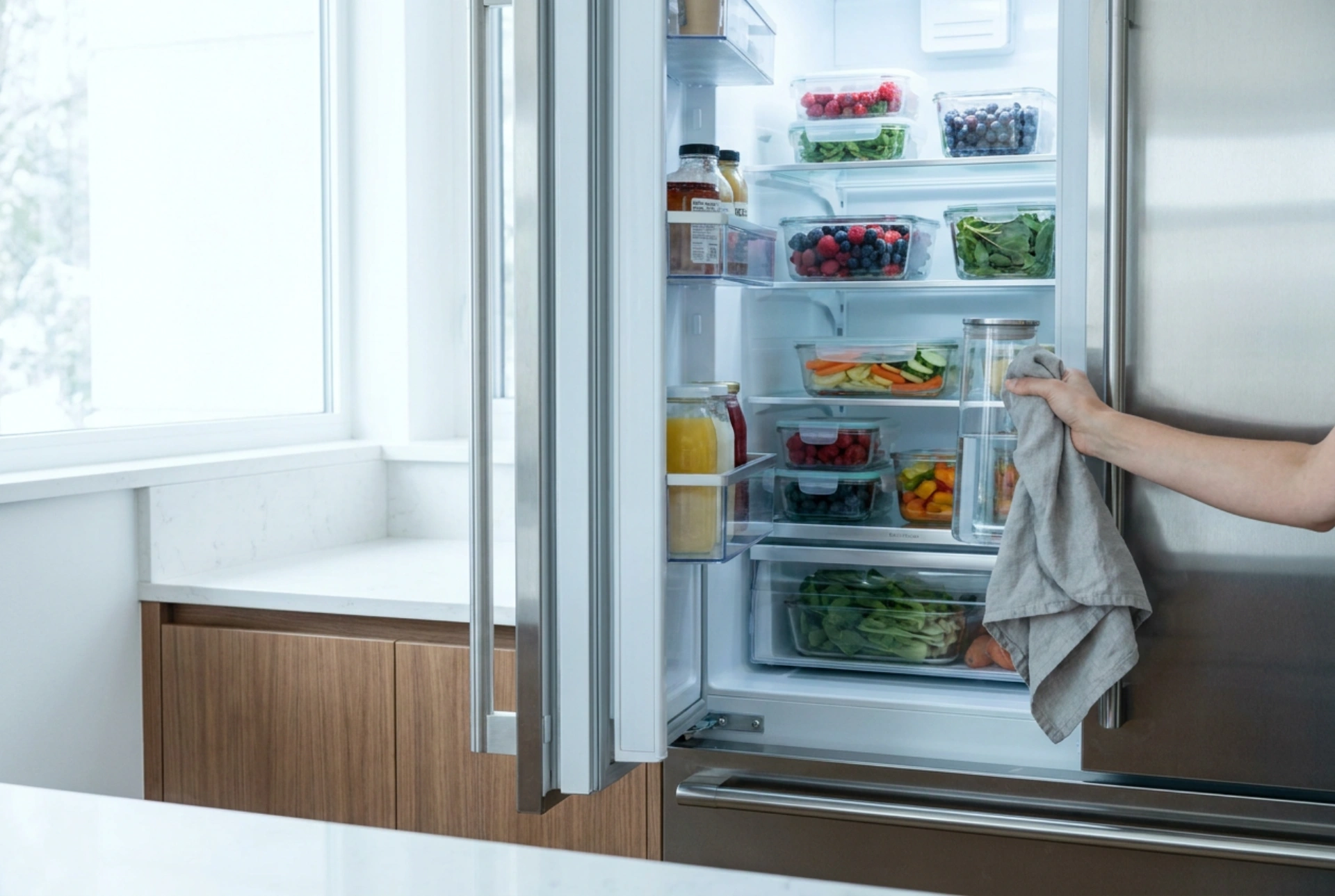
Solid items and liquids hold thermal energy far better than air. When a refrigerator is moderately full, the chilled items act as cold reservoirs, absorbing the incoming warmth and stabilising the internal temperature. If your built-in fridge is frequently empty, place sealed glass bottles filled with water on the shelves. These bottles increase the thermal mass, reducing energy spikes and keeping the system stable during daily use.
Moisture Control and Seal Integrity
Moisture is the primary enemy of efficient cooling. When warm, humid air enters the fridge, the moisture condenses on the cold evaporator plate, eventually freezing into ice. A layer of ice thicker than three millimetres acts as an insulator, reducing cooling efficiency and forcing the compressor to run continuously.
To prevent excessive frost, always store food in airtight containers. This prevents water vapour from evaporating into the cabin air. Additionally, verify the seal of the magnetic door gasket. A compromised seal allows a continuous stream of warm air to enter. To test this, place a thin sheet of paper between the seal and the cabinet frame, then close the door; if the paper pulls out without resistance, the magnetic gasket is worn and requires replacement to restore the hermetic seal.