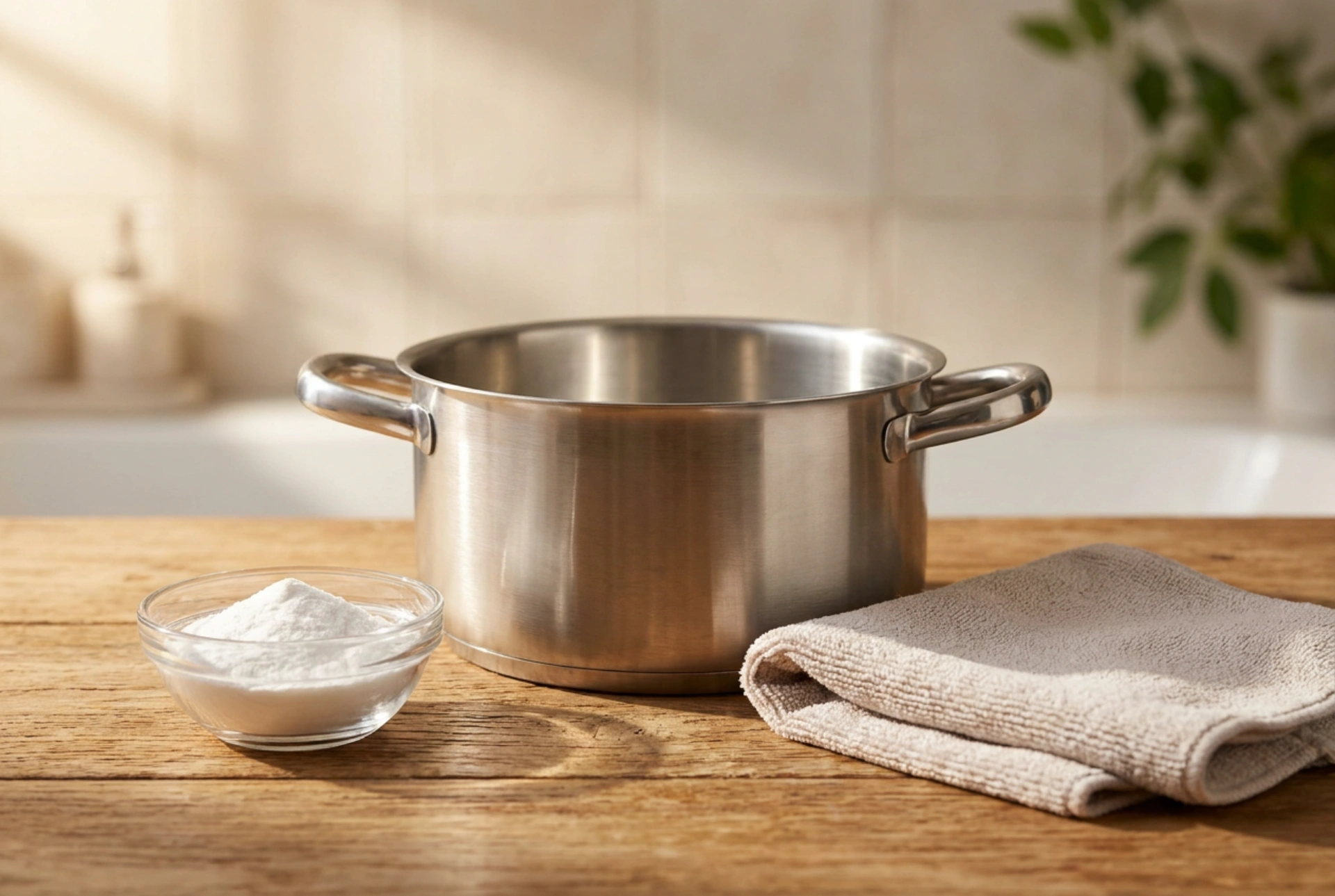


Removing stubborn, polymerised food residue from the bottom of a stainless steel pot does not require aggressive scrubbing that can permanently scratch the metal. By pairing the alkaline chemistry of sodium bicarbonate with the physics of controlled thermal expansion, you can safely lift charred layers without damaging your cookware.
The Science Behind the Burn: Saponification and Expansion
When food burns, proteins and carbohydrates undergo pyrolysis, turning into a tough, carbonised matrix. Fats present in the food polymerise under high temperatures, forming a varnish-like layer that bonds tightly to the microscopic pores of the metal. Standard dishwashing detergents, which are neutral or slightly acidic, cannot easily break these bonds.
Sodium bicarbonate (baking soda) is a mild alkali with a pH of approximately 8.3. When dissolved in water, it undergoes partial hydrolysis, producing hydroxide ions. These ions break down the polymerised fats through a process called saponification, converting insoluble greasy binders into water-soluble soaps. Simultaneously, the alkaline environment weakens the structural integrity of the charred proteins, making the crust brittle.
Why Temperature Matters: The Physics of Thermal Shock
While chemistry weakens the chemical bonds, heat introduces physical forces that pull the burnt layer apart. Metals have a relatively high coefficient of thermal expansion. When you apply controlled heat to the pot, the underlying steel expands. The carbonised crust, being ceramic-like and brittle, does not expand at the same rate. This differential expansion creates microscopic fractures within the burnt layer.
As these cracks open, the hot alkaline solution is drawn deep into the interface between the metal and the carbon via capillary action. This allows the sodium bicarbonate to work from the bottom up, peeling the crust away from the steel surface rather than just dissolving it from the top down.
The Controlled Heating Protocol: Step-by-Step
To execute this technique safely and effectively, follow these precise steps to leverage both chemical and thermal mechanisms:
- Cool the vessel: Always allow the pot to cool to room temperature before starting. Pouring liquids into a hot pot can cause thermal shock, warping the base of high-quality multi-clad cookware.
- Apply the alkaline base: Sprinkle a generous layer of sodium bicarbonate over the charred areas. Add just enough water to create a thick paste. Let this sit for 15 to 20 minutes to allow the initial penetration of the alkali.
- Dilute and hydrate: Pour in enough water to cover the burnt residue by at least two centimetres. Do not fill the pot to the brim, as the mixture will foam when heated.
- Apply controlled heat: Place the pot on a hob and bring the solution to a gentle simmer over medium-low heat. Do not use high heat, as this can cause the water to evaporate too quickly and create new burn marks.
- Agitate mechanically: As the solution simmers, use a flat-edged wooden or high-temperature silicone spatula to apply gentle pressure to the lifted crust. The carbon should flake off in large pieces. Do not use steel wool or metal scrapers, which can strip the protective passive layer of the stainless steel.
Handling Severe Carbonisation
For extremely thick, multi-layered burns where a single simmer is insufficient, turn off the heat once the solution reaches a boil, cover the pot with a lid, and let it stand overnight. The gradual cooling of the highly concentrated alkaline solution allows the water molecules to deeply hydrate the carbon structure, softening it completely by morning. A simple rinse and light wipe with a non-abrasive sponge will then suffice to clear the surface.
Restoring the Passivation Layer
After successfully removing the burn marks, the stainless steel may exhibit a cloudy, white residue or a rainbow-like sheen. The white residue is sodium carbonate deposit, while the rainbow sheen is a thickened chromium oxide layer caused by heat. To restore the pristine finish, rinse the pot thoroughly, then wipe it with a soft cloth dampened with a mild acid solution, such as diluted white vinegar or citric acid. The acid neutralises any remaining alkali and restores the optimal, corrosion-resistant passive chromium oxide layer on the steel surface.