

Selecting the right air purifier and placing it strategically determines whether the device actively sanitises your indoor environment or merely circulates dust. Understanding the physics of airflow and filtration mechanics allows you to optimise particle capture and maintain clean breathing zones.
Understanding Filtration Mechanics: HEPA and Carbon
To choose an effective device, you must understand how different pollutants are captured. Particulate matter, such as pollen, pet dander, and soot, is trapped using mechanical filtration. High-Efficiency Particulate Air (HEPA) filters operate on three primary physical principles: inertial impaction, interception, and diffusion. Large particles collide directly with the fibres (impaction), mid-sized particles brush against them and stick (interception), and the smallest particles move in erratic zig-zag paths due to Brownian motion, eventually colliding with a fibre (diffusion). For residential use, look for high-efficiency particulate filters which capture 99.97% of particles as small as 0.3 microns.
Gaseous pollutants, such as volatile organic compounds (VOCs) from paints or household cleaners, cannot be caught by physical meshes. These require an activated carbon filter. Activated carbon works through adsorption—a chemical process where gas molecules adhere to the highly porous surface area of the carbon. A high-quality purifier should combine both mechanical HEPA filtration and a substantial mass of activated carbon to address both particulate and gaseous contaminants effectively.
Sizing the Purifier: Calculating Volume and ACH
Choosing a purifier based solely on recommended room area often leads to underperformance. Instead, calculate the volume of your space and the required Air Changes per Hour (ACH). For standard living spaces, a minimum ACH of 4 is recommended, meaning the entire volume of air in the room passes through the filter four times every hour.
- Calculate room volume: Multiply the floor area in square metres by the ceiling height in metres (e.g., a 20 m² room with a 2.5 m ceiling has a volume of 50 m³).
- Determine required Clean Air Delivery Rate (CADR): Multiply the room volume by your target ACH (50 m³ x 4 = 200 m³/h). Your chosen device must have a CADR rating of at least 200 m³/h for particulates.
Operating a larger capacity purifier on a lower, quieter speed setting is often more energy-efficient and acoustically comfortable than running a smaller unit at maximum capacity constantly.
Aerodynamics of Placement: Avoiding Dead Zones
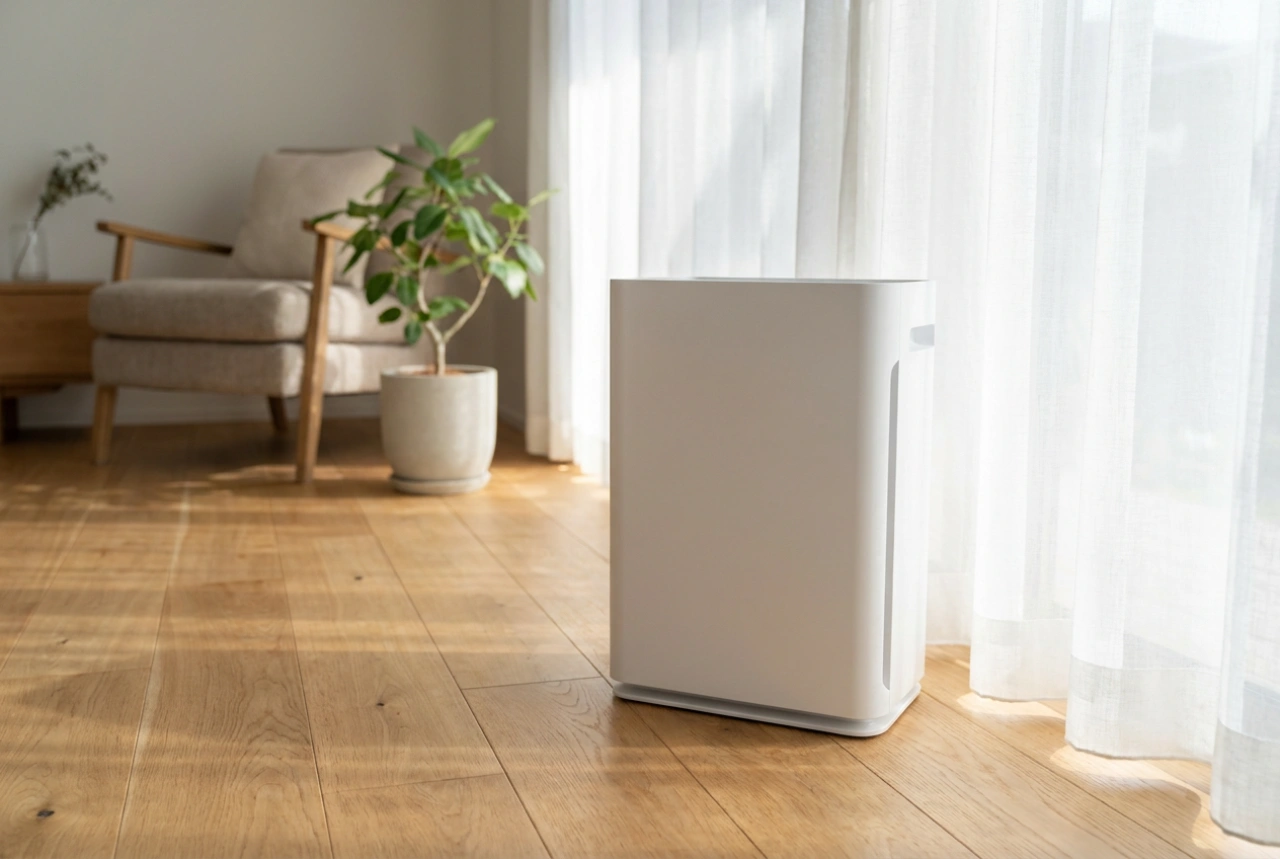
An air purifier cannot clean air it cannot reach. The device relies on creating a continuous circulation loop, drawing dirty air in and pushing clean air out. Placing a purifier in a tight corner, behind a sofa, or directly against a wall severely restricts its intake, creating 'dead zones' of stagnant air.
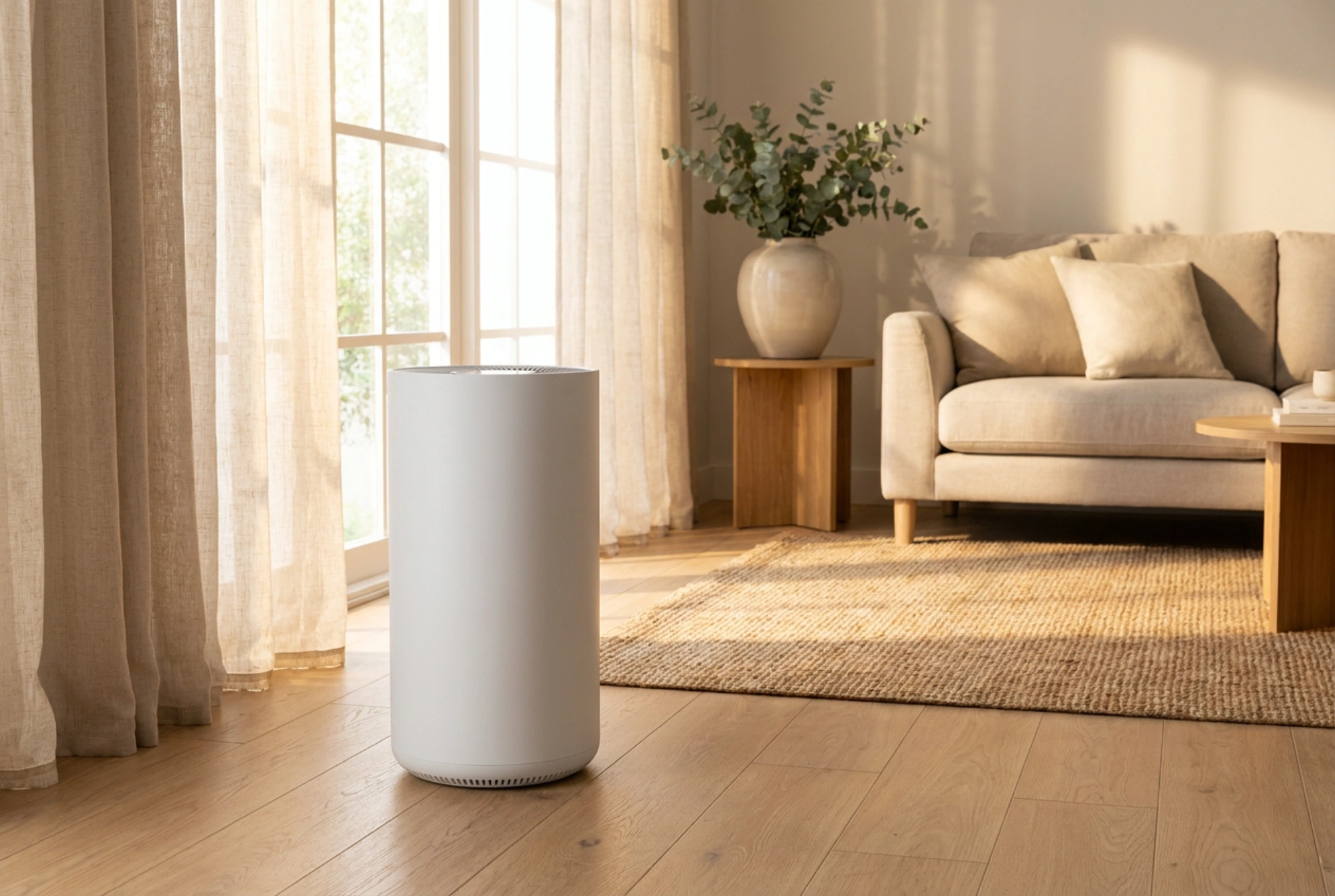
For optimal aerodynamics, maintain a clearance of at least 30 to 50 centimetres around all intake vents. If your device features a 360-degree intake, it should ideally sit closer to the centre of the room or at least a metre away from walls. For wall-facing units, ensure the intake grilles face the open space of the room. Placing the unit on a hard, flat surface rather than deep-pile carpet prevents fibres from restricting the bottom intakes and ensures stable operation.
Thermal Updrafts and Room Dynamics
The movement of air within a home is heavily influenced by temperature gradients. Warm air rises, and cool air falls, creating natural convective currents. Positioning your purifier near a radiator or a heat source can help draw air into the device more rapidly as warm air moves upward. However, keep the unit away from drafty open windows, as the continuous influx of outdoor air will overwhelm the filtration system, forcing it to work indefinitely without lowering indoor particle counts.