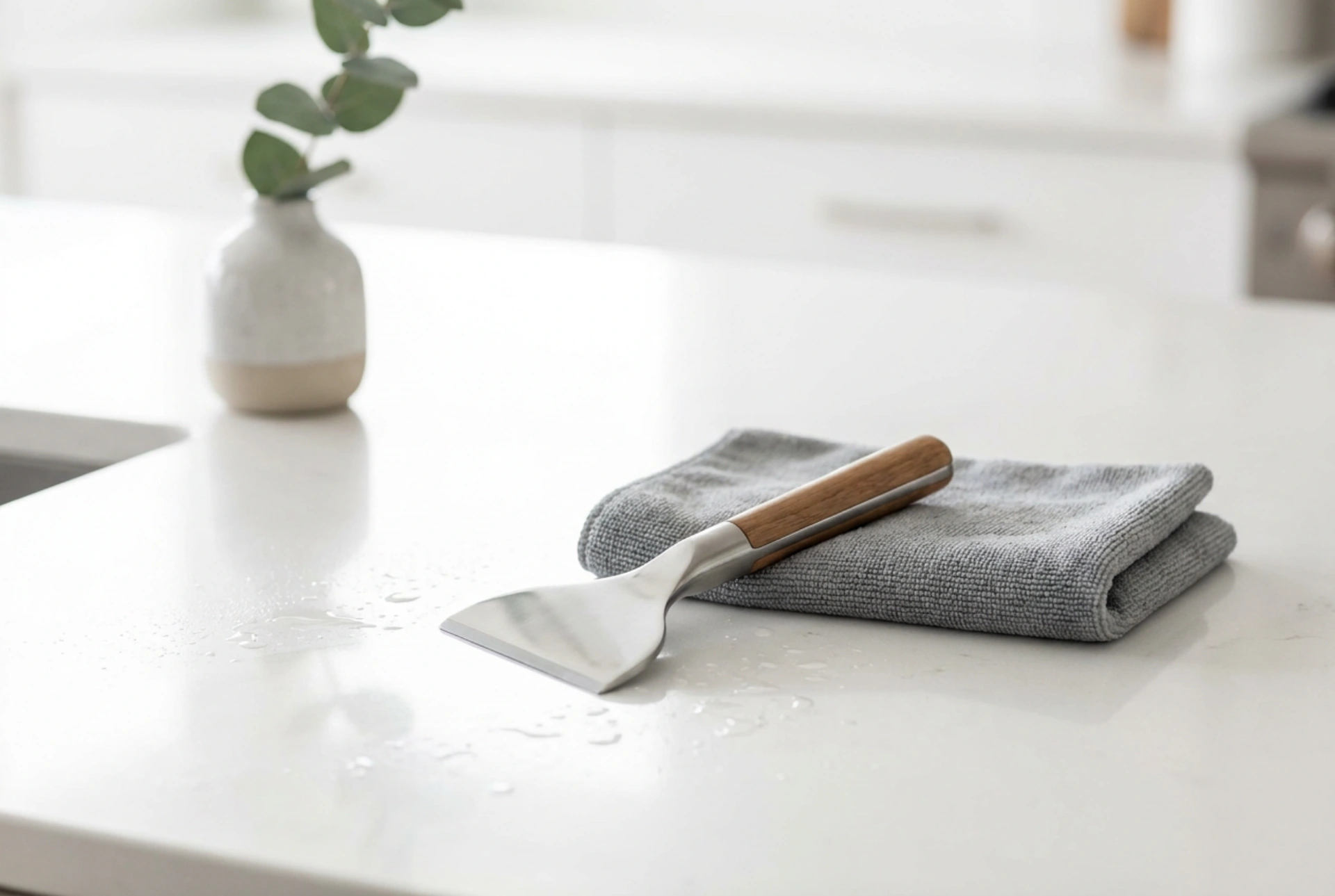


Scraping burnt-on food residues from an induction hob requires a precise understanding of the physical properties of ceramic glass and steel blades. When executed with the correct angle, lubrication, and pressure, a metal scraper can restore the surface to a pristine finish without causing microscopic abrasions or deep scratches.
The Material Science of Ceramic Glass and Steel Blades
To clean a glass-ceramic surface safely, it is essential to understand the materials in contact. Most modern induction hobs are made from lithium-aluminosilicate glass-ceramic. This material is engineered for extreme thermal shock resistance and has a high surface hardness, typically rating between 6 and 6.5 on the Mohs hardness scale. By comparison, standard steel blades used in hob scrapers have a hardness rating of approximately 5.5 to 6.
Because the steel is slightly softer than or equal to the ceramic glass, a flat blade cannot easily cut into the glass surface under normal conditions. However, scratching occurs when the mechanical forces are concentrated incorrectly, or when abrasive particles like salt crystals (hardness 2.5, but highly cubic and sharp) or silica dust (hardness 7) get caught beneath the blade. If these particles are trapped under a scraping tool, the pressure transforms them into abrasive cutters that will scar the glass. Therefore, cleanliness of both the surface and the blade is the primary defense against damage.
The Physics of Angle, Force, and Direction
The mechanical efficiency of a scraper lies in shearing force. To remove burnt-on carbonised sugars and fats, the blade must slip under the residue and lift it away from the glass. The angle of attack is the most critical variable in this process.
- Keep the angle low: The optimal angle between the blade and the hob surface is between 15 and 30 degrees. This low angle ensures that the downward force is minimised while the forward shearing force is maximised. It allows the blade to glide over the smooth glass and shear through the raised residue.
- Avoid high angles: If the scraper is held at an angle greater than 45 degrees, the blade acts as a chisel rather than a wedge. This increases the risk of the blade chatter—micro-bouncing across the surface—which can nick the glass or cause the edge of the blade to dig directly into the ceramic material.
- Ensure flush contact: Always keep the entire edge of the blade flat against the glass. Tilting the scraper to one side concentrates all your applied force onto a single sharp corner, which can easily exceed the structural threshold of the glass-ceramic and leave a permanent mark.
The Critical Role of Lubrication
Dry scraping is a frequent cause of accidental damage. Without a liquid medium, the friction between the blade and the dry, carbonised soil increases rapidly, causing the blade to jump. Furthermore, dislodged hard particles have nowhere to go but to grind between the steel and the glass.
Applying a lubricant changes the physical dynamics of the process. A thin film of warm water mixed with a generic surfactant (such as dishwashing liquid) or a dedicated non-abrasive liquid cleaner serves multiple purposes. First, it reduces surface friction, allowing the blade to slide smoothly. Second, it acts as a hydraulic suspension medium, lifting loosened micro-particles away from the glass surface so they cannot cause abrasive wear. Third, the surfactant penetrates the burnt-on organic matter, softening its bond with the glass-ceramic substrate before you even begin scraping.
Step-by-Step Procedure for Scratch-Free Scraping
Following a methodical order of operations ensures consistent, scratch-free results every time you clean your induction hob.
Step 1: Cool Down and Pre-Clean
Never attempt to scrape a hot induction zone. Thermal stress makes glass-ceramic more susceptible to damage, and any liquid lubricant applied will instantly evaporate, leaving a dry surface. Wait until the hob is completely cool to the touch. Gently wipe away loose crumbs and dust with a dry microfibre cloth to eliminate any loose abrasive grit.
Step 2: Inspect and Prepare the Blade
Before touching the hob, inspect the scraper's blade. A rusty, bent, or nicked blade must be replaced immediately. Even microscopic imperfections in the steel edge can concentrate pressure unevenly, leading to scratches. Ensure the blade is securely locked into the holder and is completely straight.
Step 3: Apply the Lubricant
Saturate the stubborn residue with a soapy water solution or apply a small amount of a non-abrasive liquid cleaner. Allow it to sit for two to three minutes. This waiting period allows the liquid to break down the surface tension of the grease and soften the carbonised layer.
Step 4: Execute the Scraping Motion
Position the blade flat against the glass a few centimetres behind the residue. Adjust the angle to approximately 20 degrees. Using light, uniform pressure, push the scraper forward in a smooth, steady motion. Let the blade do the work of shearing the residue. If you encounter resistance, do not apply excessive downward pressure; instead, lift the blade, re-wet the area, and try again from a slightly different angle.
Step 5: Clean and Polish
Once the carbonised spot is detached, wipe the entire area with a damp microfibre cloth to remove the loosened debris and the lubricant. Dry the surface with a clean, dry microfibre cloth to inspect your work and restore the natural glass shine.