

Maintaining comfortable humidity inside a vehicle during cold seasons or long journeys with active climate control can be challenging without causing obscure, dangerous condensation on the windows. Balancing air moisture levels requires understanding the thermodynamics of your car's cabin and the physical properties of water vapor.
The Science of Window Fogging: Dew Point and Humidity
To prevent your windows from fogging while using a mobile humidifier, you must understand the concept of the dew point. The dew point is the temperature at which air becomes fully saturated with water vapor, leading to condensation. Car windows, being in direct contact with the cold outside air, are significantly colder than the interior cabin air. When the warm, humidified air inside the vehicle contacts these cold glass surfaces, its temperature drops rapidly. If the glass temperature is at or below the dew point of the cabin air, the water vapor transitions from a gas to a liquid, forming a thin layer of micro-droplets on the glass—commonly known as condensation or fog.
By introducing a humidifier, you artificially raise the relative humidity inside the cabin. If this humidity reaches a certain threshold relative to the cold window surface temperature, condensation is physically inevitable. Therefore, the key to using a car humidifier successfully lies in regulating the moisture output and ensuring that the humidified air does not directly settle on cold surfaces before it distributes evenly throughout the cabin volume.
Strategic Placement and Direction of the Vapor Stream
The positioning of your portable humidifier determines how the moisture disperses. Placing the device too close to the windshield or side windows is a primary cause of localized fogging. Liquid water droplets exiting the transducer of an ultrasonic humidifier are cold and heavy compared to true gas-phase water vapor, making them highly prone to immediate precipitation on nearby cold surfaces.
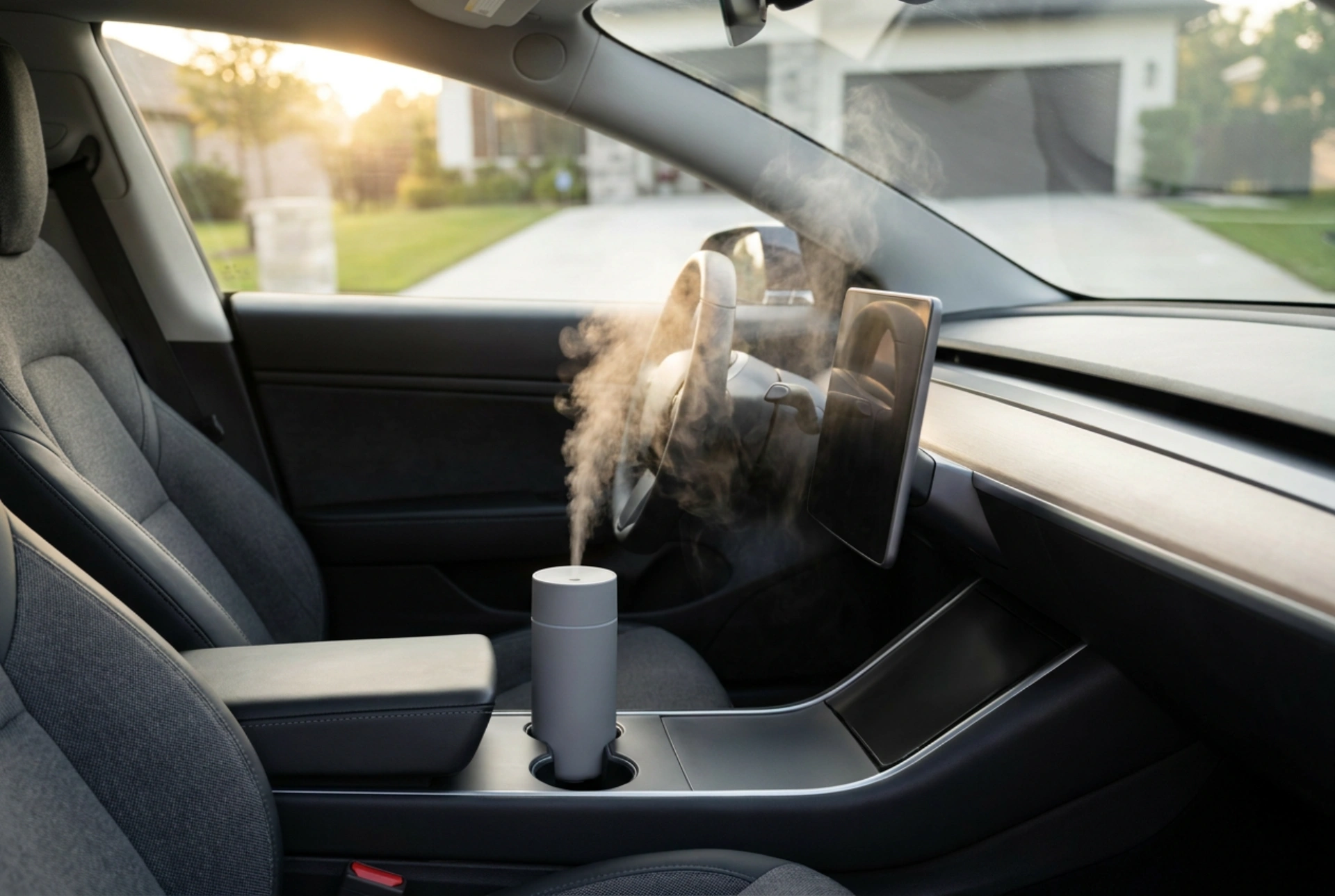
- Use Center Cupholders: Position the humidifier in a central console cupholder. This location keeps the mist source equidistant from the major glass surfaces, allowing the water droplets time to evaporate fully into the air before contacting the windows.
- Direct Mist Upward and Backward: Adjust the nozzle so the mist stream is directed vertically or slightly toward the rear of the cabin. Avoid pointing the output directly at the dashboard or windshield.
- Ensure Adequate Airflow Path: Do not block the path of the vapor. Allowing the vehicle's natural internal convection currents to mix the moisture prevents pockets of high humidity from forming.
Coordinating with Your Car’s HVAC System
Your vehicle’s heating, ventilation, and air conditioning (HVAC) system is your primary tool for managing cabin air thermodynamics. To run a humidifier safely, you must coordinate it with your climate control settings rather than letting them fight each other.
Fresh Air Mode vs. Recirculation
Using the air recirculation mode traps moisture inside the cabin. As the humidifier runs, the relative humidity will climb rapidly to saturation, causing severe fogging on all glass panels. Always operate your HVAC system on fresh air mode. This constantly introduces drier outside air, which mixes with the humidified cabin air, carrying excess moisture out through the vehicle's pressure relief vents. This continuous air exchange stabilizes the relative humidity at a comfortable level instead of letting it saturate.
Utilizing the Air Conditioner as a Regulator
It may seem counterintuitive to run the air conditioning compressor while trying to humidify the air, but the AC evaporator core acts as an excellent dehumidifier. If you notice light fogging beginning to form on the edges of your windshield, engaging the AC with a warm temperature setting allows the system to extract excess, heavy moisture from the air while still leaving a comfortable level of ambient humidity. The warm air holds more moisture in a gaseous state, while the AC prevents it from reaching the saturation point on the cold glass.
Water Chemistry and Surface Cleanliness
The physical state of your window surfaces plays a massive role in how easily water vapor condenses on them. Microscopic dust particles, residues from plastic outgassing, and fingerprint oils act as nucleation sites. These sites lower the energy barrier required for water vapor to condense into visible droplets. Cleaning your interior glass regularly with an alcohol-based cleaner removes these nucleation sites, making it much harder for fog to cling to the surface.
Additionally, always use distilled water in your portable humidifier. Tap water contains dissolved minerals. When ultrasonic humidifiers atomize tap water, these minerals are dispersed into the air and settle as a fine white dust on your dashboard and windows. This mineral film increases surface roughness, creating more nucleation sites and accelerating the fogging process over time.