

Air fryers have revolutionized modern kitchens by delivering the coveted crispy texture of deep-fried food with only a fraction of the oil, relying instead on fundamental principles of thermodynamics and fluid dynamics.
The Physics of Forced Convection
At the core of an air fryer is a highly efficient forced convection system. Unlike a traditional oven, which relies on stagnant hot air radiating heat slowly, an air fryer utilizes a powerful heating element paired with a high-velocity mechanical fan. Located directly above the cooking chamber, the heating element warms the air, while the fan forces it downward at high speed. This rapid movement creates a turbulent wind tunnel inside the compact basket. The constant motion of the air strip away the boundary layer of cooler air and moisture that naturally surrounds cold food, allowing for an incredibly rapid and direct heat transfer.
The Maillard Reaction Without the Oil Bath
To achieve a golden-brown, crispy exterior and a savory flavor profile, food must undergo the Maillard reaction. This chemical reaction occurs between amino acids and reducing sugars when exposed to temperatures above 140 degrees Celsius. In traditional deep frying, hot oil acts as the thermal conductor, transferring heat quickly and evenly to trigger this reaction. In an air fryer, the high-speed air acts as the heat-transfer medium instead. Because the air is moving so fast, it evaporates surface moisture almost instantly. This rapid dehydration of the outer layer is crucial; as long as surface water is present, the temperature cannot rise above 100 degrees Celsius, preventing the Maillard reaction. By stripping away this moisture, the air fryer allows the surface temperature to jump quickly, initiating browning and crisping with minimal added oil.
The Role of the Perforated Basket
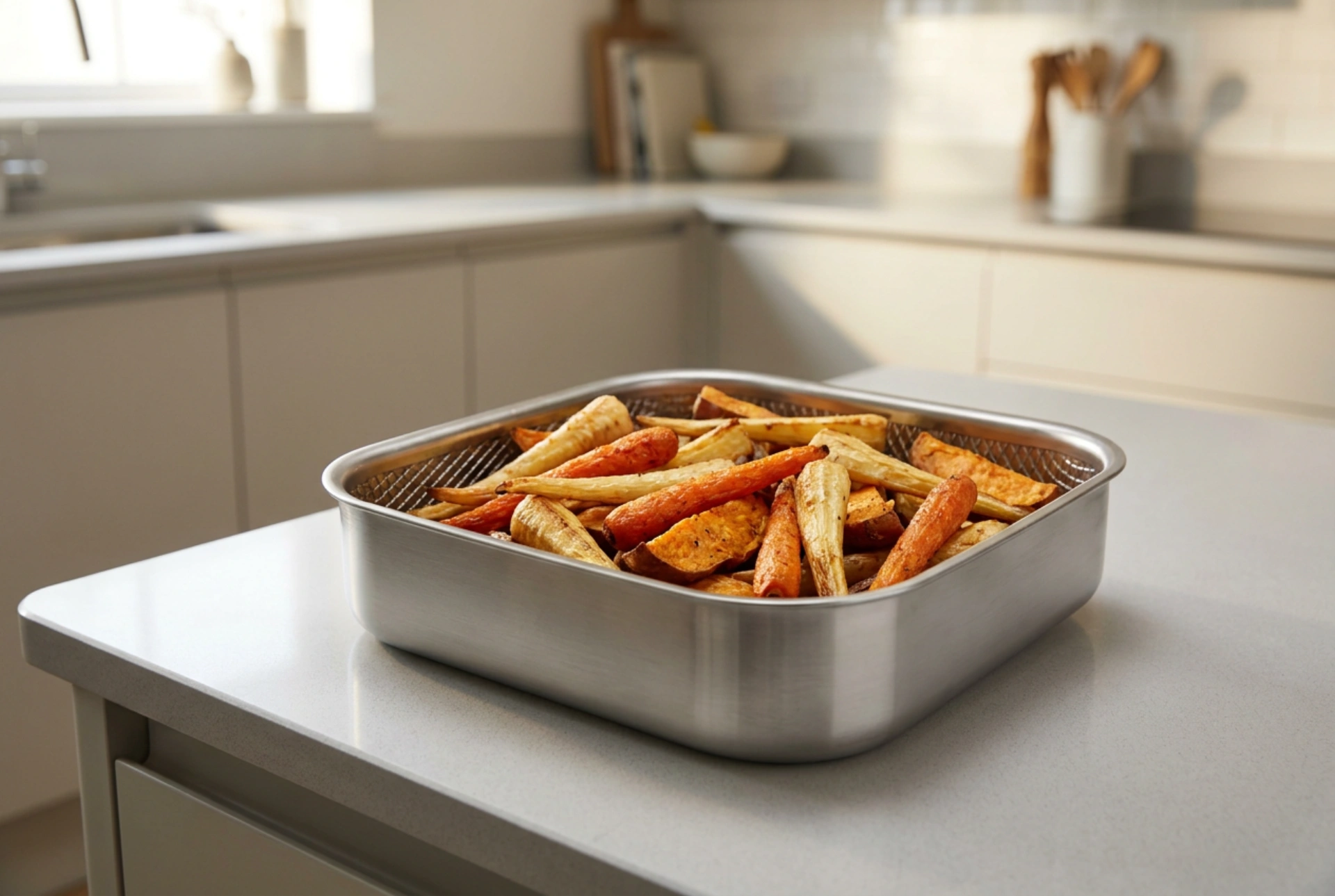
The structural design of the air fryer basket is just as critical as the fan and heating element. The basket features a perforated bottom and sides, which are elevated above a solid outer drawer. This configuration ensures 360-degree air circulation. As the hot air is forced down, it flows through the food, passes through the perforations, and is channeled back up around the outside of the basket to be reheated. This continuous aerodynamic cycle ensures that the bottom and sides of the food cook at the same rate as the top. Furthermore, any excess fats naturally present in the food liquefy and drip through the perforations into the drawer below, preventing the food from sitting in grease and becoming soggy.
Why a Small Amount of Oil is Still Beneficial
While an air fryer can cook food without any added fat, applying a very thin layer of oil can significantly enhance the results. Oil has a higher thermal conductivity than air, meaning it transfers heat to the food's surface even faster. A light mist of oil helps distribute the heat evenly across the microscopic crevices of the food, preventing dry spots and ensuring a uniform golden color. For the best results, use a high-smoke-point oil and apply it using a pump spray to achieve a micro-fine layer, rather than pouring it directly. This keeps the fat content exceptionally low while maximizing the efficiency of the heat transfer.