

Using an air purifier in your vehicle improves cabin air quality, but running it constantly or at the wrong settings can lead to premature filter wear and unnecessary battery strain.
The Dynamics of Car Cabin Airflow
A vehicle cabin is a small, sealed environment of approximately three to four cubic meters. Unlike a spacious room, the air volume inside a car recirculates rapidly when the ventilation system is active. Introducing an air purifier into this space requires an understanding of basic fluid dynamics. When your car ventilation is set to fresh air intake, external air enters through the cabin filter, gets conditioned, and exits through pressure relief vents in the trunk. If you run a portable purifier during this continuous air exchange, the device constantly processes new, untreated air from the outside, rendering it highly inefficient. To optimize purification, set the vehicle ventilation to recirculation mode for the first ten minutes of operation. This creates a closed loop, allowing the purifier to rapidly clean the static volume of air inside the cabin before you switch back to fresh air intake to prevent carbon dioxide buildup.
The Chemistry of Air Quality: Particles vs. Gases
Car air purifiers typically rely on two distinct filtration mechanisms: mechanical filtration and chemical adsorption. Understanding what you are trying to eliminate determines how long you should run the device. High-Efficiency Particulate Air (HEPA) filters capture microscopic physical particles like road dust, pollen, and PM2.5 soot through interception, inertial impaction, and diffusion. Activated carbon filters, on the other hand, utilize chemical adsorption to trap gaseous pollutants, volatile organic compounds (VOCs) from plastics, and fuel exhaust odors. Running a purifier at maximum speed indefinitely does not speed up chemical adsorption; in fact, gaseous molecules require a certain dwell time within the carbon matrix to bind effectively. A moderate, steady fan speed is actually more efficient for odor and VOC removal than the highest setting.
Preventing Filter Saturation and Electrical Strain
Overusing a car air purifier accelerates filter saturation without providing any additional health benefits. Once the microscopic pores of an activated carbon filter are filled, or the physical mesh of a HEPA filter is clogged, the device merely circulates air without cleaning it. Furthermore, active purification devices draw power from the vehicle 12V accessory socket or USB ports. While a running alternator easily handles this load, operating a purifier while the engine is off can drain the car battery. To prevent unnecessary wear on both the device filter and your vehicle electrical system, operate the purifier only when the vehicle is occupied and the engine is running. Utilizing a device with an automatic shut-off timer or a smart air quality sensor ensures the motor rests once the particulate count reaches safe levels.
Optimal Placement for Maximum Efficiency
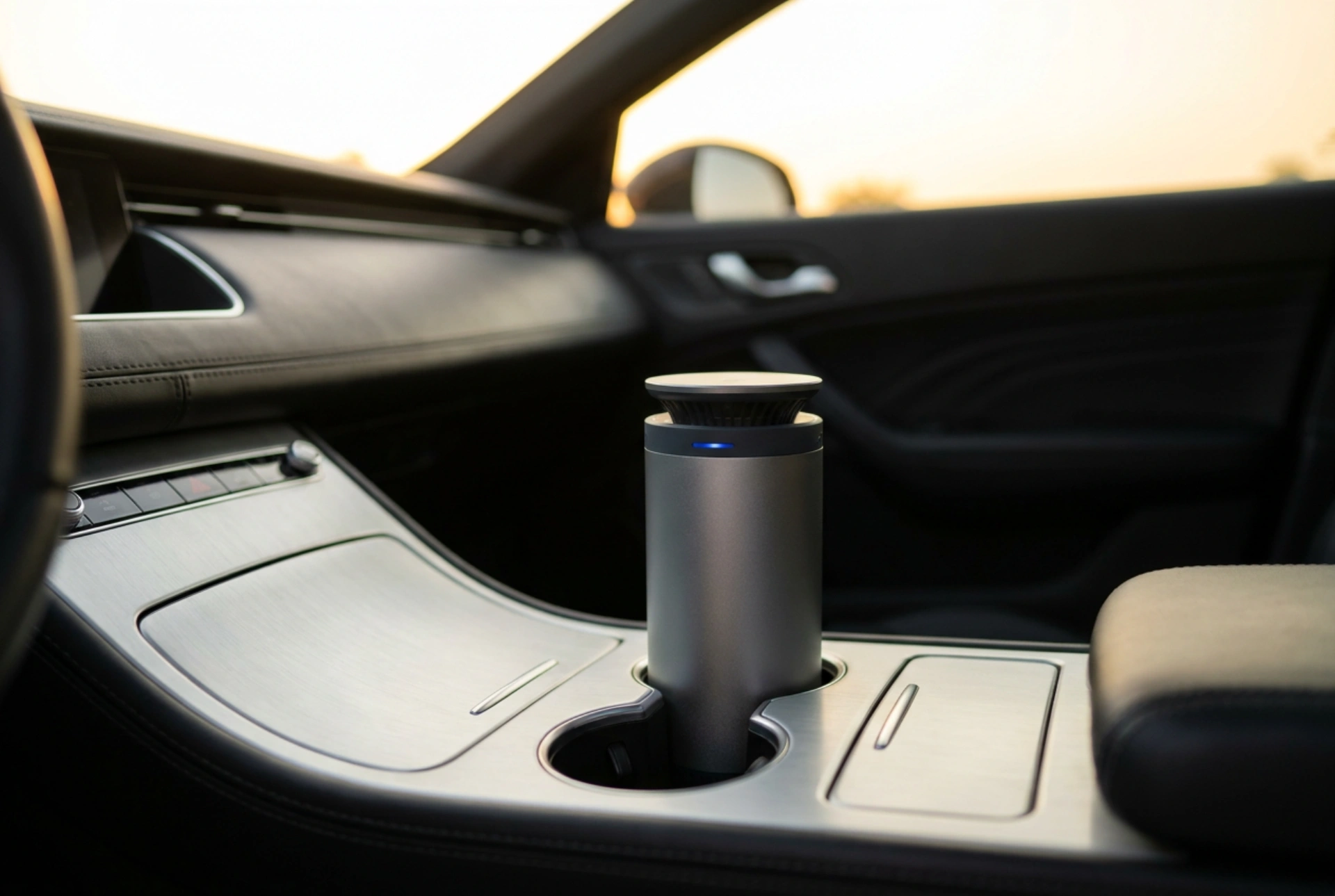
The physical location of your air purifier dictates its performance. Air purifiers rely on unobstructed intake and exhaust pathways to establish an efficient airflow pattern. Placing a purifier deep inside a glove compartment, under a seat, or tightly wedged into a cluttered side pocket restricts airflow, causing the motor to overheat and reducing clean air delivery rates. The ideal position is in a central cup holder or mounted securely on the dashboard or headrest. This central placement allows the device to draw in contaminated air from the breathing zone of the passengers and distribute purified air evenly throughout the cabin volume.