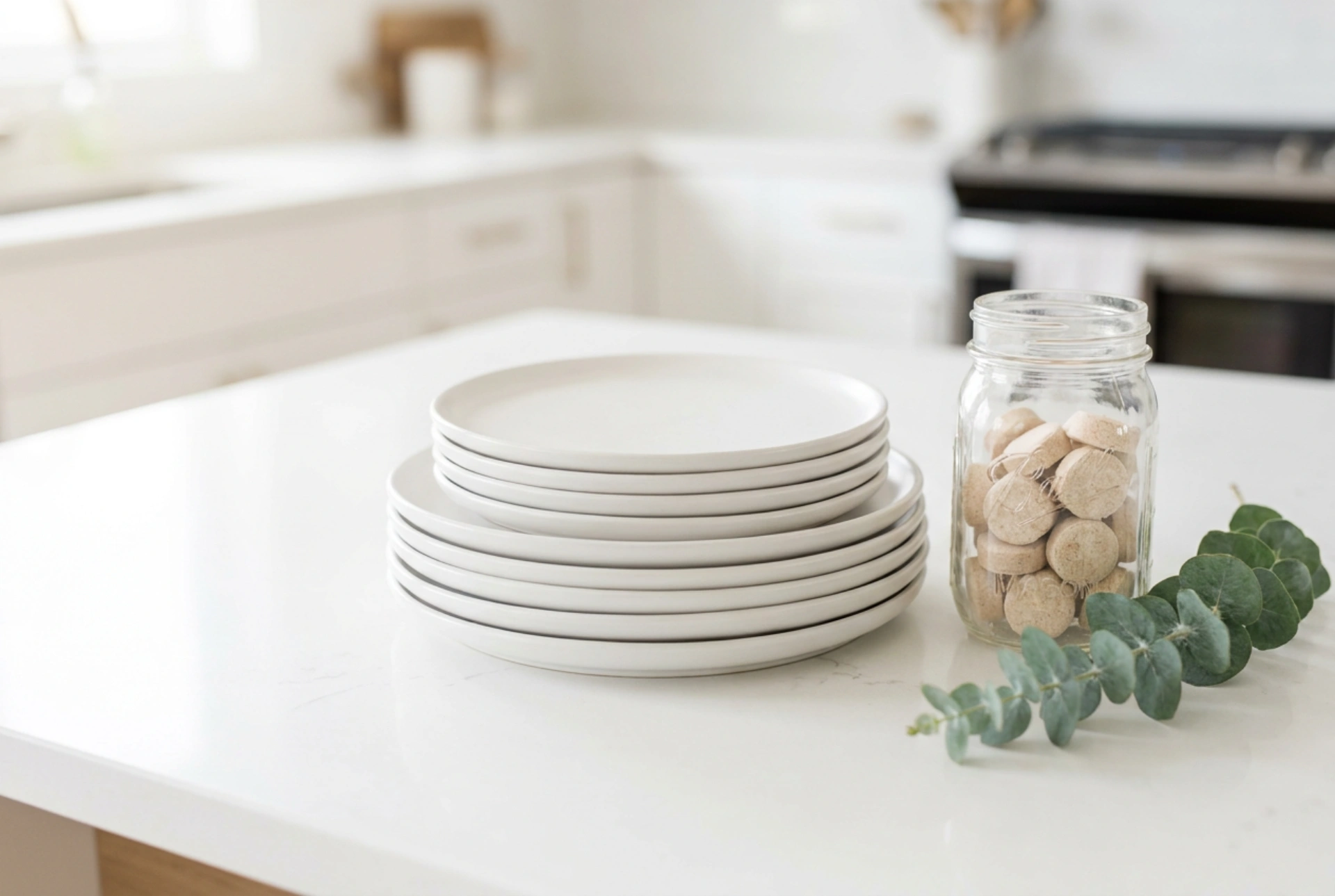


Switching to homemade dishwasher tablets requires understanding the chemical reactions needed to dissolve grease, soften water, and prevent spots on glassware without commercial synthetic surfactants.
The Chemistry of Clean: Active Ingredients
Commercial dishwashing detergent relies on complex synthetic formulas, but you can achieve equivalent results using basic material science. To build an effective natural tablet, you need ingredients that address three main challenges: fat emulsification, water softening, and mechanical rinse assistance. Here is what you need and why it works:
- Sodium Carbonate (Washing Soda): This is your primary alkaline agent. It raises the pH of the water, which helps break down organic soils and fats through saponification, turning greasy residues into water-soluble substances.
- Sodium Bicarbonate (Baking Soda): A milder alkali that acts as a buffer to stabilize the pH levels and serves as a gentle abrasive to physically dislodge stuck-on food particles without scratching delicate glaze.
- Citric Acid: A natural chelating agent. It binds to calcium and magnesium ions in hard water, preventing them from depositing on your dishes as white limescale. It also helps neutralize the alkaline residues during the rinse cycle.
- Sodium Chloride (Coarse Salt): Essential for water softening, it supports the ion exchange process in the dishwasher's built-in softener and prevents cloudy water spots.
The Binding Process: Formulating the Tablets
The main challenge with natural DIY tablets is preventing them from crumbling or expanding prematurely due to the reaction between citric acid and sodium bicarbonate when exposed to moisture. To control this reaction, the mixing and drying process must be executed with precision.
Step-by-Step Production Technique
First, thoroughly mix two parts sodium carbonate, two parts sodium bicarbonate, one part citric acid, and one part coarse salt in a dry glass bowl. Ensure there are no clumps, as uniform distribution is critical for consistent dissolution rates during the wash cycle.To bind these dry powders without triggering the effervescent reaction, use a fine mist spray bottle to introduce a minimal amount of water or high-proof rubbing alcohol. Spritz the mixture once or twice, then immediately stir with a spatula. The texture should resemble damp sand that holds its shape when squeezed in your hand. If it fizzes, you have added too much moisture too quickly.
Press the mixture firmly into silicone ice cube molds. Compression is vital; use the back of a spoon to pack the material as tightly as possible to ensure structural integrity once dry. Allow the tablets to cure in a dry, warm place for at least 24 to 48 hours before removing them from the molds.
Optimizing the Wash Cycle for Natural Formulations
Natural ingredients dissolve and react differently than synthetic enzymes. To get the best results, always run your dishwasher on a hot cycle (at least 60 degrees Celsius). High temperatures are necessary to fully dissolve the sodium carbonate and to trigger the thermal breakdown of fats without the aid of chemical surfactants.
Additionally, always fill your dishwasher's integrated salt reservoir with coarse regenerating salt and use distilled white vinegar in the rinse aid compartment. The acidic vinegar is released automatically during the final rinse cycle, neutralizing any lingering alkaline washing soda residues and ensuring spot-free drying.