

Selecting the right television technology for a sun-drenched living room requires understanding how ambient light interacts with different display panel physics to prevent washed-out colors and distracting reflections.
The Core Technologies: Quantum Dots vs Self-Emitting Pixels
To make an informed decision, it is essential to understand the fundamental mechanical differences between QLED (Quantum Dot Light Emitting Diode) and OLED (Organic Light Emitting Diode) panels. A QLED television is transmissive. It relies on a powerful LED backlight system that pushes light through a liquid crystal layer and a film of quantum dots to produce color. Because the entire backlight can be driven with high electrical current, QLED screens can achieve immense luminous flux, measured in nits.
Conversely, OLED is an emissive technology. Each individual pixel consists of organic compounds that generate their own light when an electric current is applied. When a pixel is turned off, it emits absolutely zero light, resulting in perfect, infinite contrast. However, because driving these organic elements with high current over long periods accelerates degradation and heat generation, OLED panels generally cannot sustain the same peak and full-screen brightness levels as premium QLED displays.
The Bright Room Challenge: Ambient Light and Reflection
In a room with large windows and abundant daylight, two main optical phenomena degrade your viewing experience: screen glare and ambient light washout. When sunlight hits a television screen, the glass or plastic outer substrate reflects that light directly back to your eyes, acting like a mirror. Simultaneously, intense ambient light raises the perceived black level of the screen, making dark areas look grey and dulling the overall contrast.
This is where the raw luminance of QLED screens offers a distinct physics-based advantage. By producing high peak brightness (often exceeding 1,500 to 2,000 nits), a QLED display can physically overpower the competing ambient light in the room. The high ratio of screen-emitted light to reflected environmental light preserves the perception of contrast and color saturation, allowing the image to remain vivid even in midday sun.
How OLED Fares under High Ambient Light
Modern OLED televisions have made significant strides in brightness through the integration of micro-lens arrays (MLA) and advanced heat-dissipation substrates, allowing some panels to reach high peak brightness in small highlights. However, when displaying bright, full-screen content, such as a hockey game or a sunny outdoor scene, an internal mechanism called the Automatic Brightness Limiter (ABL) dims the screen to protect the organic compounds from overheating and premature aging.
In a brightly lit room, this dimming effect can make the image appear flat and difficult to see. Furthermore, the deep, perfect blacks that make OLED famous are visually compromised when ambient light reflects off the screen's surface, turning those pitch-black pixels into a dark purple or grey reflective sheen.
Anti-Reflective Coatings and Panel Choices
When evaluating a television for a bright room, the panel technology is only half of the equation; the screen's surface treatment is equally critical. Manufacturers apply specialized anti-reflective or anti-glare coatings to mitigate reflections:
- Glossy Coatings: These preserve maximum sharpness and contrast but reflect light like a mirror, creating sharp, distracting reflections of windows and light fixtures.
- Matte or Semi-Glossy Treatments: These coatings use microscopic surface textures to scatter incoming light in different directions. While this blurs sharp reflections, it can slightly reduce overall contrast by spreading the reflected ambient light across a wider viewing angle.
For a room with uncontrolled daylight, a QLED panel equipped with a high-performance, light-scattering anti-reflective filter offers the most balanced performance, combining high light output with minimized glare.
Optimizing Your Room Layout for Better Viewing
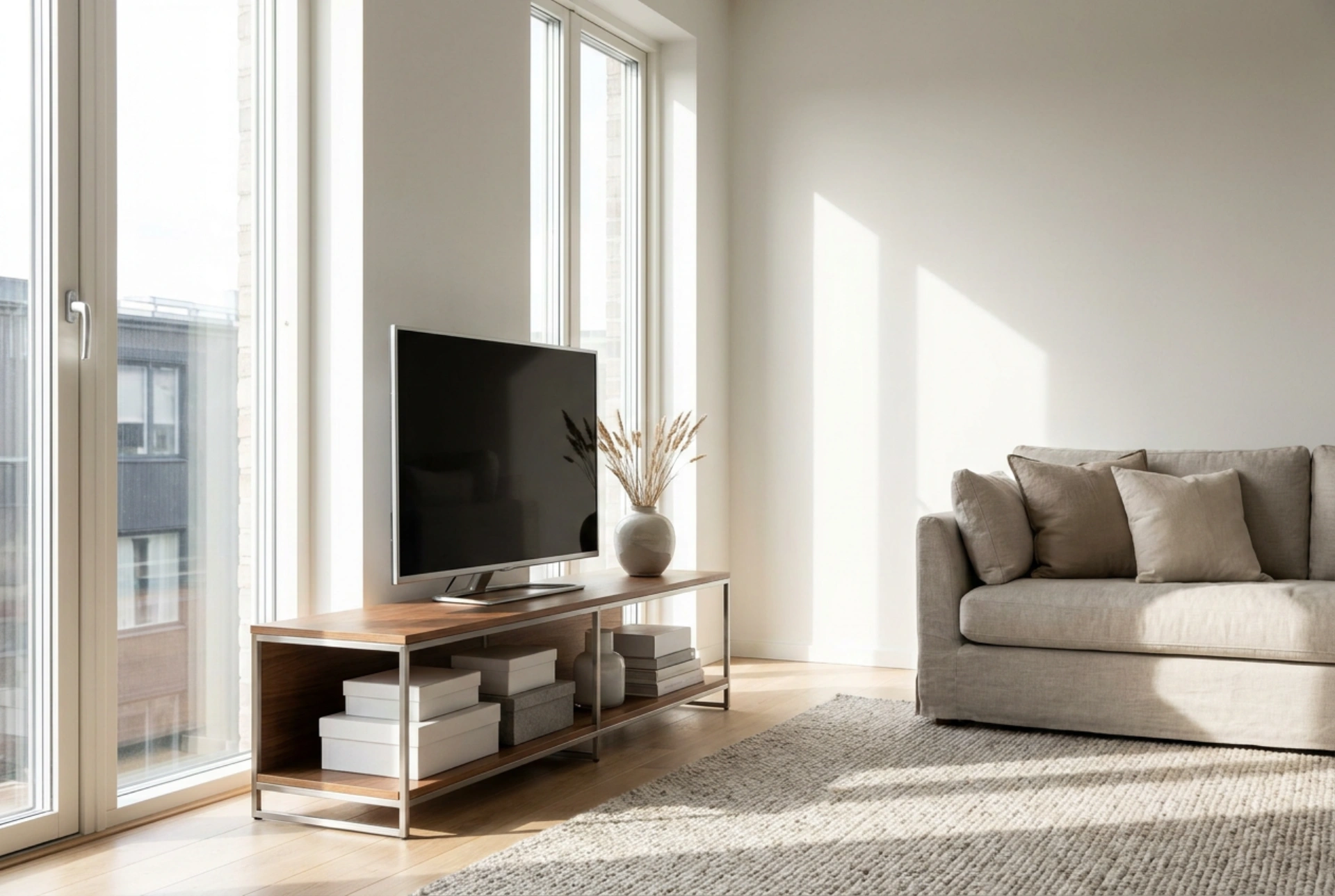
Beyond technology, physical placement is key to managing light. Avoid mounting a television directly opposite large windows, as this creates direct, geometric reflections. Positioning the screen at a 90-degree angle to the light source significantly reduces direct glare. Additionally, installing sheer curtains can diffuse harsh sunlight without completely darkening the room, lowering the ambient light level just enough to allow either QLED or high-end OLED screens to perform at their absolute best.