

Maximize the lifespan of your household rechargeable batteries by mastering the chemical and thermal principles of modern cell charging.
The Chemistry Behind Rechargeable AA Batteries
Most modern rechargeable AA batteries used in household devices are Nickel-Metal Hydride (NiMH) cells. Unlike older Nickel-Cadmium (NiCd) batteries, NiMH chemistry does not suffer from a severe memory effect, but it is highly sensitive to heat and overcharging. During a standard charge cycle, electrical energy drives an electrochemical reaction, converting nickel hydroxide and a hydrogen-absorbing alloy back into their active, energized states. If charging continues after the active materials are fully converted, this electrical energy is transformed into thermal energy. Excessive heat accelerates the degradation of the internal separator and increases internal pressure, which permanently reduces the battery capacity.
Choosing the Right Charger and Current
The method of delivering current to the battery determines its long-term health. Avoid cheap chargers that operate on simple timers, as they do not account for the residual charge already present in the battery, leading to chronic overcharging. Instead, select a smart charger equipped with negative delta V (-dV) detection. This technology monitors the voltage profile of the cell; when a NiMH battery reaches full charge, its voltage drops slightly. The charger detects this drop and immediately terminates the high-current charge, switching to a minimal trickle charge.
When selecting charging speeds, opt for a moderate current. For a standard 2000 mAh AA battery, a charging current between 500 mA and 1000 mA (0.25C to 0.5C) is ideal. Charging too slowly (under 200 mA) prevents the charger from accurately detecting the voltage drop, risking silent overcharging. Charging too fast (above 1500 mA) generates extreme localized heat, which degrades the internal chemical structure.
Optimal Temperature and Environment
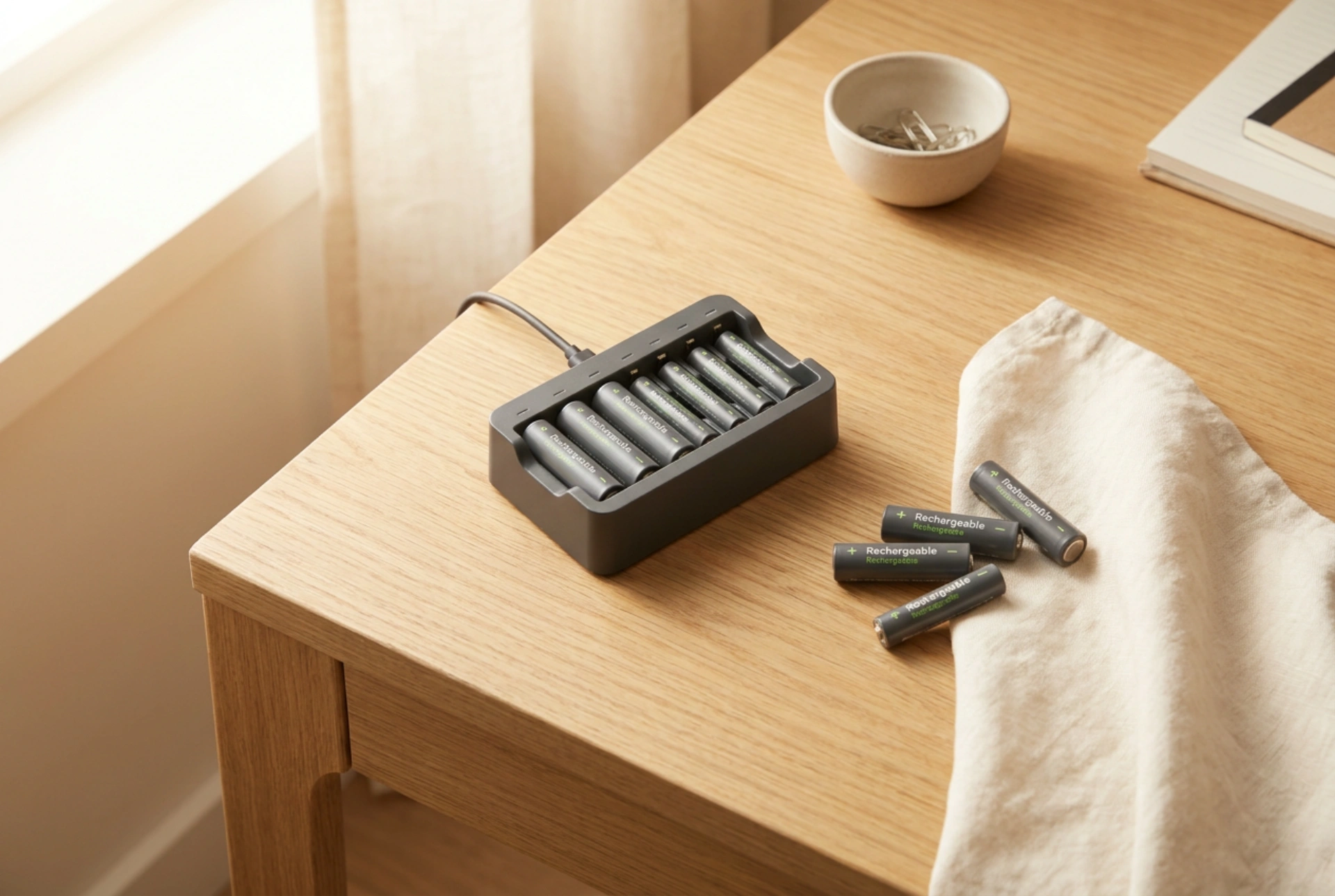
Chemical reactions are highly dependent on ambient temperatures. Always charge AA batteries at room temperature, ideally between 15°C and 25°C. Never charge cells in sub-zero temperatures, as this causes lithium plating in lithium-ion variations or structural damage in NiMH cells. Similarly, charging in direct sunlight or confined, unventilated spaces traps heat around the cells. Ensure the charging station is placed on a flat, non-flammable surface, such as a wooden desk or ceramic tile, allowing natural convection to dissipate heat away from the charger casing.
Preventing Deep Discharge and Proper Storage
To keep your batteries performing optimally, manage their discharge cycles carefully. NiMH batteries should never be discharged completely to zero volts, as this can cause cell reversal, where the polarity of the weakest cell in a multi-battery device flips, rendering it permanently dead. Remove batteries from devices when they stop functioning, or when the low-battery indicator activates. For storage, keep rechargeable AA batteries in a cool, dry place at approximately 30% to 50% charge. Since NiMH batteries experience self-discharge over time, check and top them up every six months to prevent the voltage from dropping below the critical threshold of 0.9V per cell.