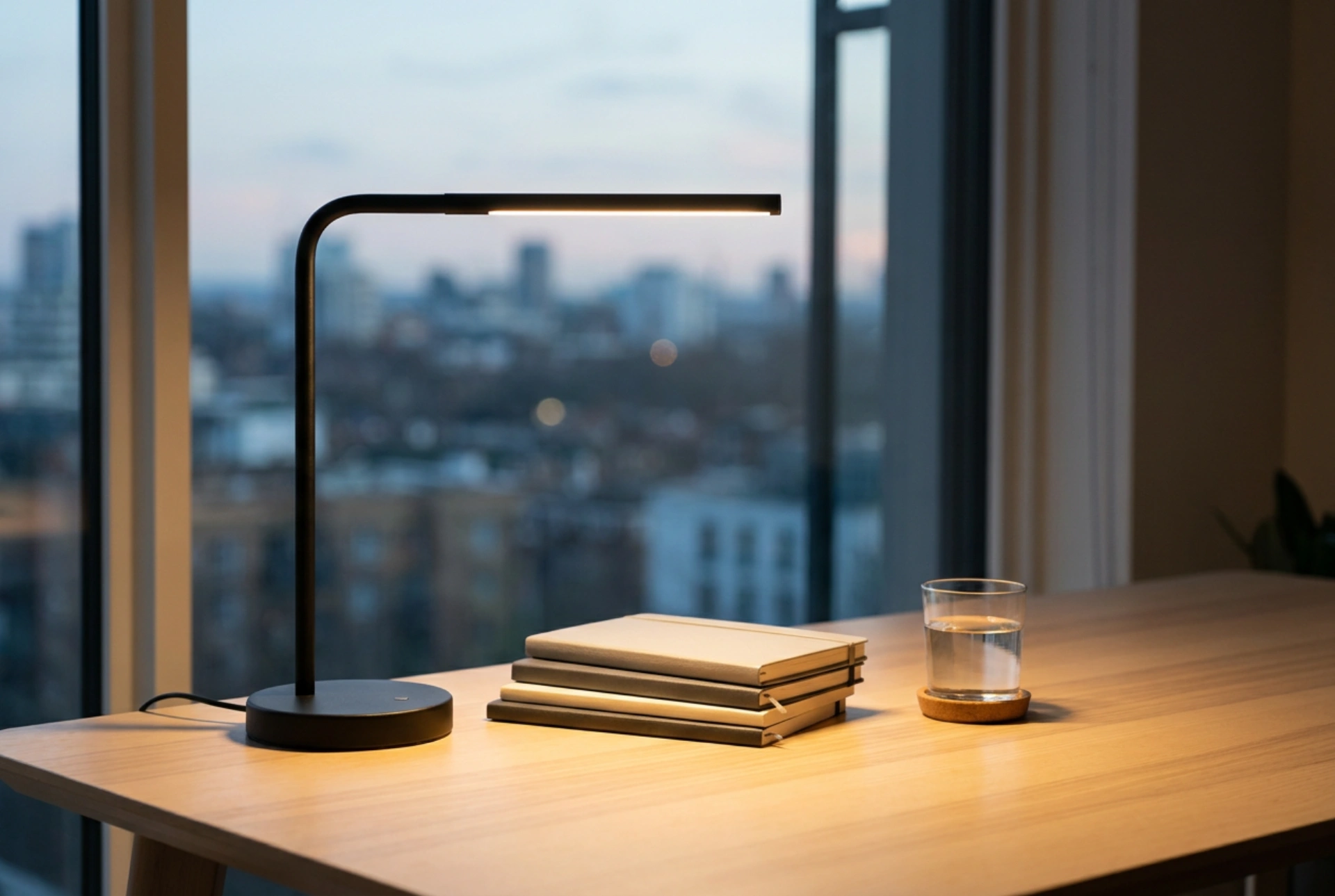


Selecting the right black desk lamp for late-night tasks requires understanding light physics and visual ergonomics to prevent eye strain and maintain focus. The ideal fixture balances aesthetic appeal with precise lumen output, colour rendering, and directional control to create a healthy nocturnal workspace.
The Physics of Matte Black Finishes and Light Contrast
When choosing a black desk lamp, the finish of the material plays a significant role in visual comfort. Glossy black surfaces act as mirrors, reflecting ambient light and creating distracting specular reflections. A matte black finish, on the other hand, absorbs up to 95% of incident light, minimising glare and preventing visual clutter within your field of vision. This absorption capacity is crucial when working in a darkened room, as it allows your eyes to focus entirely on the illuminated work surface rather than on distracting reflections from the lamp body itself.
Furthermore, working after dark introduces the challenge of high contrast. A single, bright point of light in a pitch-black room forces the pupils to constantly dilate and constrict as your eyes move between the illuminated document and the dark background. This phenomenon, known as transient adaptation, leads to rapid eye fatigue. To combat this, select a black desk lamp that offers a diffused light output or use it in conjunction with low-level ambient bias lighting behind your screen or workspace.
Colour Temperature and the Circadian Rhythm
The spectral composition of the light source is critical for night-time productivity and subsequent sleep quality. Light temperature is measured in Kelvins (K) and dictates the warmth or coolness of the emitted beam. For evening work, a colour temperature between 2700K and 4000K is optimal. Light at 2700K to 3000K (warm white) mimics the natural sunset, encouraging a relaxed yet focused mental state, whereas 4000K (neutral white) is excellent for tasks requiring high alertness without emitting excessive blue wavelengths.
Avoid lamps that emit light above 5000K (cool daylight) after sunset. High-temperature blue light suppresses the synthesis of melatonin, the hormone responsible for regulating sleep-wake cycles. Additionally, look for a high Colour Rendering Index (CRI or Ra). A CRI of 90 or above ensures that colours are represented accurately, which reduces cognitive load as the brain does not have to work harder to interpret distorted hues in low-light conditions.
Luminous Flux, Illuminance, and Light Distribution
To ensure adequate illumination without over-lighting, you must understand the distinction between luminous flux (measured in lumens) and illuminance (measured in lux). Luminous flux refers to the total amount of light emitted by the source, while lux measures the intensity of light falling on a specific surface area. For standard desk work, reading, and writing, the target illuminance on your desk surface should be approximately 500 lux.
Achieving this requires a lamp that distributes light evenly rather than focusing it into a harsh, narrow spotlight. Asymmetrical lighting distribution is highly beneficial for night-time workspaces. By casting light at an angle across the desk rather than directly downwards, asymmetrical lamps eliminate screen glare and prevent direct light from entering your pupils, thereby maintaining optical comfort over long working sessions.
Ergonomics, Articulation, and Positioning
A fixed, rigid lamp is rarely sufficient for dynamic night work. Optimal ergonomics require a lamp with multiple points of articulation, such as a pantograph arm or a ball-and-socket joint at the shade. These mechanical features allow you to adjust the height and angle of the light beam precisely, keeping the light source below eye level to prevent direct glare.
- Dominant Hand Placement: Position the lamp on the opposite side of your dominant hand (e.g., on the left side if you are right-handed) to prevent your hand from casting a shadow over your work.
- Height Adjustment: The bottom edge of the lamp shade should ideally be level with your chin or slightly lower to ensure the bulb or LED array is shielded from direct line of sight.
- Stability and Footprint: A heavy, counterweighted base prevents tipping when the arm is fully extended, maintaining a stable beam direction even during adjustments.