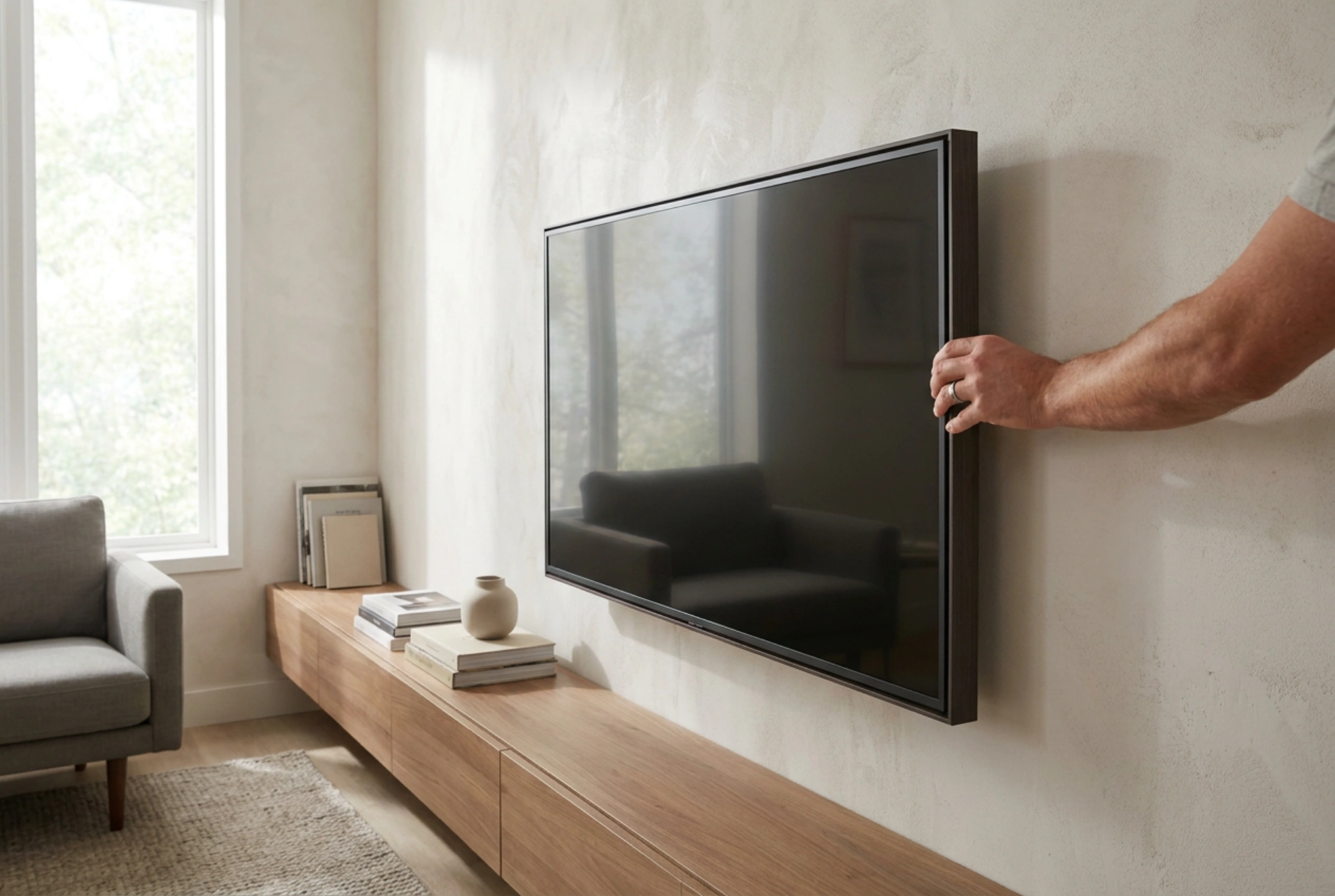


Positioning a television screen at the perfect viewing angle involves managing light physics and human ergonomics, a task that manual wall brackets often complicate. Motorized TV wall mounts solve these spatial challenges by using automated articulation to dynamically adjust the screen's position, eliminating glare and reducing physical strain.
The Physics of Light Reflection and Screen Polarization
To understand why dynamic screen adjustment is necessary, one must examine how light interacts with modern displays. Liquid crystal displays (LCDs) and organic light-emitting diode (OLED) screens are engineered with polarizing filters that control light emission. When light from windows or lamps hits the screen surface, it reflects at an angle of incidence equal to the angle of reflection. If the viewer sits directly in the path of these reflected light waves, glare occurs, severely reducing the perceived contrast ratio and color accuracy of the panel.
By utilizing a motorized mount, viewers can alter the horizontal (pan) and vertical (tilt) angles of the screen by a few degrees. This subtle mechanical shift redirects the reflected light paths away from the viewer’s eyes. Because the adjustment is automated, it allows for micro-corrections from the exact viewing position, ensuring optimal contrast and luminance without the need to repeatedly get up and manually adjust the screen.
Mechanical Advantages and Structural Load Distribution
Manual adjustment of large-format televisions often introduces uneven physical stress to both the screen frame and the wall structure. When a user pulls a manual bracket, they apply a localized shear force to one side of the television bezel. Over time, this mechanical stress can twist the frame, potentially damaging the delicate bonding of the screen panel or loosening the mounting screws on the back of the device.
A motorized TV mount utilizes integrated electric stepper motors to apply smooth, symmetrical torque. This controlled motion distributes the load evenly across the internal steel or aluminum scissor arms. The benefits of this mechanical precision include:
- Reduced Wear on Fasteners: Smooth, automated acceleration prevents sudden jerks, minimizing the pulling forces exerted on wall anchors and plasterboard.
- Precise Angular Memory: Stepper motors allow the system to store specific rotational coordinates, returning to the ideal angle with millimeter-accuracy every time.
- Consistent Cable Clearance: Motorized hinges are engineered with defined paths of motion, ensuring that HDMI, optical, and power cables are never compressed or subjected to excessive tension during movement.
Optimizing Ergonomics for the Cervical Spine
Human ergonomics dictate that the top third of a television screen should ideally be at eye level. However, modern architectural layouts often force screens to be mounted higher, such as above fireplaces or on structural pillars. Looking upward for extended periods forces the cervical spine into hyperextension, compressing the posterior cervical discs and straining the neck muscles.
A motorized mount with a downward tilt function corrects this structural mismatch. By tilting the screen downward, the optical axis of the display aligns perpendicularly with the viewer's natural line of sight. This alignment minimizes ocular muscle fatigue and prevents long-term muscular strain. In open-plan living spaces, where a single screen must serve both a low-profile sofa and a higher kitchen island, a motorized mount provides the versatility to adapt the screen’s height and angle to match the viewer’s posture instantaneously.
Substrate Preparation and Structural Considerations
Installing an articulated motorized mount requires careful assessment of the wall's material properties. Because the motorized arm extends the television outward, it creates a leverage effect, significantly increasing the cantilever load on the wall anchors. For concrete or solid brick walls, heavy-duty nylon expansion plugs or chemical anchors are ideal to withstand these pulling forces. When mounting on drywall, the bracket must be fastened directly into wooden or steel studs using lag bolts; relying solely on hollow-wall anchors is highly discouraged due to the dynamic forces generated during movement.