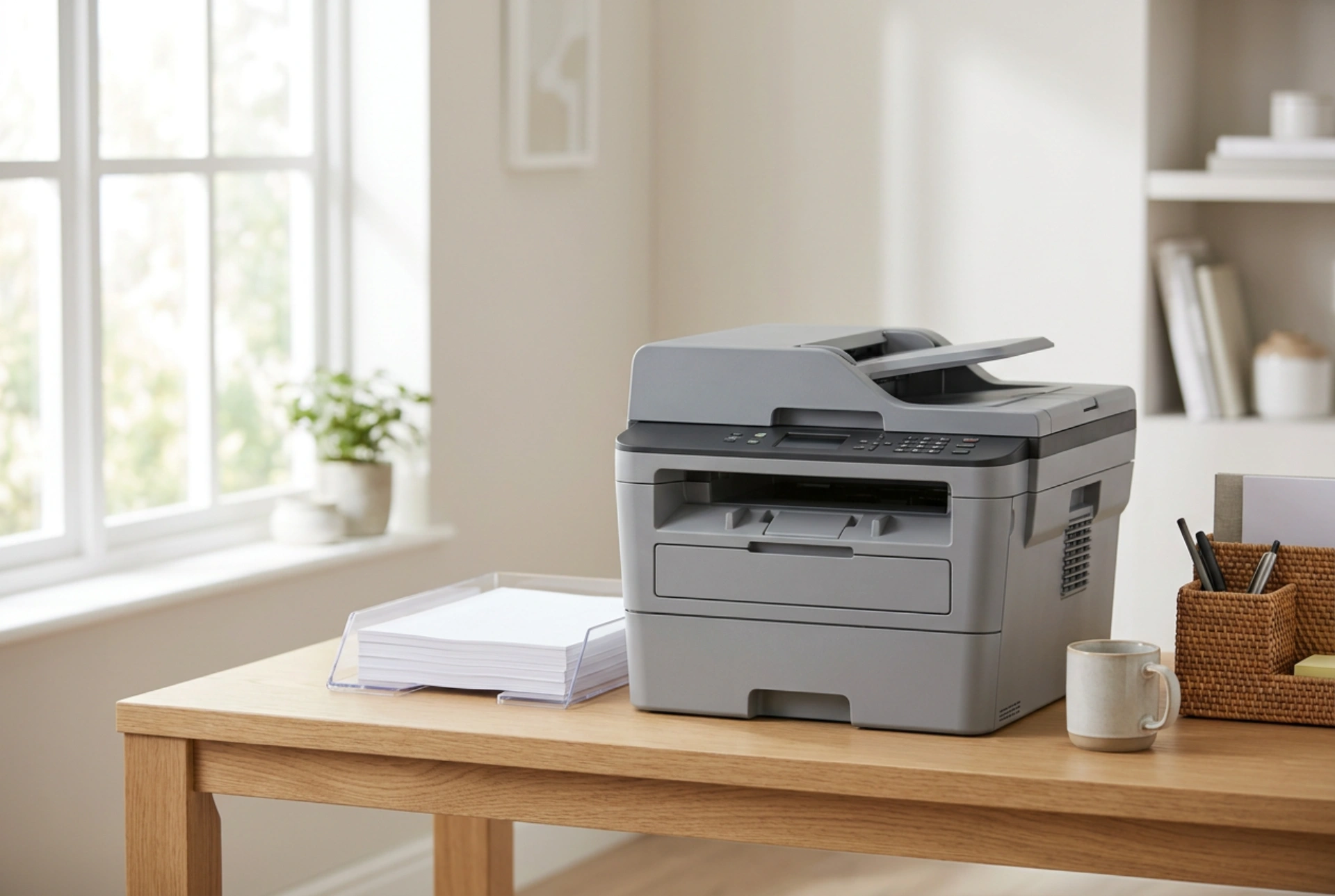


Integrating scanning optics with precision fluid-dynamic ink deposition in a single unit optimises both digitising physical media and reproducing digital assets. Understanding the mechanics of home inkjet multifunction devices allows users to maximise output quality and prevent common mechanical failures.
The Physics of Inkjet Deposition: Thermal vs. Piezoelectric
At the core of any inkjet printer is the printhead, which relies on precise microfluidic control to deposit picolitre-sized droplets of ink onto paper. Home devices generally utilise one of two technologies: thermal or piezoelectric deposition. In thermal inkjet systems, a tiny resistor quickly heats the ink solvent to over three hundred degrees Celsius, vapourising a micro-layer of liquid into a gas bubble. This bubble expands rapidly, forcing an exact volume of ink through the micro-nozzle before the bubble collapses and draws in fresh ink. Piezoelectric systems, conversely, apply an electrical charge to a specialised crystal. This charge induces physical deformation in the crystal, mechanically forcing the ink out of the nozzle. Piezoelectric printing provides superior control over droplet size and allows for a wider variety of ink formulations, as it does not rely on high thermal thresholds that can break down complex chemical compounds in organic inks.
Understanding Optical Scanning Mechanics
The scanner component of a multifunction printer relies on photoelectric principles to convert physical documents into high-resolution digital arrays. Most home units utilise Contact Image Sensor (CIS) technology due to its compact form factor and energy efficiency. In a CIS scanner, a linear array of red, green, and blue light-emitting diodes (LEDs) sequentially illuminates a narrow strip of the document. The reflected light is captured by a corresponding line of photodetectors placed extremely close to the scanning glass. These photodetectors measure the intensity of the reflected light and convert photons into analogue electrical signals, which are then processed by an analogue-to-digital converter (ADC) into pixel data. Unlike Charge-Coupled Devices (CCD) that use a system of mirrors and lenses to focus light onto a sensor, CIS scanners operate at a 1:1 optical ratio, requiring the original document to lie perfectly flat against the glass to prevent focal distortion.
Ink Chemistry and Paper Fibre Interaction
The final print quality depends heavily on the chemical interaction between the ink formulation and the paper substrate. Inkjet printers utilise either dye-based or pigment-based inks. Dye-based inks consist of fully dissolved colourants in a liquid carrier, typically water or glycol. These molecules penetrate deep into the paper's cellulose fibres via capillary action, offering highly vibrant, continuous-tone colour transitions ideal for images. However, they remain susceptible to moisture and ultraviolet degradation. Pigment-based inks contain suspended solid microscopic particles. Upon deposition, the liquid carrier evaporates or is absorbed, leaving the pigment particles bound to the surface of the paper. This creates sharper text edges, greater water resistance, and high durability against fading. Standard copy paper, which consists of porous cellulose fibres, causes liquid ink to feather as capillary action draws the moisture outward. Utilising coated or high-weight papers restricts this lateral spreading, ensuring high edge definition and preventing paper warping.
Preventative Maintenance and Glass Care
To maintain peak performance, the physical components of both the printer and scanner require systematic care. Printhead clogging occurs when the liquid carrier in the ink nozzle evaporates, leaving dried pigment or dye residue that blocks the micro-apertures. Running regular print cycles prevents this crystallisation. For the scanner, dust particles, fingerprints, and static charges on the glass platen degrade optical scanning accuracy. Dust particles scatter the LED light, resulting in vertical streaks on scanned images. Cleaning should be performed using a microfibre cloth moistened with isopropyl alcohol, which dissolves oils without leaving residue or damaging the anti-reflective coatings on the glass surface.