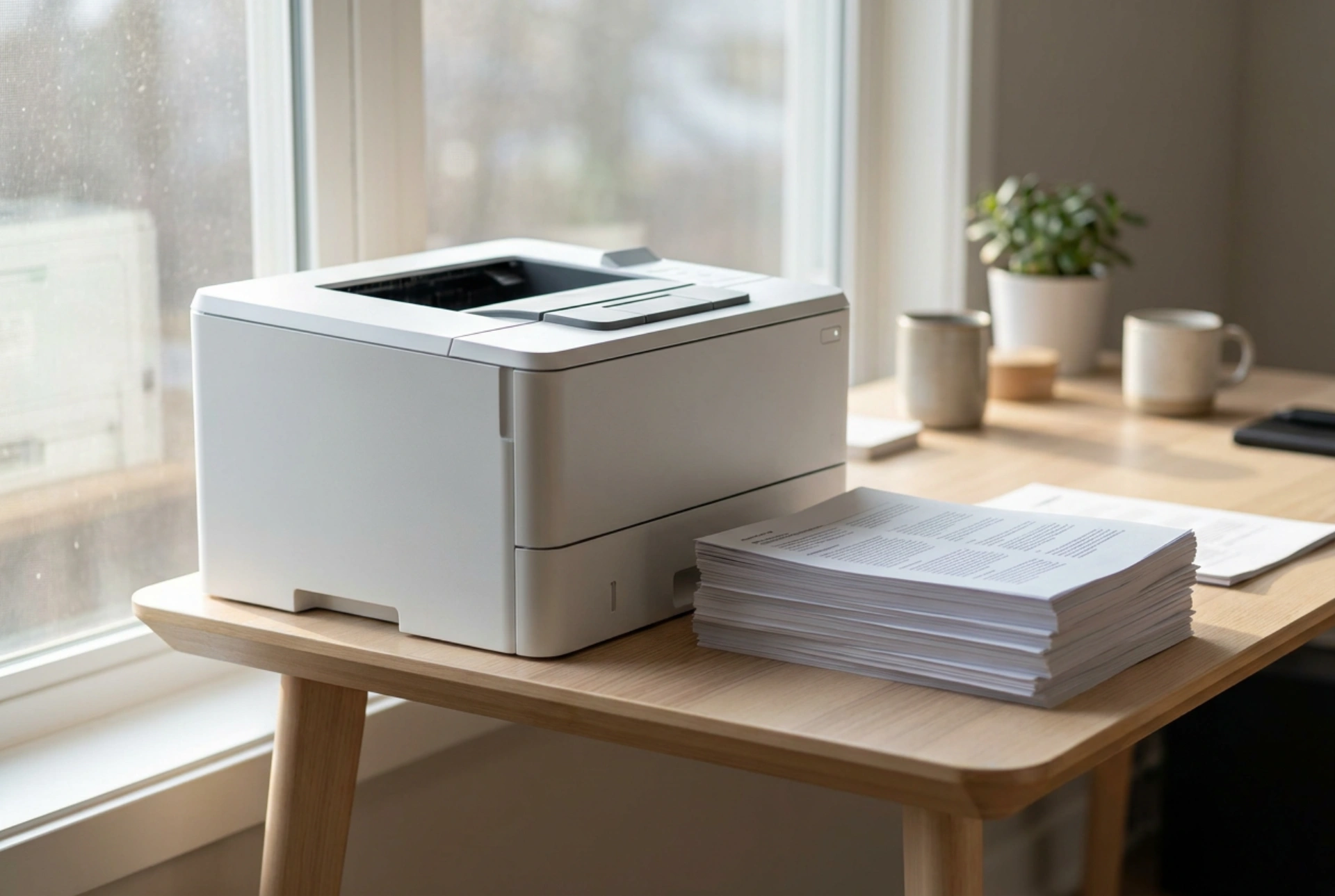


Duplex colour laser printing combines electrophotographic technology with mechanical inversion to deliver highly efficient, double-sided documents. Understanding the thermal properties of toner and the physical behaviour of paper fibres allows users to drastically reduce running costs and resource consumption.
The Science of Toner Adhesion and Electrophotography
Unlike inkjet technology, which relies on liquid dyes absorbing into paper, colour laser printing is an anhydrous (waterless) electrostatic process. The printer uses a laser beam to draw an electrostatic image onto a photosensitive drum. Negatively charged toner particles—composed of a polymer resin, carbon black, and organic colour pigments—are attracted to the discharged areas of the drum. This powder image is then transferred onto the paper via static charge.
The crucial stage for durability and economy is the fusing process. The paper passes through two rollers: a heated fuser roller (operating between 150°C and 200°C) and a pressure roller. The heat melts the polymer resin within the toner, while the pressure forces the liquefied plastic into the microscopic voids between the cellulose fibres of the paper. This creates a permanent, smudge-proof bond. For colour printing, this process is repeated or layered using four separate toner cartridges (cyan, magenta, yellow, and black), requiring precise temperature calibration to prevent thermal degradation of the pigments.
The Mechanical and Thermal Physics of Duplex Printing
Duplex printing automatically prints on both sides of a sheet of paper using an internal reversing mechanism. Once the first side is printed and fused, a set of duplexing rollers reverses the direction of the paper, routing it through an auxiliary path that flips the sheet before sending it back through the transfer drum and fuser for the second side.
This double exposure to high temperatures introduces physical challenges to the paper substrate. Paper is hygroscopic, meaning it absorbs and releases moisture from the surrounding air. When the first side is fused, the extreme heat drives out moisture, causing the cellulose fibres to shrink slightly on that side. When the sheet is flipped and printed on the second side, it undergoes a second thermal cycle. This uneven moisture loss can lead to paper curling, which increases friction in the transport path and causes paper jams. To prevent this, quality duplex printers utilise temporary cooling paths and reverse-curl rollers to mechanically flatten the paper before the second pass.
Practical Techniques for Economical Operation
Reducing the cost per page requires a combination of software calibration and mechanical awareness. By adjusting how the printer deposits toner and manages heat, you can significantly extend the lifespan of your consumables:
- Toner-Saver Mode: This setting reduces the electrical bias on the developer roller, depositing a thinner layer of toner on the drum. While the resulting text may appear slightly lighter, the structural integrity of the print remains intact for standard reading.
- DPI Reduction: Lowering the print resolution from 1200 DPI to 600 DPI halves the density of the laser scan lines. This drastically cuts toner consumption during large text-heavy print runs without affecting readability.
- Font Optimization: Using thinner, eco-friendly sans-serif fonts reduces the total surface area requiring toner coverage, leading to measurable material savings over thousands of pages.
Selecting and Managing Consumables for Thermal Stability
To ensure flawless duplex printing, the raw materials must match the thermal requirements of the machine. Standard copy paper of 80 gsm (grams per square metre) is generally sufficient, but for heavy duplex runs, a weight of 90 gsm offers better structural rigidity against thermal warping. Paper must be stored in a climate-controlled environment in its original moisture-barrier wrapping; exposed paper absorbs atmospheric humidity, which can turn into steam during the fusing process, resulting in micro-blisters on the print surface and severe paper distortion.