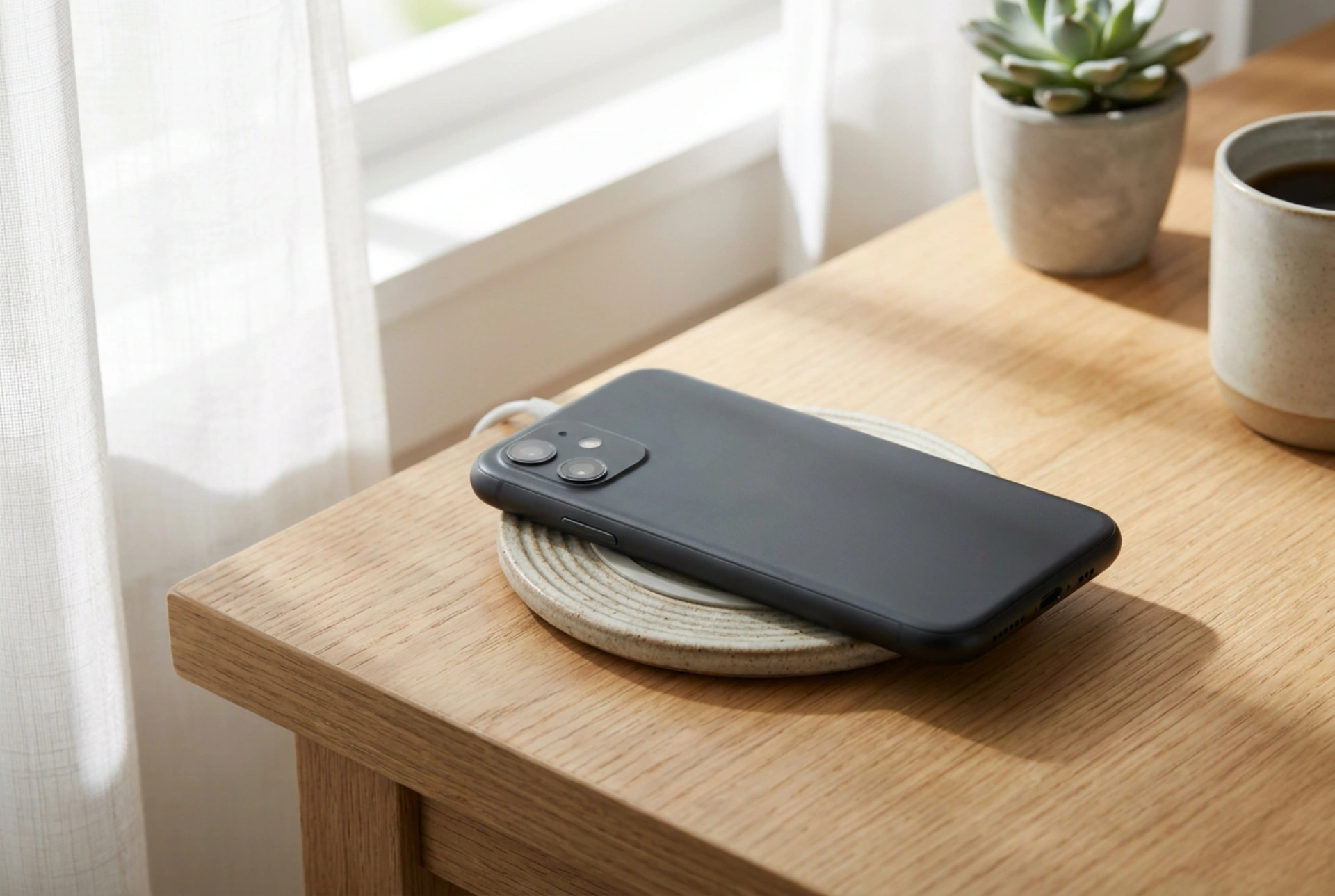


Inductive charging offers unparalleled convenience, but the physics of wireless power transfer inherently generates heat that can degrade your device's lithium-ion battery. Minimising this thermal stress requires understanding how electromagnetic fields interact with materials and coil alignment.
The Physics of Wireless Power Transfer and Heat
To understand why wireless power banks get warm, we must look at Faraday's Law of Induction. An inductive power bank contains a transmitter coil through which an alternating current passes, creating a dynamic magnetic field. When you place a compatible smartphone on top, this magnetic field penetrates the receiver coil inside the phone, inducing an electrical current that charges the battery.
However, this energy transfer is never one hundred percent efficient. A portion of the electromagnetic energy is lost as heat due to electrical resistance in the copper coils and eddy currents induced in nearby metallic components. When coils are misaligned, the magnetic flux coupling decreases. The power bank must then increase its current output to maintain the same charging speed, which exponentially increases heat generation according to Joule's first law, where heat is proportional to the square of the current.
The Role of Case Materials and Thermal Insulation
The materials placed between the power bank and your device act as thermal barriers. While plastic, silicone, and leather allow magnetic waves to pass through, they are poor thermal conductors. They trap the heat generated by the coils directly against the back of the phone and the surface of the power bank.
- Metal Attachments: Any phone case featuring integrated metal plates, kickstands, or ring holders must be avoided during inductive charging. The magnetic field will induce strong eddy currents in these metallic elements, causing them to heat up rapidly to temperatures that can permanently damage the battery.
- Thickness Barriers: Cases thicker than three millimetres increase the distance between the two coils. Because magnetic field strength decreases rapidly with distance following the inverse-square law, a thick case forces the transmitter coil to work at maximum capacity, generating unnecessary thermal energy.
Optimising Alignment and Environmental Placement
Achieving perfect physical alignment between the transmitter and receiver coils is the most effective way to prevent overheating. Many modern power banks utilise magnetic alignment rings to physically snap the coils into the optimal position. If your device lacks this feature, manually centering the phone on the power bank is crucial.
Furthermore, the physical environment during charging dictates how heat dissipates. Placing a charging power bank on a soft, insulating surface like a mattress, sofa, or blanket prevents air circulation around the devices. Instead, always place the power bank and phone on a hard, flat, and conductive surface—such as a wooden desk or ceramic counter—which helps draw heat away from the electronics through passive conduction and convection.
Managing Device Workloads During Charging
Charging your phone wirelessly while simultaneously running high-performance applications creates a double thermal load. The phone's central processing unit and graphics processing unit generate significant heat under load, which combines with the thermal output of the inductive charging coils.
To mitigate this, avoid using navigation apps, high-resolution video streaming, or intensive background downloads while the phone is on the inductive power bank. If possible, enable power-saving modes or airplane mode to reduce processor activity and minimise background current draw, allowing the battery to charge more efficiently and at a lower temperature.
Sensible Charging Habits for Battery Longevity
Lithium-ion batteries are most sensitive to heat when they are at high states of charge, typically above eighty percent. As the battery nears full capacity, the internal resistance increases, generating more heat. Utilising your inductive power bank primarily for topping up your device to around seventy or eighty percent, rather than forcing it to reach a full one hundred percent charge, dramatically reduces the time the battery spends at high thermal thresholds.