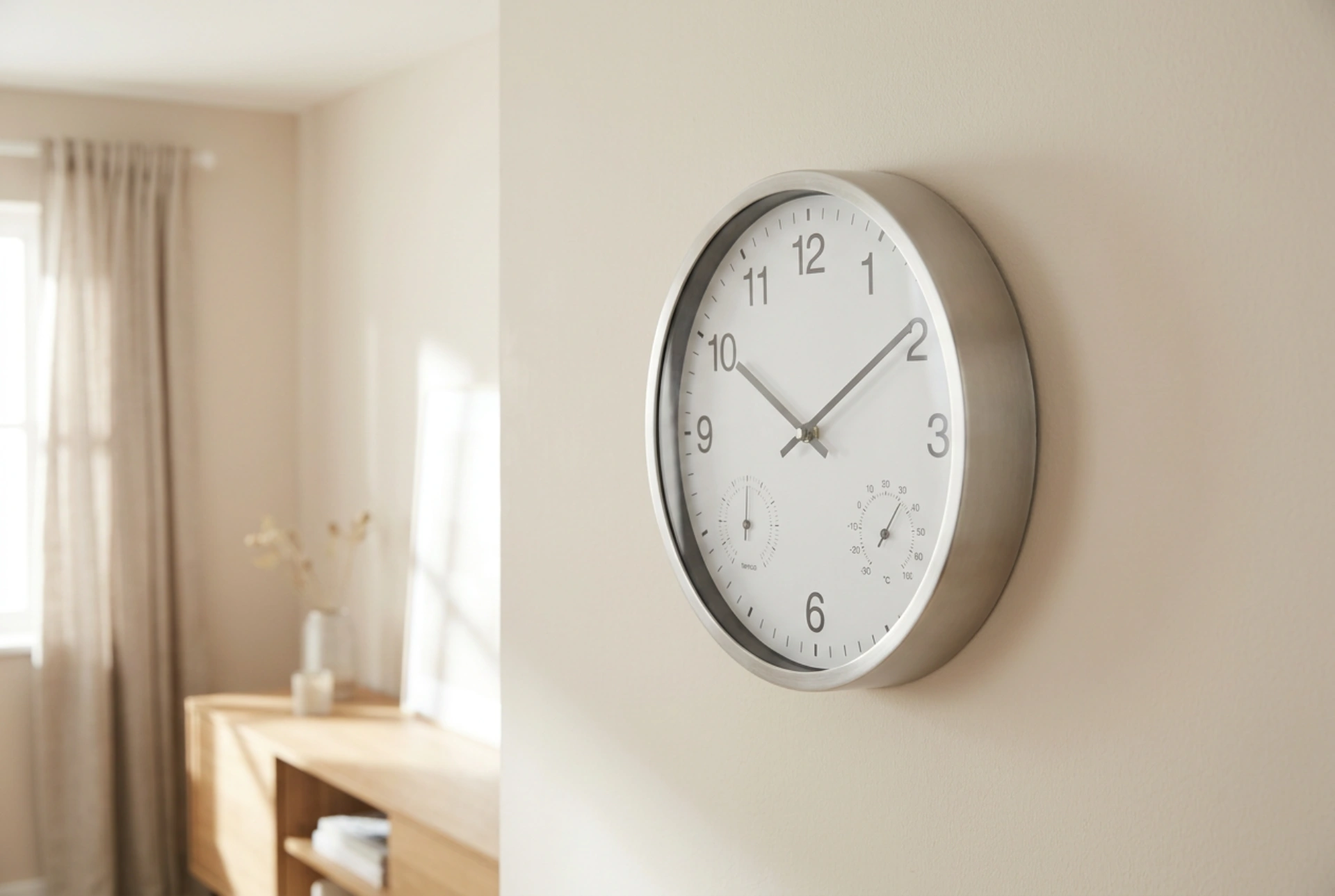


Achieving an accurate room temperature reading from a wall clock with an integrated thermometer requires understanding how thermal energy moves through your living space. Placing the device in the wrong spot can cause localized temperature distortions of several degrees, rendering the thermometer ineffective for monitoring actual ambient comfort.
The Role of Convection: Height Matters for Thermal Accuracy
Air inside a room is in a constant state of motion driven by temperature differences—a process known as natural convection. Because warm air is less dense than cold air, it rises toward the ceiling, while cooler, denser air sinks toward the floor. This thermal stratification means that a thermometer mounted too high or too low will not reflect the average ambient temperature of the living zone.
To capture a representative measurement, the clock should be positioned at breathing or sitting height, typically between 1.5 and 1.8 metres from the floor. Mounting the sensor within this zone ensures that the reading closely aligns with the temperature experienced by the room's occupants, rather than the overheated air trapped near the ceiling or the drafts lingering along the floorboards.
Thermal Mass and the Impact of External Walls
One of the most common placement errors is mounting a thermometer on an external wall. External walls are in direct contact with the outdoor environment. Despite modern insulation, these walls exhibit higher thermal conductivity than internal partition walls. During winter, external walls undergo continuous heat loss, creating a cool microclimate directly adjacent to the plaster. Conversely, in summer, solar gain can heat these walls, transferring energy inward.
A thermometer mounted directly onto an external wall will register the temperature of the wall itself (via conduction) rather than the ambient air temperature. For a reliable reading, always choose an internal partition wall. Internal walls are insulated by the surrounding indoor air on both sides, ensuring they maintain a stable thermal mass that closely matches the true room temperature.
Avoiding Infrared Radiation and Direct Heat Sources
Thermometer sensors, whether bimetallic coils or electronic thermistors, are highly sensitive to infrared radiation. Placing your clock where it receives even brief periods of direct sunlight will cause radiant heat to warm the casing far beyond the actual air temperature. This greenhouse-like effect within the device housing can skew readings by up to five degrees Celsius.
Similarly, invisible heat plumes rise from household appliances, lighting fixtures, and heating systems. Ensure the clock is positioned well away from:
- Radiators, underfloor heating manifolds, and fireplaces.
- Kitchen appliances, including ovens and refrigerators, which vent warm air during operation.
- Television screens, computers, and lamps, which emit steady streams of low-grade thermal radiation.
Navigating Drafts and Dead Air Zones
Air velocity significantly influences temperature sensor performance. Placing a thermometer in a high-velocity draft—such as directly opposite an air conditioning unit, near an exterior door, or adjacent to a frequently opened window—leads to rapid fluctuations. These drafts introduce localized air masses that do not represent the overall room climate, and can also cause evaporative cooling on the sensor casing.
Conversely, mounting the clock in a completely stagnant "dead zone," such as deep inside a recessed alcove, behind large furniture, or directly behind a door, prevents natural air circulation. In these stagnant pockets, air can become trapped, leading to delayed or inaccurate readings. The ideal location is a spot with gentle, natural air movement, allowing the ambient air to circulate freely around the sensor housing.
Optimal Placement Checklist
To ensure your thermometer clock delivers highly reliable data year-round, follow this systematic positioning protocol:
- Select an internal wall: Avoid any wall shared with the outdoors or an unheated garage.
- Maintain proper height: Aim for approximately 1.5 metres above the finished floor level.
- Shield from light: Ensure the wall remains shaded from direct morning and afternoon sunlight.
- Distance from vents: Keep at least 1.5 to 2 metres away from active heating, ventilation, or cooling registers.
- Allow breathing room: Ensure there is at least 10 centimetres of clear space around the clock to permit unrestricted natural convection.