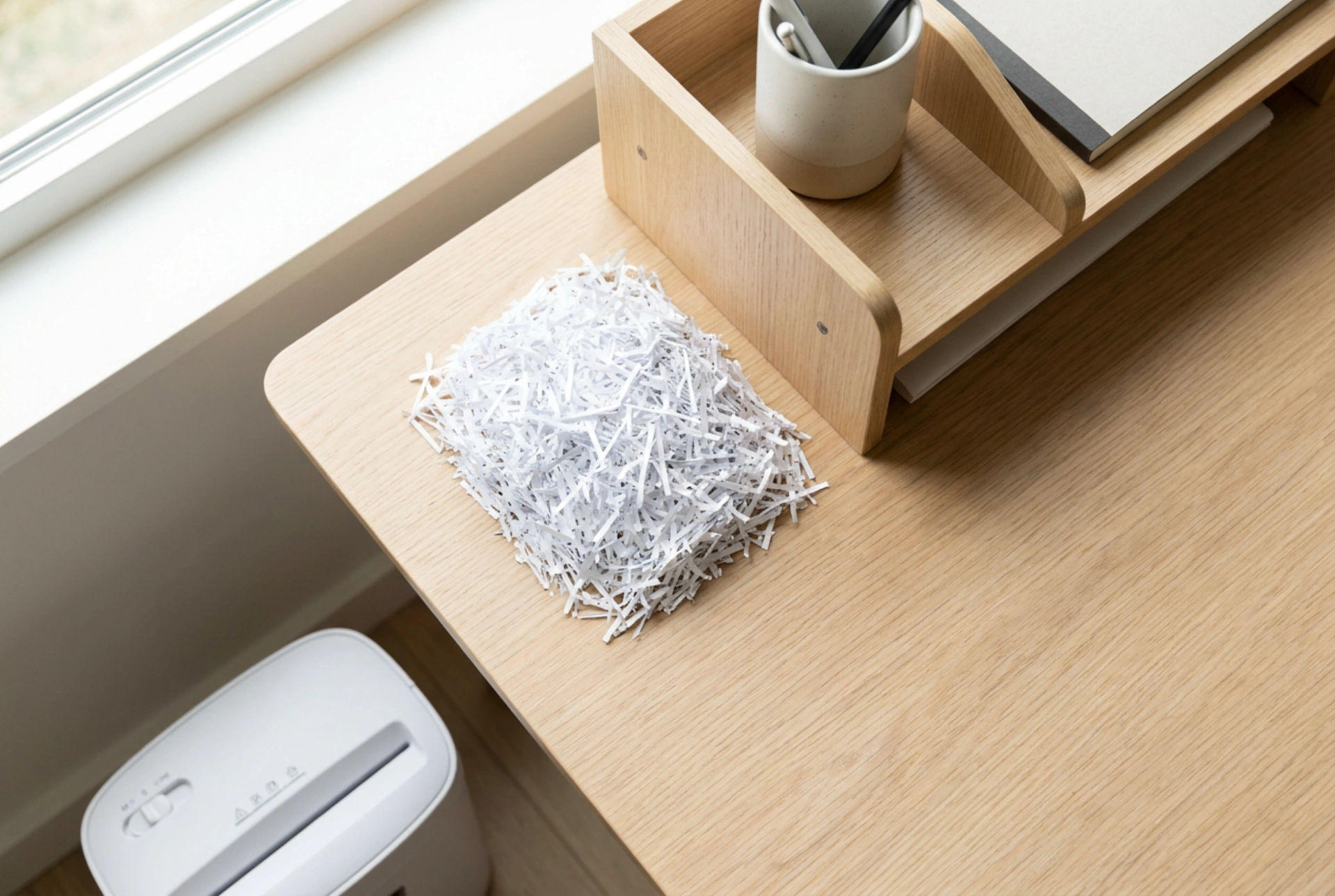


Protecting sensitive information in a home office requires a systematic approach to destroying physical documents containing personal or financial data. Simply throwing intact paperwork into the recycling bin exposes you to identity theft and breaches data privacy standards.
The Physics of Shredding: Particle Size and Security Levels
Document destruction relies primarily on mechanical shear forces to reduce paper sheets into fragments that cannot be easily reassembled. The effectiveness of this process is measured by the surface area of the resulting particles. Under international data destruction standards, security levels range from P-1 to P-7, based on the size of the shredded pieces.
Strip-cut shredders slice paper into continuous parallel strips. A standard A4 page is cut into roughly 39 strips. While this reduces legibility, the spatial relationships between the text elements remain largely intact, making reconstruction relatively simple using basic spatial puzzles or digital scanning software. Cross-cut shredders introduce a diagonal or secondary cut, transforming the strips into small rectangular confetti. This reduces an A4 sheet into roughly 400 particles. Micro-cut shredders use highly precise, interlocking rotary cutters to reduce a single sheet into more than 2,000 microscopic particles. At this level, the physical surface area of each particle is less than 30 square millimetres, rendering manual or digital reconstruction mathematically and physically unfeasible.
The Chemistry of Pulping: Eco-Friendly Liquid Destruction
When a mechanical shredder is unavailable, chemical pulping offers a highly secure, non-combustive method to destroy paper. Paper is composed of cellulose fibers bound together by hydrogen bonds and organic polymers like lignin. Breaking these physical bonds requires a combination of mechanical agitation, water, and a mild chemical catalyst.
To execute this at home, submerge the documents in a large plastic container filled with warm water. Introduce a small amount of sodium carbonate (washing soda) or a mild oxygen bleach. The alkaline environment weakens the hydrogen bonds between the cellulose fibers, causing the paper to swell and lose its structural integrity. After soaking for several hours, use a mechanical paint mixer attachment on a standard drill to agitate the mixture. The shear forces, combined with the chemical degradation, reduce the documents into a homogenous grey slurry. Once the slurry is compressed and dried, the resulting cellulose mass is entirely unreadable and can be safely composted or disposed of as organic waste.
Managing Magnetic and Optical Media
Home offices often generate non-paper data storage media, such as credit cards, CDs, DVDs, and old magnetic tapes. Destroying these requires different physical mechanisms due to the materials involved. Credit cards contain magnetic strips and embedded EMV chips. To neutralize them, you must disrupt the magnetic domains. This is achieved by physically cutting through the magnetic stripe horizontally and crushing the metallic contacts of the microchip with pliers to break the internal integrated circuit.
Optical media like CDs and DVDs store data in a spiral track of microscopic pits within a reflective aluminium layer sandwiched between polycarbonate plastic. Simply scratching the surface is insufficient, as professional data recovery tools can often bypass superficial damage. Instead, utilize a heavy-duty shear-cut shredder designed for plastics, or physically bend the disc until the internal reflective aluminium layer fractures and delaminates from the plastic substrate. Always wear protective eyewear during this process to guard against flying polycarbonate shards.
Disposal and Environmental Considerations
Once documents are physically or chemically destroyed, their disposal path changes. Standard municipal recycling facilities often reject dry shredded paper. The mechanical sorting screens in recycling plants are designed for whole sheets and large cardboard; small paper particles slip through the grates, clogging the machinery or mixing with glass and metal streams. Furthermore, the shredding process tears the cellulose fibers, drastically reducing their length and quality for future paper production.
To minimize environmental impact, shredded paper should be diverted from the standard recycling bin. It can be used as carbon-rich material in home composting bins, where it assists in balancing the nitrogen-rich food waste. Alternatively, it can be repurposed as biodegradable packaging filler or animal bedding, ensuring that your security measures do not come at the expense of ecological responsibility.