

Integrating a modern wall clock into a living room requires more than matching colours; it demands a precise understanding of spatial geometry, visual weight, and the physics of light. Finding the exact balance between the timepiece and the wall dimensions ensures the clock anchors the room without cluttering it.
The Mathematics of Wall Scale
To choose the correct clock size, you must first analyse the target wall as a distinct geometric plane. A common design error is placing a small clock on a large, blank wall, creating a "lost" visual effect, or conversely, squeezing a massive clock into a restricted space. The ideal proportion for an isolated wall clock is to occupy roughly one-third of the active wall width. For example, if you have a clear wall section of 2.4 metres, a clock with a diameter of 60 to 80 centimetres will establish a balanced focal point.
When positioning a clock above furniture, such as a sofa or sideboard, the rules of visual scale shift. The clock should act as a crown to the furniture piece, not compete with it. To achieve this, the clock's diameter should ideally represent 50% to 66% of the width of the furniture below. This creates a stable triangular visual hierarchy, keeping the arrangement grounded and preventing it from feeling top-heavy.
Visual Weight and Material Science
Physical dimensions alone do not dictate how large a clock appears; material density and design complexity determine its "visual weight". An open-frame, skeletal clock made of thin metal wire has low visual weight. Because the wall texture and colour remain visible through the frame, a skeletal clock can be significantly larger—sometimes up to 90 centimetres in diameter—without overpowering the room.
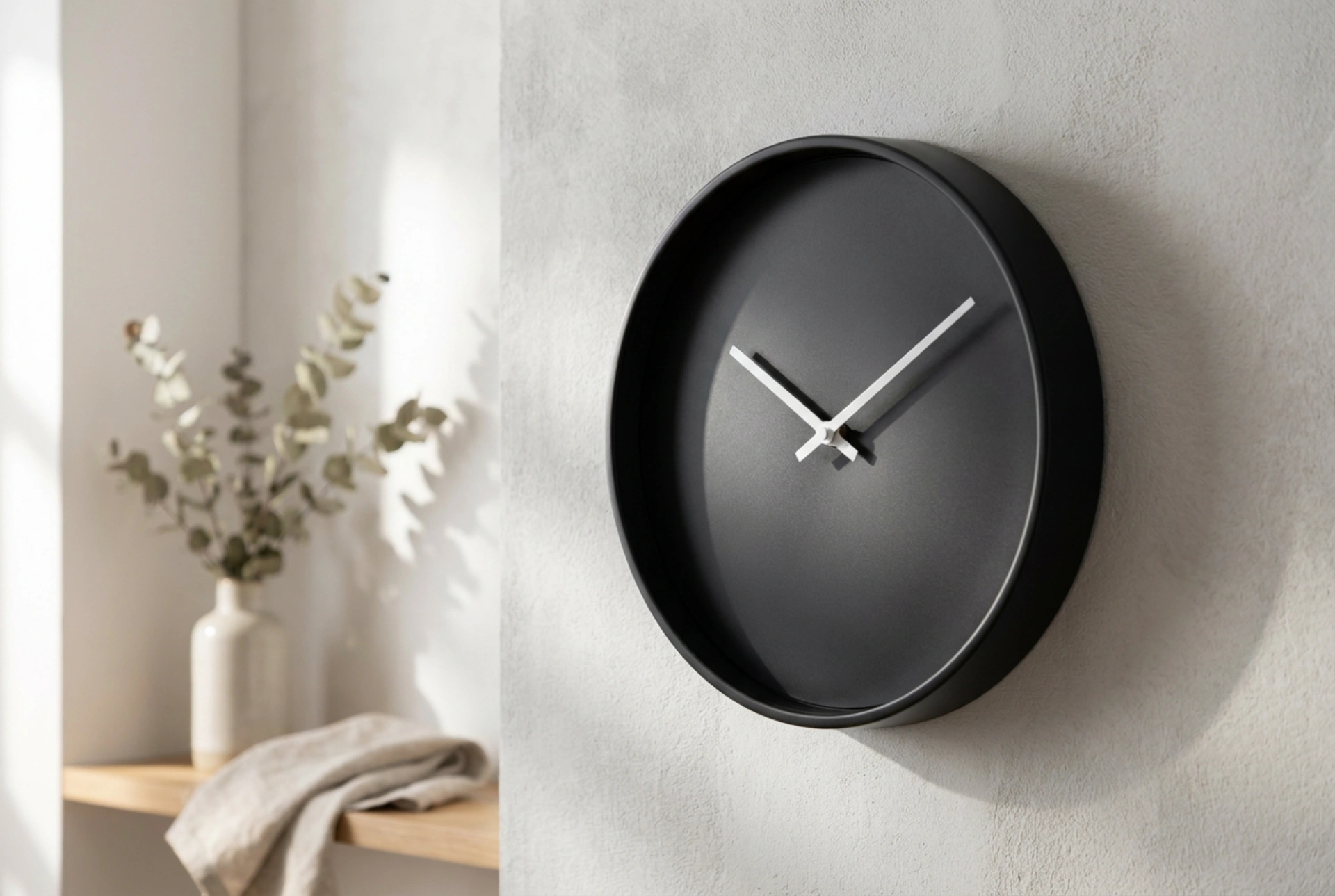
Conversely, a solid, deep-set clock crafted from heavy materials like dense concrete, dark oak, or matte slate has high visual weight. These materials absorb light and block the background completely. A solid clock of this type must be scaled down slightly, as its dense visual footprint makes it appear larger than its actual physical measurements suggest. When matching these materials to your walls, pair heavy, opaque clocks with smooth, minimalist surfaces, and lighter, skeletal designs with textured plaster or brick to create depth.
The Geometry of Elevation and Alignment
Hanging a clock at the incorrect height can disrupt the physical comfort of the room. The universal standard for hanging eye-level art also applies to clocks: the centre of the dial should sit approximately 145 to 150 centimetres from the finished floor. This aligns with the natural human line of sight when standing.
However, if the clock is situated in a primary seating area where people are predominantly seated, you should lower the mounting point slightly to keep it within a comfortable 15-degree upward viewing angle. When placing the clock above high furniture, maintain a clear vertical gap of at least 15 to 20 centimetres between the top of the furniture and the bottom edge of the clock. This gap provides visual "breathing room," preventing the two elements from merging into a single, bulky mass.
Light, Contrast, and Surface Finish
How a clock interacts with light determines its daily readability and aesthetic success. Matte-finished clocks, such as those made of powder-coated metals or brushed polymers, are highly practical for bright, sunlit living rooms. Matte surfaces diffuse incoming light, minimising specular reflection (glare) and ensuring that the hands remain visible from any angle in the room.
If you prefer a clock with glass casing or polished metallic components, position it perpendicular to the main window rather than directly opposite it. Direct sunlight hitting a glossy surface at a 180-degree angle creates a blinding reflection that renders the timepiece unreadable. Additionally, consider how shadow play affects the clock's readability; clocks with raised, three-dimensional indices or deep-set hands rely on soft directional light to cast subtle shadows, which naturally enhances readability without relying on high-contrast colour schemes.
Structural Integrity and Safe Mounting
Before mounting your clock, you must account for its weight and the composition of your wall. Lightweight plastic or thin aluminium clocks (under 1.5 kg) can be safely mounted on standard drywall using simple polymer wall anchors. However, heavy stone, solid wood, or concrete timepieces require robust structural support.
For heavy clocks, locate a wall stud using a magnetic finder, or use high-capacity steel toggle bolts designed for hollow walls. Ensure the screw or hook is mounted at a slight upward angle (approximately 10 to 15 degrees) to counteract the downward gravitational shear force, preventing the clock from slipping forward over time.