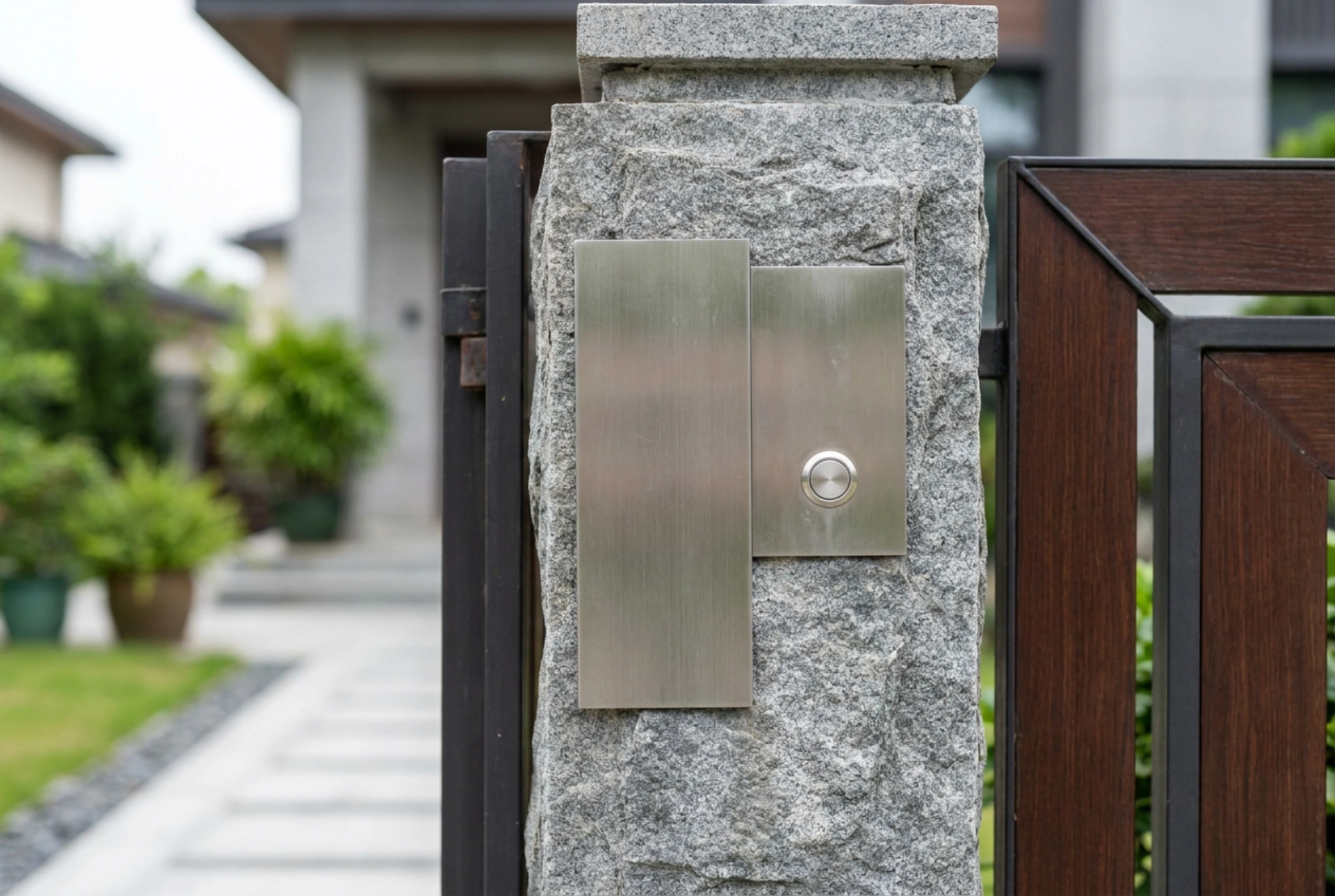


Selecting the right video intercom system requires a clear understanding of signal transmission, camera optics, and environmental resistance to ensure reliable long-term entry control. Matching the technical specifications of both the outdoor station and indoor monitor to the physical layout of your property is essential for a seamless installation.
Transmission Mediums: Wired Integrity vs. Wireless Attenuation
The physical medium carrying your video and audio signals determines the system's reliability. Wired configurations are the gold standard for residential properties. Traditional systems rely on either two-wire or four-wire setups. Two-wire systems modulate power, audio, and video onto a single pair of conductors using digital bus technology, making them ideal for retrofitting existing doorbell wires. Four-wire systems typically separate these functions, using dedicated lines for power, audio, video, and ground.
For distances exceeding 20 metres from the house to the boundary gate, cable resistance becomes a critical factor. Voltage drop over long distances can cause screen flickering, audio distortion, or failure to trigger the electric strike. To prevent this, pure copper (CU) cabling must be used rather than copper-clad aluminium (CCA). Copper has significantly lower electrical resistivity (1.72 x 10^-8 Ohm-metres) than aluminium (2.65 x 10^-8 Ohm-metres). For runs over 50 metres, increasing the wire gauge (cross-sectional area) is necessary to maintain signal integrity and adequate voltage levels at the gate.
Wireless systems operate on radio frequencies (typically 2.4 GHz or 5 GHz). While they offer ease of installation, they are highly susceptible to signal attenuation. Solid brick walls, wet foliage, concrete pillars, and metal gates act as physical barriers that absorb or reflect radio waves. A metal gate can act as a partial Faraday cage, severely degrading signal strength. If wireless is chosen, the outdoor unit must have a high-gain external antenna, or a dedicated wireless access point must be positioned with a clear line of sight to the gate.
Optical Performance and Night Vision Physics
An intercom's primary security function relies on visual identification. The field of view (FoV) of the outdoor camera lens dictates how much of the entry area is visible. A standard lens with a narrow horizontal angle of 70 to 80 degrees creates significant blind spots directly beneath or to the sides of the panel. For gate installations where visitors may stand close to the pillar, a wide-angle lens with a horizontal FoV of at least 110 to 180 degrees is required to capture both tall adults and children.
Night-time identification requires active illumination. Most systems utilise either Infrared (IR) LEDs or white-light LEDs. IR illumination (typically at 850nm wavelength) is invisible to the human eye, preserving nighttime aesthetics while allowing the camera's monochrome sensor to capture clear images. However, 850nm IR light can cause overexposure (washing out faces) if the visitor stands too close, due to the inverse-square law of light propagation. White-light LEDs maintain colour imaging at night and serve as a visible deterrent, but they can be obtrusive in quiet residential areas.
Environmental Resilience: IP and IK Standards
The outdoor panel is subjected to harsh weather, UV radiation, and temperature fluctuations. The Ingress Protection (IP) rating defines the enclosure's resistance to solids and liquids. An outdoor unit mounted on an exposed gate pillar must have a minimum rating of IP65, meaning it is dust-tight and protected against water jets from any angle. For locations with direct, driving rain or snow accumulation, IP67 (immersion up to 1 metre) is preferred.
Thermal dynamics also affect outdoor electronics. Direct sunlight can raise the internal temperature of a dark metal or plastic casing far beyond the ambient air temperature, leading to component degradation or processor lockups. Panels with integrated sunshields or those constructed from brushed anodised aluminium help dissipate heat and deflect direct solar radiation. Furthermore, the Impact Protection (IK) rating measures resistance to mechanical impacts. An IK08 or IK10 rating indicates a vandal-resistant housing capable of withstanding physical blows from tools or stones without exposing the internal circuitry.
Actuation and Inductive Load Protection
Integrating the video intercom with a gate or wicket gate requires controlling an electric strike or magnetic lock. The intercom's outdoor unit contains an internal relay that acts as a switch. When choosing an electric strike, you must distinguish between Fail-Secure (remains locked during power failure, ideal for external boundaries) and Fail-Safe (unlocks during power failure, ideal for safety exits) mechanisms.
Electric strikes rely on electromagnetic solenoids. When the relay cuts power to the solenoid, the sudden collapse of the magnetic field generates a high-voltage spike, known as back-EMF (electromotive force). This transient voltage can travel back through the wires and burn out the delicate relay contacts in the outdoor station. To prevent this, a flyback diode (such as a standard 1N4007) must be installed in parallel with the electric strike coil to safely dissipate the stored energy. Alternatively, utilising a separate, dedicated power supply for the lock—isolated from the intercom logic circuit via an optocoupler—ensures long-term operational stability.