

Thermal label printers offer a fast, ink-free solution for home organisation and shipping logistics, relying on heat-sensitive materials rather than traditional liquid ink. Understanding how this chemical printing process works helps you choose the right materials and settings to achieve crisp, durable labels for every household application.
The Chemistry of Heat-Activated Printing
Unlike standard inkjet or laser printers that deposit pigment onto a surface, direct thermal printers utilise physical chemistry to create images. The core of this system is the thermal printhead, which contains a dense row of microscopic heating resistors. These elements heat up and cool down rapidly as the label stock passes beneath them.
The magic happens within the paper itself. Direct thermal labels are coated with a chemical layer containing a colourless leuco dye, an organic acid developer, and a sensitiser matrix. At room temperature, these components remain solid and separated. However, when the printhead applies precise heat (typically between 100°C and 150°C), the sensitiser melts, allowing the dye and the acid to mix. This chemical reaction alters the molecular structure of the dye, shifting it from a transparent state to a highly visible dark state, creating the printed text or barcode.
Direct Thermal versus Thermal Transfer
When selecting a thermal printer for home use, it is crucial to distinguish between two primary technologies: direct thermal and thermal transfer.
- Direct Thermal: This method requires no ribbon, ink, or toner. The printer applies heat directly to the chemically treated label paper. While highly convenient and cost-effective, these labels remain chemically active. Exposure to high temperatures, friction, or ultraviolet (UV) radiation will trigger the reaction across the entire surface, causing the label to fade or turn entirely black over time.
- Thermal Transfer: This technique uses a thermal ribbon coated with wax, resin, or a wax-resin hybrid. The printhead melts the substance on the ribbon, transferring it onto standard paper or durable synthetic labels (like polyester). Because the final label does not contain heat-sensitive chemical coatings, it is highly resistant to moisture, chemicals, scratch damage, and UV light.
Maintenance and Printhead Preservation
To ensure consistent print density and prolong the lifespan of your machine, regular maintenance is essential. Over time, microscopic paper dust and adhesive residue from the edges of the labels accumulate on the thermal printhead. This buildup acts as an insulator, preventing heat from transferring efficiently to the paper, resulting in faded spots or streaky prints.
To clean the printhead, power down the device and allow it to cool completely. Moisten a lint-free microfibre cloth or a cotton swab with high-purity isopropyl alcohol (at least 90%). Gently wipe the printhead line in a single direction to remove accumulated debris. Avoid using metal tools or abrasive materials, as the protective glass coating on the thermal elements is easily scratched, which permanently ruins print quality.
Best Practical Applications in the Home
Direct thermal printing excels in scenarios where labels are needed quickly and are not exposed to extreme environmental stress. For shipping labels, return packets, and temporary filing systems, direct thermal is unmatched in efficiency and low running costs.
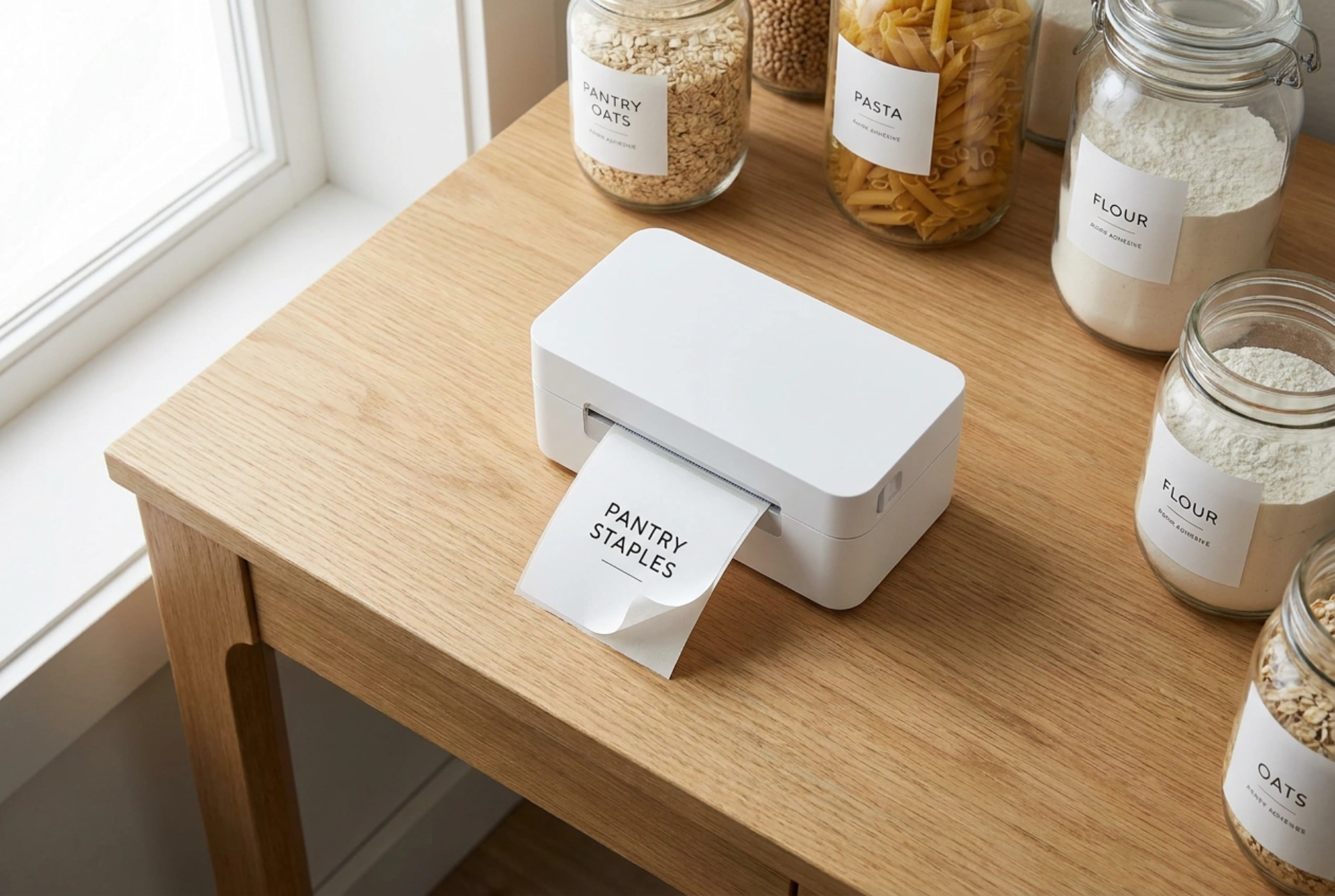
For kitchen pantry organisation, glass spice jars, and garage storage, consider the placement. While direct thermal labels work well inside dark cupboards, items that undergo frequent handling, moisture exposure, or washing should utilise synthetic thermal transfer labels to prevent degradation from water and hand oils.