

Selecting a bedroom wall clock requires balancing aesthetic preferences with sensory ergonomics to ensure an undisturbed sleep cycle. Acoustic and visual distractions from poorly designed clocks can disrupt sleep architecture, making the underlying mechanics of the timepiece critical to a restful environment.
The Physics of Silence: Stepping vs. Sweep Movements
The primary source of sleep disruption from analog clocks is the rhythmic ticking sound. To understand how to avoid this, one must look at the clock’s movement mechanism. Standard quartz clocks utilise a stepping motor. In this design, the gears move the second hand in precise, one-second intervals. This sudden start-and-stop motion creates a mechanical impulse, producing a transient acoustic spike. Even at low decibel levels, the human brain is highly sensitive to rhythmic, repetitive sounds, which can prevent the transition into deep slow-wave sleep.
The solution lies in choosing a continuous sweep movement. Instead of stepping once per second, the motor in a sweep mechanism operates at a much higher frequency, typically distributing the kinetic energy smoothly across the gear train to eliminate the sharp acoustic impact. When evaluating a clock, verify that it features a continuous quartz sweep movement, which effectively lowers the operational noise level to under 10 decibels, making it virtually imperceptible in a quiet bedroom.
Visual Ergonomics: Luminescence and Melatonin Preservation
Acoustics are only half of the equation; visual stimulation during the night can also degrade sleep quality. The human circadian rhythm is highly sensitive to light, particularly short-wavelength blue light, which suppresses the synthesis of melatonin, the hormone responsible for regulating sleep cycles.
- Avoid Active Digital Displays: Liquid crystal displays (LCD) and light-emitting diode (LED) screens often emit constant backlighting. Even dim screens can emit enough light to interfere with photoreceptors in the retina.
- Opt for Passive Photoluminescence: If night-time legibility is necessary, select a clock featuring passive phosphorescent markers. These materials, such as strontium aluminate, absorb ambient light during the day and slowly release it as a soft, decaying glow in the dark. This emission diminishes over the night, aligning naturally with your eyes’ dark adaptation without emitting disruptive light waves.
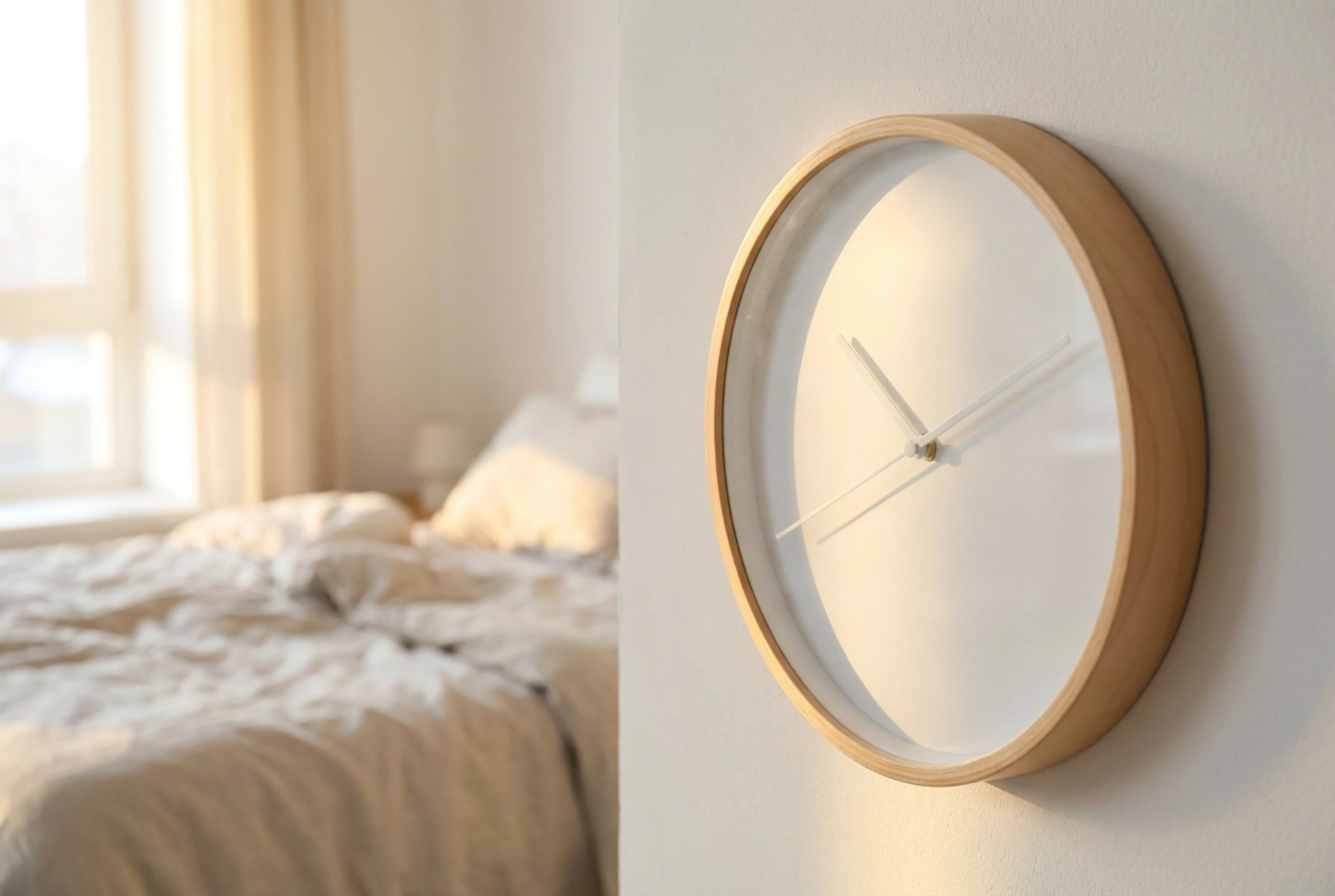
- High Contrast, Matte Dials: For daytime viewing, choose a dial with a matte finish and high-contrast hands. Glossy surfaces can catch reflections from streetlights or morning sun, creating glare that causes unnecessary visual strain.
Acoustic Resonance: Case Materials and Sound Dampening
Even a quiet movement can become audible if the clock’s casing acts as an acoustic amplifier. The materials surrounding the clock mechanism play a vital role in dampening or magnifying internal vibrations.
Hollow, thin-walled plastic cases act like the body of an acoustic guitar, reflecting and amplifying the subtle hum of the gear train. Conversely, dense materials such as solid hardwood, natural stone, or thick metal composites possess natural damping properties that absorb mechanical energy before it can radiate as sound waves. Additionally, ensure the front lens is secured with a soft gasket; loose glass or acrylic covers can vibrate against the frame, creating a low-frequency buzz. Look for clocks that incorporate silicone or rubber dampeners around the battery compartment and gear housing to isolate physical vibrations.
Strategic Placement and Vibration Isolation
The physical positioning of the clock in your bedroom affects how sound travels. Placing a clock directly on a hollow partition wall, such as plasterboard mounted on timber studs, can turn the entire wall into a sounding board. The mechanical vibrations of the clock transfer directly into the drywall, which then radiates the sound into the room.
To prevent this, mount the clock on a solid masonry wall whenever possible, as dense brick or concrete will not vibrate easily. If mounting on drywall is unavoidable, place a small felt or adhesive silicone pad on the back of the clock frame where it contacts the wall. This simple boundary layer decouples the clock from the wall structure, absorbing kinetic energy and ensuring complete silence.