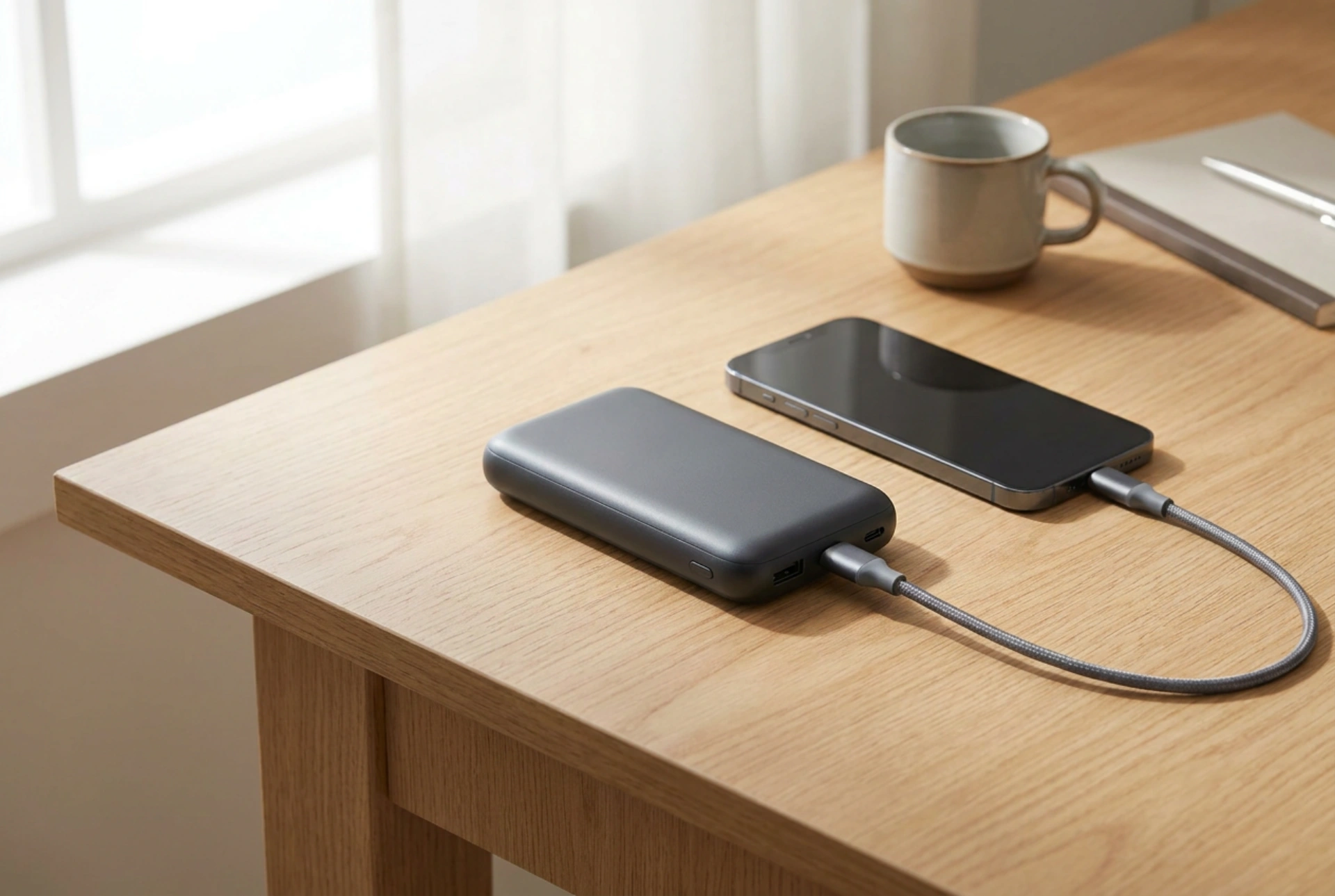


Compact, high-capacity power banks pack immense energy into pocket-sized enclosures, making thermal management and voltage regulation critical for protecting your devices. Understanding the physics of lithium-ion cells and integrated safety mechanisms ensures efficient, degradation-free charging at home.
The Chemistry of Energy Density: Li-Ion vs. Li-Po
To pack 10,000 mAh or more into a chassis the size of a deck of cards, manufacturers rely on highly dense chemical compositions. The two primary technologies are Lithium-Ion (Li-ion) and Lithium-Polymer (Li-Po). Li-ion cells typically use a liquid electrolyte housed in rigid cylindrical metal casings, whereas Li-Po cells utilise a gel-like polymer electrolyte in flexible pouch formats. While Li-Po allows for thinner, custom shapes, both rely on the same fundamental chemistry: the movement of lithium ions between a cathode and an anode.
The physical challenge in squeezing high capacity into a small volume lies in energy density. If a physical defect, manufacturing impurity, or external pressure causes an internal short circuit, the stored chemical energy is rapidly released as heat. This can trigger thermal runaway, a self-sustaining exothermic reaction where the temperature rises exponentially, potentially leading to off-gassing or cell failure.
Electronic Safeguards: How Smart Controllers Protect Devices
Modern portable chargers do not feed raw current directly from the battery cells to your smartphone. Instead, they employ sophisticated printed circuit boards containing Integrated Circuits (ICs) that act as gatekeepers. These components perform several critical electrical functions:
- Overcurrent Protection (OCP): Automatically cuts off the circuit if the connected device demands more amperes than the power bank or cable can safely handle.
- Overvoltage Protection (OVP): Prevents the output voltage from exceeding safe thresholds, which could otherwise damage the delicate oxide layers inside a processor.
- Under-voltage and Over-discharge Prevention: Lithium cells degrade permanently if their voltage drops below a critical threshold (typically around 2.5V). The IC shuts off power output before this point is reached.
To deliver fast charging safely, the power bank and the receiving device undergo a digital handshaking protocol upon connection. Using standard communication lines within the cable, the device requests a specific voltage and current profile. If the cable or power bank cannot sustain this transfer, the system defaults to a safe, low-power state, preventing overheating of the internal copper traces.
The Impact of Temperature on Battery Lifespan
Heat is the primary accelerator of battery degradation. When charging, the internal resistance of the battery cells generates thermal energy. If this heat cannot escape the small enclosure of a compact power bank, the internal temperature climbs. High temperatures accelerate the growth of the Solid Electrolyte Interphase (SEI) layer on the anode, which permanently traps lithium ions and reduces the overall capacity of the cell.
To prevent this, high-quality portable chargers feature negative temperature coefficient (NTC) thermistors. These sensors continuously monitor temperature and communicate with the controller to throttle the charging current if thermal thresholds are breached. This explains why charging speeds often drop when a device becomes warm during heavy use.
Practical Rules for Safe High-Capacity Charging
Maximising the lifespan of both your compact power bank and your mobile devices requires adhering to basic laws of thermodynamics and electrical resistance. Implement these protocols in your daily charging routine:
- Avoid Pass-Through Charging: Charging a power bank while it simultaneously powers another device generates dual thermal loads. Unless the unit features dedicated, independent thermal zones, this practice drastically raises internal temperatures.
- Optimise Thermal Dissipation: Place the power bank on hard, flat surfaces like wooden desks or stone countertops during operation. Soft surfaces like beds or sofas trap heat, acting as insulation.
- Use Certified Low-Resistance Cables: Thin, poor-quality cables have higher internal resistance, leading to a voltage drop and excess heat generation along the wire. Use thick-gauge copper cables with appropriate shielding.
- Do Not Store at Full Charge: If storing the power bank for extended periods, keep the charge state around 50%. High voltage states combined with time accelerate chemical degradation of the cathode material.