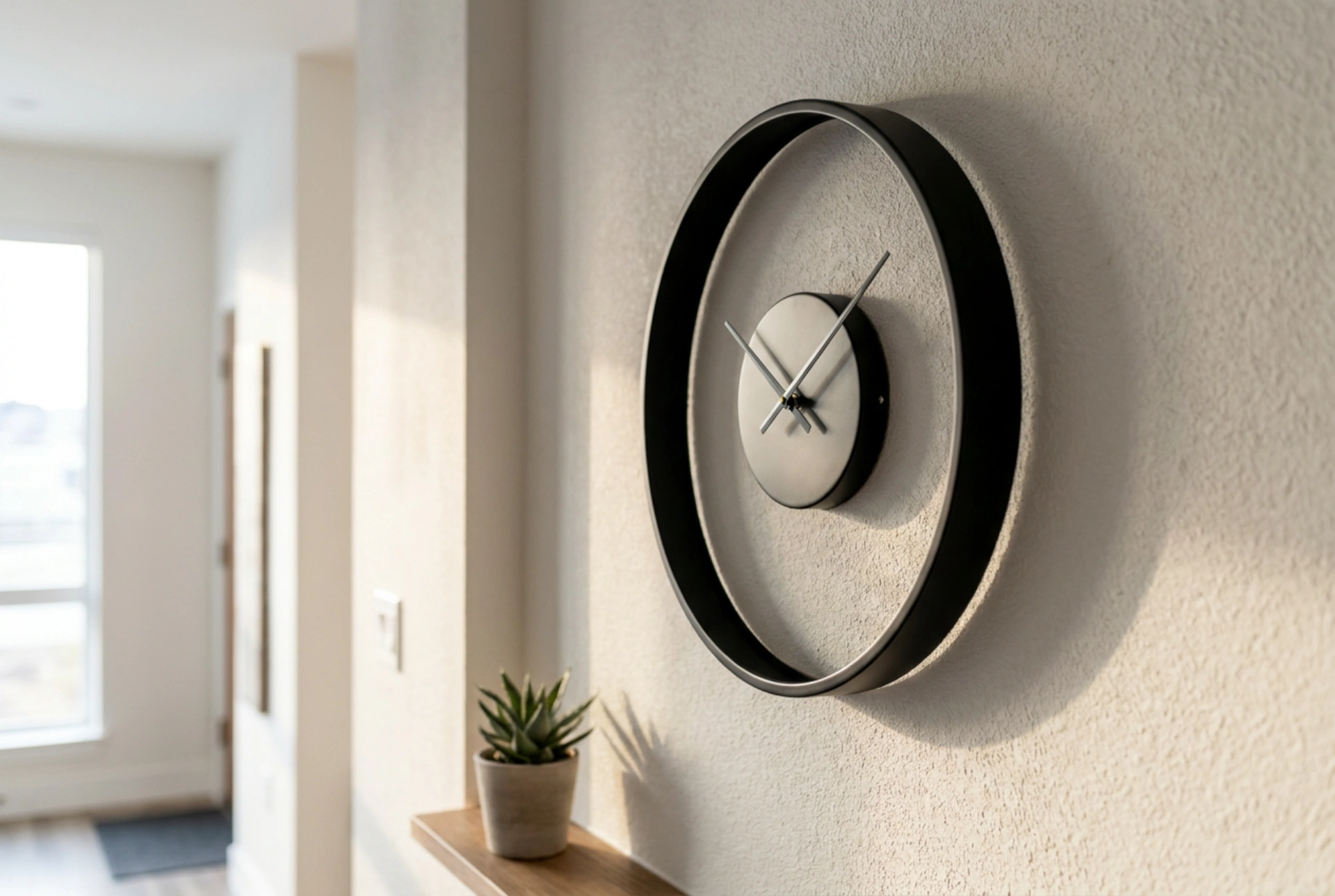


Hanging a large black wall clock on a light wall is a classic high-contrast interior design choice that relies on physical contrast and spatial geometry to anchor a room. Achieving the perfect visual balance requires understanding light absorption, structural weight, and the optical relationship between different materials.
The Physics of Contrast: Matte vs. Gloss Finishes
When you place a dark object against a light surface, you create a point of high visual tension. In physics, this is governed by the Light Reflectance Value (LRV). Light walls reflect up to 80-90% of incident light, whereas black surfaces absorb nearly all of it. To make this contrast work harmoniously, you must consider how light reflects off the clock itself. A high-gloss black finish creates specular reflection, bouncing light directly into the viewer's eyes and creating glare. This glare can obscure the hands and face of the clock, reducing its functionality. Conversely, a matte black finish—often achieved through powder-coating or ultra-flat acrylic paint—results in diffuse reflection. Diffuse reflection scatters incoming light in multiple directions, maintaining the deep black tone of the clock from any angle and ensuring optimal legibility while softening the stark contrast against a bright white or cream wall.
Evaluating Visual Weight and Materiality
The physical construction of the clock dictates its visual weight—the perceived heaviness of an object in a space. A solid, heavy black wooden or metal disc acts as a dominant visual block. This works exceptionally well in large, open-concept spaces with high ceilings where a strong anchor point is needed. However, in smaller rooms, a solid black circle can feel oppressive. In such cases, skeleton clocks—featuring open-frame designs where the wall behind remains visible—are mathematically superior. They allow the high LRV of the light wall to pass through the clock's body, maintaining an airy, spacious feel while the dark metal hands and Roman or Arabic numerals provide the necessary contrast. For materials, powder-coated iron or steel offers clean, sharp geometric lines that do not warp over time, unlike cheap plastics which can degrade under UV exposure from nearby windows.
Shadow Play and Dimensional Depth
An often-overlooked element of hanging a large clock is the interaction of light and shadow. A flush-mounted flat clock can look two-dimensional and sterile. Choosing a clock with a deeper profile—typically between three to five centimetres—allows side lighting from windows or lamps to cast a soft shadow on the light wall behind it. This shadow acts as a natural gradient transitions, easing the harsh transition between the absolute black of the frame and the bright wall surface. The shadow also emphasizes the geometric structure of the timepiece, giving it a sculptural, three-dimensional presence. When positioning the clock, observe how natural light moves through the room throughout the day to ensure the shadows enhance rather than distort the readability of the dial.
Precision Mounting and Structural Security
Because a large, high-quality clock carries significant physical mass, proper mechanical anchoring is critical. To avoid damage to the wall substrate, you must match the fastening hardware to the wall type. For hollow drywall (gypsum board), never rely on simple nails or plastic expansion plugs. Instead, utilize metal toggle bolts or heavy-duty threaded drywall anchors that distribute the shear force behind the plasterboard. For solid masonry or brick walls, a nylon wall plug paired with a deep-seated steel screw is required. Before drilling, locate the exact center of gravity of the clock, which is typically directly behind the central hand mechanism. Use a spirit level to ensure the mounting point is perfectly vertical, preventing any rotational drift over time that could disrupt both the aesthetic symmetry and the internal mechanical movement of the clock.
Technical Checklist for Flawless Clock Calibration
- Determine wall substrate composition (drywall, plaster, or masonry) to select the correct mechanical anchor.
- Mark the mounting point using a pencil and a spirit level to prevent visual rotational bias.
- Ensure the mounting screw extends far enough from the wall to safely catch the clock's integrated hanging bracket.
- Clean the clock face and frame with a dry, static-free microfibre cloth to remove oils before hanging.