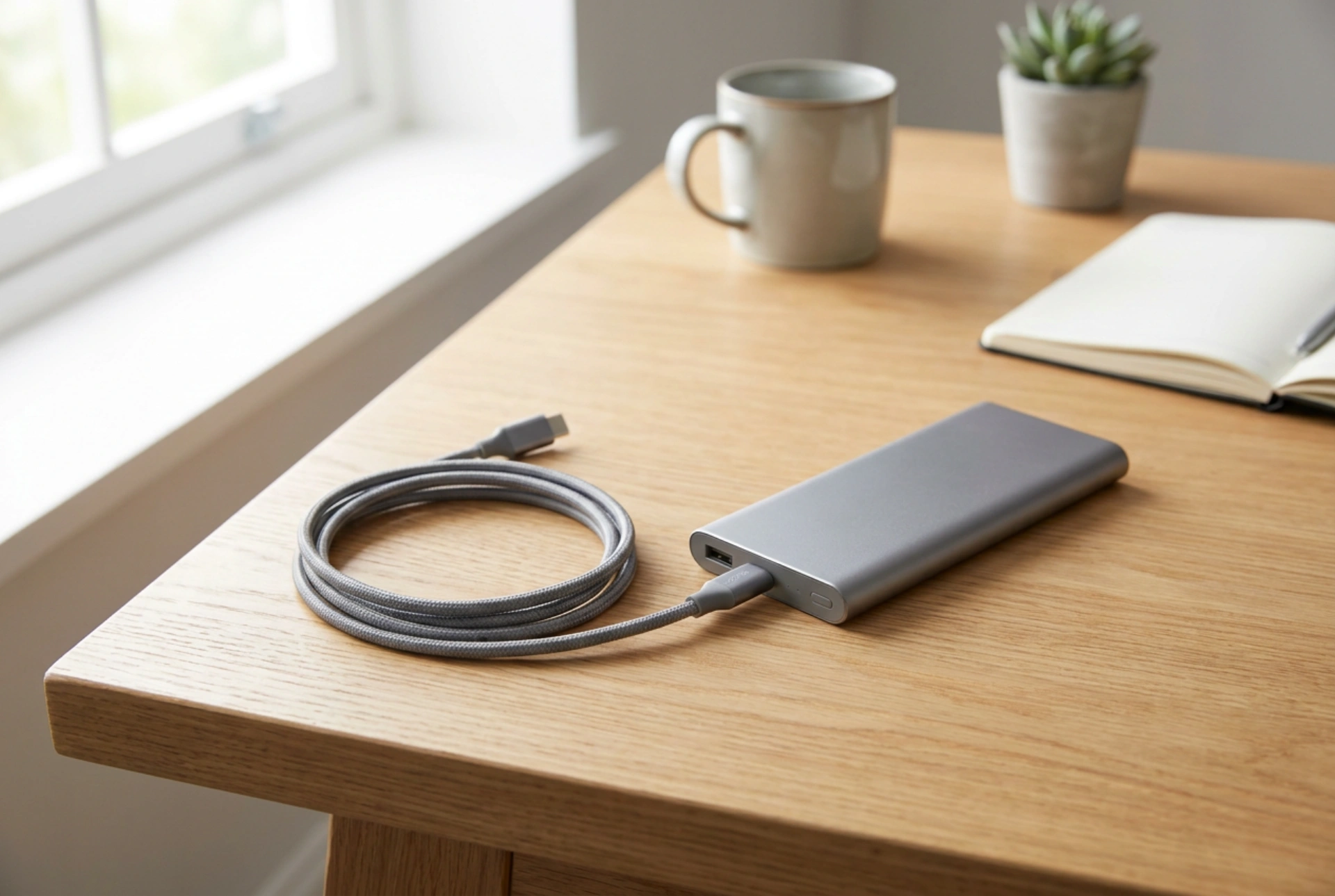


Charging a USB-C power bank correctly involves understanding the physics of lithium-based cells and the protocols governing USB Power Delivery. Choosing the right power source and managing thermal conditions prevents premature degradation of the internal batteries, ensuring long-term energy retention.
The Science of Battery Degradation: Why Capacity Fades
At the core of modern USB-C power banks are lithium-ion or lithium-polymer cells. These cells store energy through the movement of lithium ions between a cathode and an anode. During charging, ions migrate from the positive cathode to the negative anode, embedding themselves in a process known as intercalation. When you use the power bank, the reverse occurs.
Capacity loss happens primarily due to the natural aging of these cells, which is significantly accelerated by mechanical stress and chemical reactions. Every charge-discharge cycle causes the physical structure of the electrodes to expand and contract, leading to microscopic fractures. Furthermore, a layer called the Solid Electrolyte Interphase (SEI) naturally forms on the anode. While this layer protects the anode, excessive heat and high voltage levels cause the SEI layer to grow too thick, trapping active lithium ions and reducing the overall capacity of your power bank permanently.
The Role of USB Power Delivery (USB-PD) and Smart Handshakes
USB-C technology introduced the USB Power Delivery (USB-PD) standard, which enables devices to negotiate power levels dynamically. When you plug a high-quality charger into a USB-C power bank, a digital handshake occurs. The integrated circuit inside the power bank communicates with the charger to request a specific voltage (such as 5V, 9V, 15V, or 20V) and current (measured in Amperes).
To preserve capacity, it is crucial to use a power source that natively supports the specific power profiles requested by your power bank. If a charger lacks compatible voltage steps, the charging circuit inside the power bank is forced to step down the incoming voltage to match the battery cells (typically 3.7V to 4.2V internally). This stepping-down process generates excess heat due to electrical resistance within the internal conversion circuitry. Utilising highly efficient Gallium Nitride (GaN) power adapters is recommended, as they maintain highly stable voltages with minimal thermal waste.
Managing Thermal Dissipation During the Charging Cycle
Heat is the primary catalyst for accelerated chemical degradation inside lithium batteries. As the internal temperature of a power bank rises above 30 degrees Celsius, the rate of parasitic chemical side reactions increases exponentially. This degrades the liquid electrolyte and permanently reduces the active surface area of the electrodes.
- Surface Selection: Always place your power bank on a hard, flat, and thermal-conductive surface such as wood, stone, or metal during charging. Avoid soft surfaces like beds, cushions, or blankets, which act as insulators and trap heat.
- Avoid Passthrough Charging: Using the power bank to charge other devices while it is itself being charged creates immense thermal stress. This simultaneous input and output operation forces the internal circuitry to run at maximum capacity, generating localized heat zones that damage the adjacent battery cells.
Optimal State of Charge (SoC) for Longevity
Maintaining a power bank constantly at 100% capacity creates high physical voltage stress on the cathode material. Conversely, draining it completely to 0% can cause the copper current collectors inside the cells to dissolve into the electrolyte, causing permanent short circuits and safety hazards upon recharging.
For daily usage, the ideal operational range is between 20% and 80% capacity. When preparing a power bank for long-term storage, charge or discharge it to approximately 50% to 60% capacity. Store the device in a cool, dry place with ambient temperatures between 15 and 20 degrees Celsius. This minimises both mechanical stress on the atomic grid of the electrodes and the rate of natural self-discharge.
The Physics of Cable Resistance
The cable connecting the power source to the power bank plays a pivotal role in efficiency. According to Ohm's law, electrical resistance is directly proportional to the length of the conductor and inversely proportional to its cross-sectional area. Thin, poor-quality cables exhibit high resistance, which causes a significant voltage drop over the length of the cable.
This resistance forces the charger to increase voltage or the power bank to work harder to pull the required current, generating heat directly at the USB-C connector. This localized heat quickly transfers to the power bank's internal controller and battery cells. Opting for short, high-gauge copper cables with robust braided shielding ensures clean power delivery and prevents unwanted heat generation.