

Ceiling-mounted television brackets are often overlooked, yet they offer unique ergonomic and spatial advantages in specific architectural scenarios. Understanding the structural and physical principles of ceiling mounting allows you to optimise both viewing comfort and room utility without compromising safety.
Spatial Geometry and Room Layout Constraints
In modern residential architecture, open-plan layouts, loft conversions, and extensive glazing often limit traditional wall-mounting options. When a room features floor-to-ceiling windows or structural pillars, a standard wall bracket is physically impossible to install. This is where the ceiling mount excels by utilising unused overhead space.
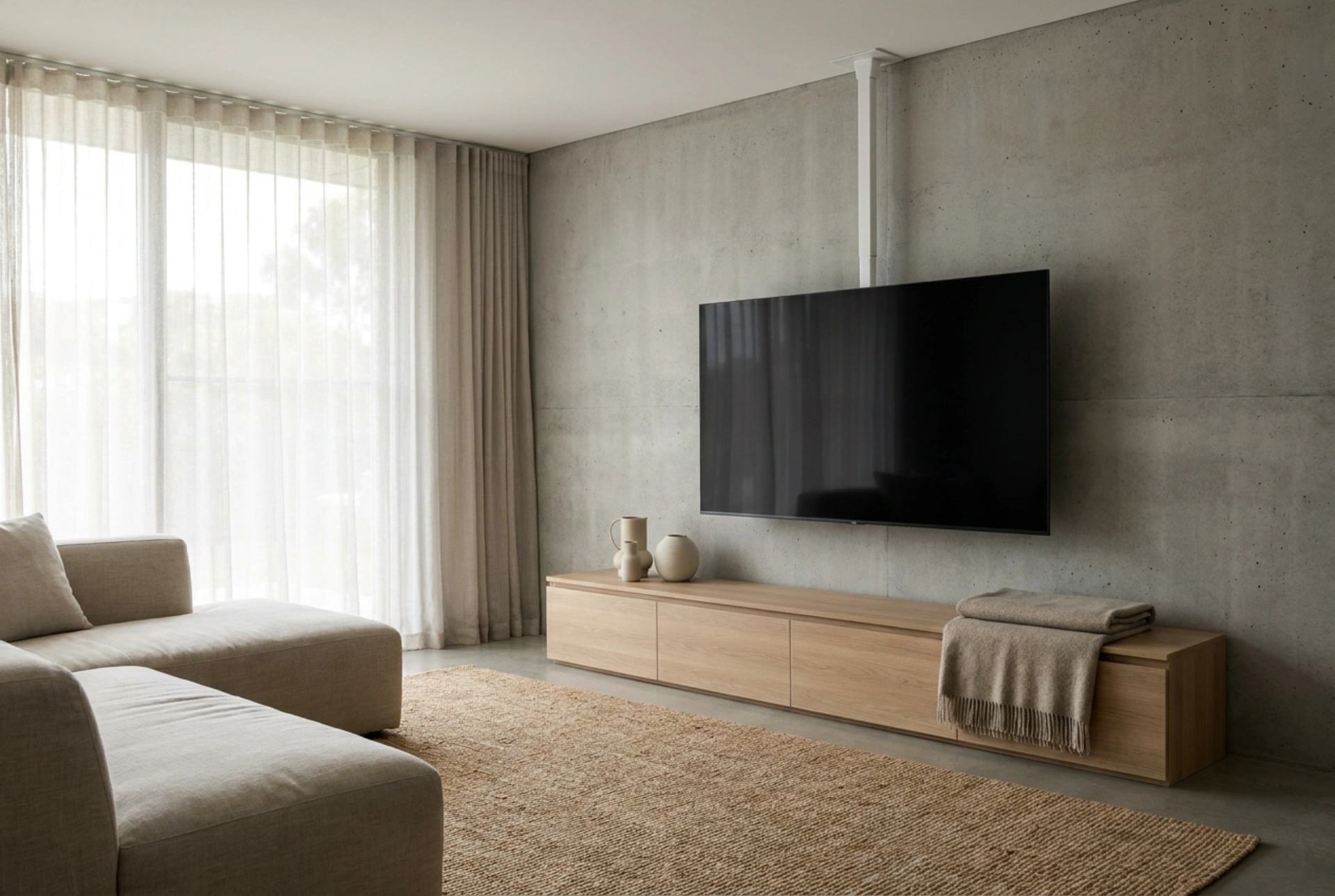
By suspending the television, you eliminate the need for bulky media consoles, freeing up valuable floor area. This is particularly beneficial in multi-functional zones where a screen needs to be visible from different angles, such as an open-kitchen-living area. A ceiling mount with a 360-degree rotational axis allows the screen to be repositioned effortlessly, aligning the display plane with the viewer's line of sight regardless of their position in the room.
Ergonomics and the Physics of Viewing Angles
Human neck anatomy is highly sensitive to vertical viewing angles. Ideally, the centre of a television screen should sit at eye level to prevent strain on the cervical spine. However, when a screen must be mounted higher—such as in a bedroom or a high-traffic zone—a ceiling mount becomes highly practical due to its adjustable tilt mechanisms.
To calculate the optimal tilt angle, consider the viewing distance and the height difference between your eyes and the centre of the screen. As height increases, the screen must tilt downward to maintain a perpendicular relationship with your line of sight. This perpendicular alignment is crucial for minimising glare and maintaining colour accuracy, especially on panels with limited viewing angles. Most ceiling mounts allow for a downward tilt of 15 to 25 degrees, which compensates for the elevated position and keeps the neck in a neutral, relaxed posture.
Ceiling Material Science: Load Distribution and Safety
The feasibility of a ceiling installation depends entirely on the structural composition of the ceiling. The bracket must counteract gravity and potential dynamic forces (such as rotation or adjustment) by transferring the load securely into a structural element.
For solid concrete ceilings, the installation relies on mechanical expansion anchors or chemical anchors. These anchors expand against the dense concrete, creating a high-friction hold that easily withstands tensile forces. In contrast, hollow-core ceilings or plasterboard suspended ceilings require careful reinforcement. Plasterboard itself lacks the shear and tensile strength to support a heavy cantilevered load. In these cases, the bracket must be anchored directly into the timber joists or steel framework using heavy-duty lag screws, or reinforced with an internal mounting plate to distribute the weight across multiple joists.
Thermal Dynamics and Cable Management
Concealing cables is not merely an aesthetic choice; it also protects the wiring from mechanical wear and environmental degradation. High-quality ceiling mounts feature hollow support pillars designed for internal cable routing. This keeps signal and power cables shielded from dust and physical impact.
Additionally, mounting a television near the ceiling subjects it to different thermal conditions than a wall mount. Because hot air rises, the ambient temperature near the ceiling is naturally higher. Televisions rely on passive convection cooling, where cool air enters from the bottom vents and warm air escapes from the top. When positioning a ceiling-mounted screen, ensuring adequate clearance from the ceiling surface is essential to allow this thermal cycle to function, preventing localised heat buildup and prolonging the lifespan of the internal electronics.