

Selecting the right home printer requires looking beyond raw price tags to understand the underlying physical and chemical mechanisms of inkjet and laser technologies. Whether you are archiving family photographs, printing high-volume text documents, or seeking to minimise long-term running costs, the choice between liquid ink and thermoplastic toner dictates how pigment binds to paper fibres and how the machine behaves during periods of inactivity.
The Chemistry of Inkjet Printing: Capillary Action and Colour Depth
Inkjet printers operate by ejecting micro-droplets of liquid ink through microscopic nozzles onto a paper substrate. This process relies on either thermal propulsion—where a minute resistor vapourises a portion of the solvent to create an expanding bubble that forces the ink out—or piezoelectric deformation, which uses physical pressure to expel the fluid. Once the droplet lands on the paper, the physics of capillary action take over. The liquid carrier, usually water or a glycol-based solvent, must be absorbed by the paper fibres while the dye or pigment molecules remain locked at the surface.
For standard text, this liquid phase can be a disadvantage. Raw cellulose fibres in standard printer paper act like tiny wicks, drawing the liquid ink outwards along the grain in a process known as feathering, which reduces text sharpness. However, when printing photographs, liquid ink reigns supreme. When paired with specialised photo paper containing a microporous silica or polymer coating, the liquid droplets pool slightly before drying, allowing for seamless chemical blending and infinitely smooth gradients. This high-density dye absorption produces rich, deep blacks and a wide colour gamut that dry toner particles simply cannot replicate.
The Physics of Laser Printing: Static Electricity and Polymer Fusion
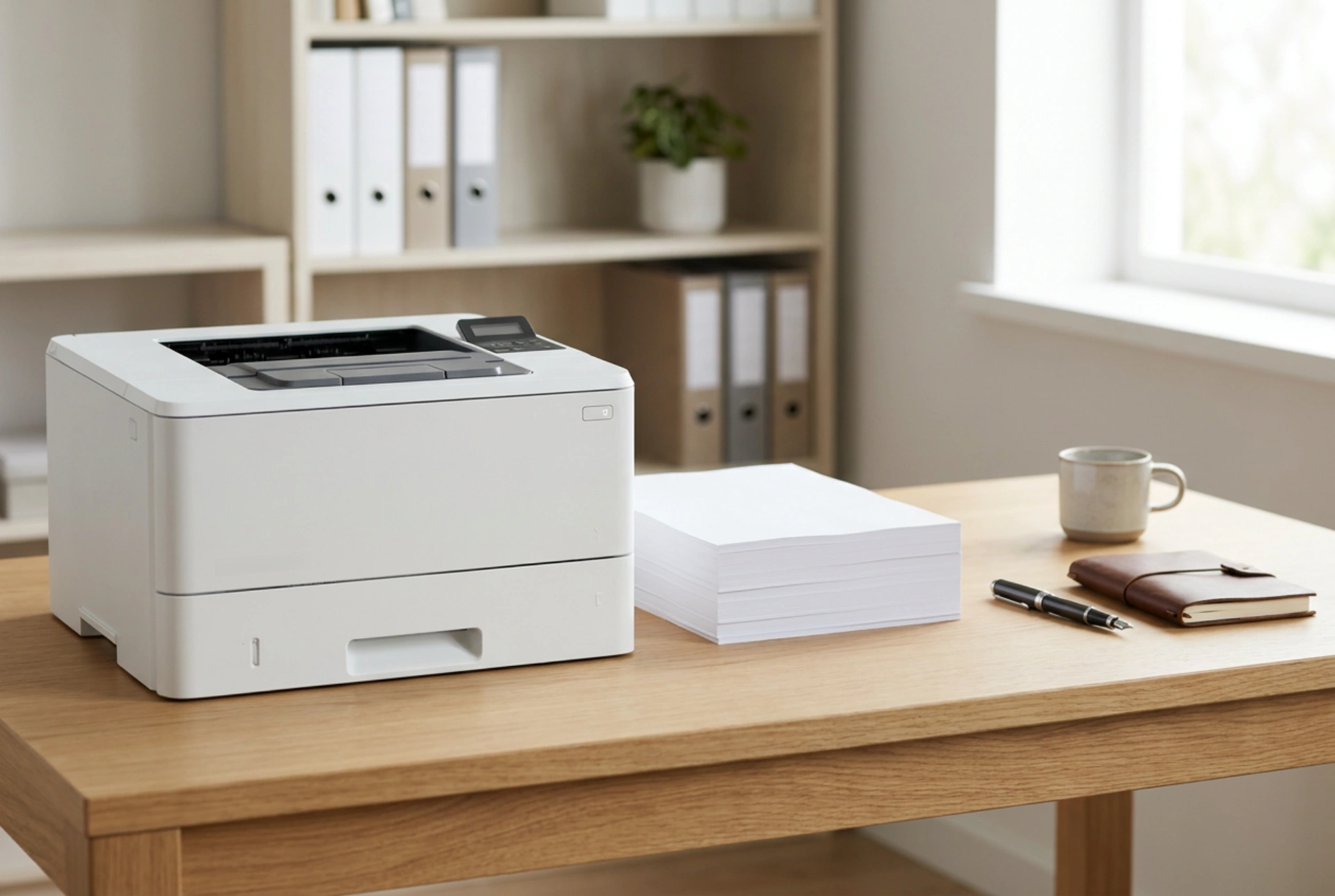
Laser printing is a dry, electrostatic process that treats the paper substrate completely differently. The core of a laser printer is the photoreceptor drum, which is given a uniform static charge. A laser beam discharges specific areas of the drum, creating an electrostatic image that attracts dry toner particles. Toner is not liquid; it is a fine powder composed of pigment trapped inside thermoplastic resin beads, along with iron oxide to assist electrostatic transport.
Once the toner particles transfer from the drum to the paper, they must be permanently secured. This occurs in the fuser assembly, where two rollers apply intense heat (typically between 150°C and 200°C) and physical pressure. This heat melts the thermoplastic resin, causing it to flow and physically bond with the cellulose fibres of the paper. As it cools, it solidifies into a water-resistant, durable polymer-paper composite. Because there is no liquid carrier, feathering is physically impossible, resulting in exceptionally crisp, razor-sharp text characters. Furthermore, laser-printed documents are highly resistant to moisture, UV degradation, and highlighting markers, as the fused plastic does not dissolve in water.
The Total Cost of Ownership: Solvents, Evaporation, and Yield
When calculating home printing costs, the most significant factor is not the price of the machine, but the chemical stability of the consumables. Liquid inks are highly volatile. When an inkjet printer sits idle, the water or solvent inside the printhead nozzles begins to evaporate, leading to crystallisation and clogged channels. To combat this, inkjet printers must perform periodic self-cleaning cycles, which force pressurised ink through the nozzles to clear blockages. This maintenance cycle consumes significant amounts of ink, meaning a user who prints infrequently may find up to half of their paid-for ink wasted in maintenance cycles.
Conversely, thermoplastic toner is chemically inert at room temperature. It cannot evaporate, dry out, or clog, regardless of how long the printer remains idle. This makes laser printers highly cost-efficient for low-frequency users, as every milligram of toner is preserved for actual printing. Additionally, toner cartridges boast significantly higher yields, often printing thousands of pages before requiring replacement, which dramatically lowers the cost-per-page ratio over the lifespan of the hardware.
Substrate Compatibility: Matching Paper to Technology
Achieving optimal print quality requires pairing the technology with the correct substrate chemistry. Standard uncoated copy paper, ideally around 80 to 90 gsm (grams per square metre), is highly suitable for laser printing and everyday inkjet text. However, specialised media requires caution. Placing glossy, plastic-coated photo paper designed for inkjets into a laser printer can be catastrophic; the intense heat of the fuser rollers can melt the synthetic coating directly onto the drum, permanently damaging the printer. For laser printers, any non-standard media must be rated to withstand temperatures exceeding 200°C. For inkjet printers, the key is absorption; using papers with a high clay or polymer binder content prevents the ink from soaking too deep, preserving colour vibrancy at the surface.