

Mounting a television onto a wall transforms a living space, but it also introduces structural loads that must be carefully calculated to prevent costly mechanical failures. Selecting the correct mount requires an understanding of structural physics, fastener shear strength, and the mechanical properties of your wall substrate.
Understanding the VESA Standard and Weight Distribution
Before evaluating the aesthetic profiles of different mounts, you must match the mechanical interfaces of the television and the bracket. This is governed by the VESA (Video Electronics Standards Association) standard. The VESA pattern refers to the distance between the four threaded mounting holes on the back of the television, measured in millimetres (for example, 400x400 mm). Trying to adapt a non-compliant bracket with makeshift extensions alters the load distribution and can lead to localized stress fractures in the TV chassis.
Equally critical is the weight capacity. Every bracket is rated for a maximum static load. However, the static rating does not paint the whole picture. When a television is mounted, the downward gravitational pull exerts a shear force on the upper wall screws. Choosing a bracket rated well above your television’s weight provides a safety margin that accounts for minor vibrations, dynamic physical contact, or accidental downward pressure during cable adjustments.
The Physics of Motion: Fixed vs. Articulating Mounts
The choice between a low-profile fixed mount and an articulating full-motion arm is not merely about viewing angles; it dictates the rotational force, or torque, applied to your wall. Understanding the mechanics of levers is vital here.
- Fixed Mounts: These hold the television flat against the wall, minimizing the distance between the center of gravity of the display and the mounting surface. Because this distance is small, the bending moment (torque) is negligible. The load is primarily transferred as a downward vertical shear force, which is the easiest force for wall fasteners to resist.
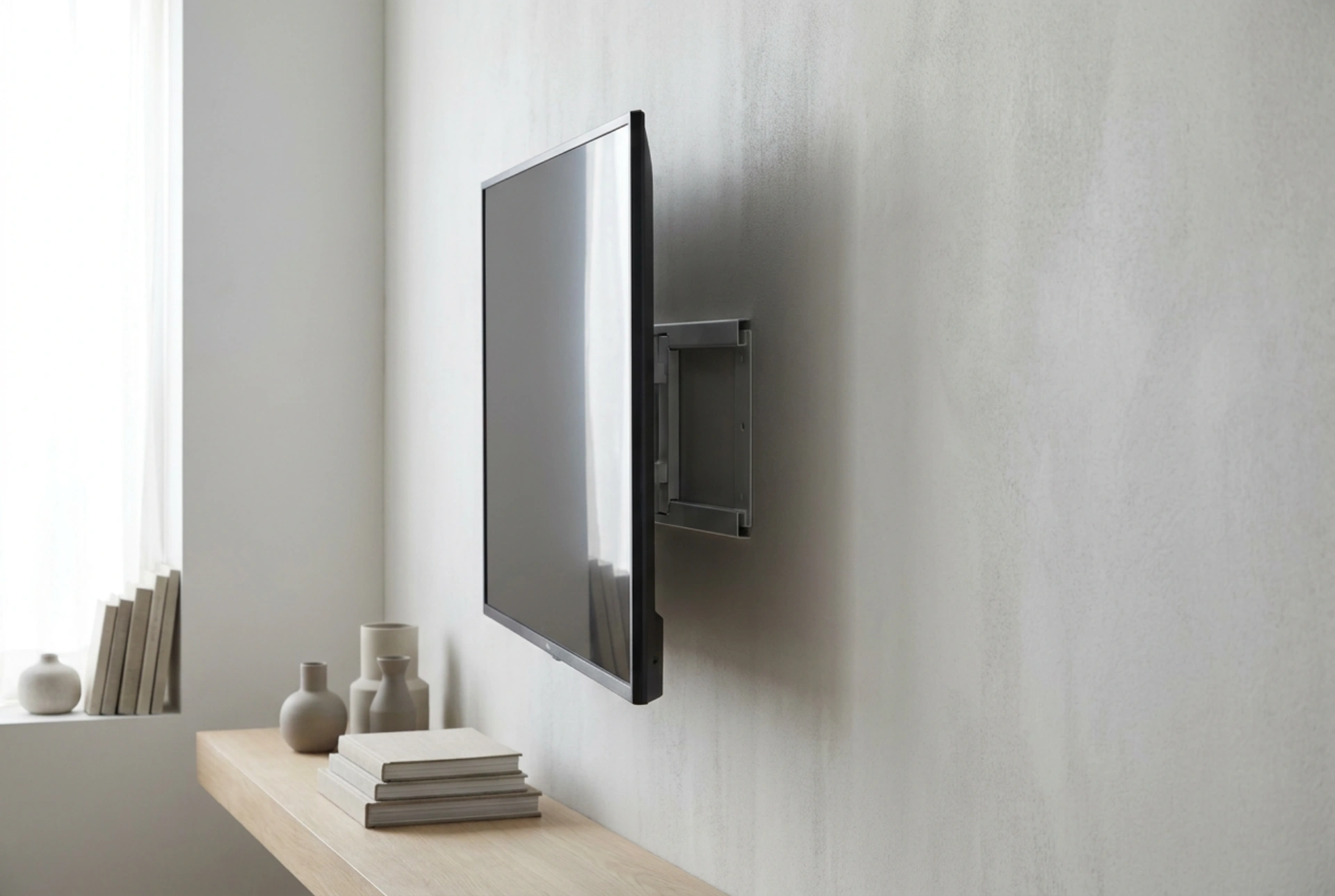
- Tilting Mounts: These allow vertical angular adjustment to eliminate glare or accommodate higher placements. By moving the screen slightly away from the wall to allow rotation, they introduce a small lever arm, marginally increasing the pull-out force on the top fasteners.
- Full-Motion (Articulating) Mounts: These brackets use extendable arms to allow lateral rotation and extension. When an articulating arm is fully extended, it acts as a powerful lever. The weight of the TV at the end of the arm multiplies the tension force acting on the upper wall anchors. If a TV weighs 20 kg and is extended 50 cm away from the wall, it exerts significantly more torque on the wall attachment points than when folded flat. Consequently, articulating mounts require exceptionally secure anchoring.
Wall Materials and Anchor Mechanics
The limiting factor of any installation is rarely the metal bracket itself; it is the wall substrate behind it. Different materials react uniquely to tension and shear forces, requiring specific fastening strategies.
Solid Masonry and Concrete
Concrete, solid brick, and stone offer excellent load-bearing capacity. For these surfaces, standard plastic or nylon expansion plugs are highly effective. When a screw is driven into the plug, it forces the polymer to expand against the walls of the drilled hole, generating immense friction. For heavy displays on concrete walls, steel sleeve anchors or concrete screws provide even greater mechanical interlock.
Timber Stud Walls
In modern drywall constructions, the plasterboard itself cannot reliably support the weight of a television, especially under the dynamic load of an articulating arm. Brackets must be fastened directly into the vertical timber studs behind the plasterboard. This requires a stud finder to locate the center of the wooden joist. Heavy-duty lag screws (wood screws with hexagonal heads) are threaded directly into the timber, transferring the shear and tension forces deep into the building’s structural framework.
Drywall and Hollow Cavity Walls
If mounting into a stud is impossible, and you must mount directly to plasterboard, you must use specialized hollow-wall anchors such as spring toggles or metal cavity dowels. These anchors pass through a pre-drilled hole and expand behind the drywall panel, distributing the load over a wider surface area. However, because plasterboard has low shear resistance, this method should strictly be reserved for lightweight displays and low-profile fixed mounts. Articulating brackets should never be mounted directly onto unsupported drywall.
Ancillary Considerations: Heat and Clearance
Modern televisions generate heat from their internal processors and LED backlights. A mount that sits too close to the wall can restrict airflow, causing thermal buildup that shortens the lifespan of the electronics. Ensure there is a minimum clearance of 20 to 30 millimetres to facilitate natural convective cooling, where cool air enters from the bottom and warm air escapes from the top.