

Integrating an oversized wall clock into a living space requires a careful balancing of spatial proportions, visual weight, and structural alignment to avoid overwhelming the room. Success lies in understanding how the human eye perceives scale, negative space, and focal points within an interior.
The Physics of Visual Weight and Scale
When selecting a large wall clock, the actual physical diameter is only one part of the equation; visual weight plays an equally critical role. Visual weight refers to how heavy an object appears to the eye based on its design, material density, and color. A solid black metal clock with a thick wooden bezel appears significantly heavier than an open-dial skeleton clock of the exact same diameter. Understanding this distinction allows you to manipulate how the room feels.
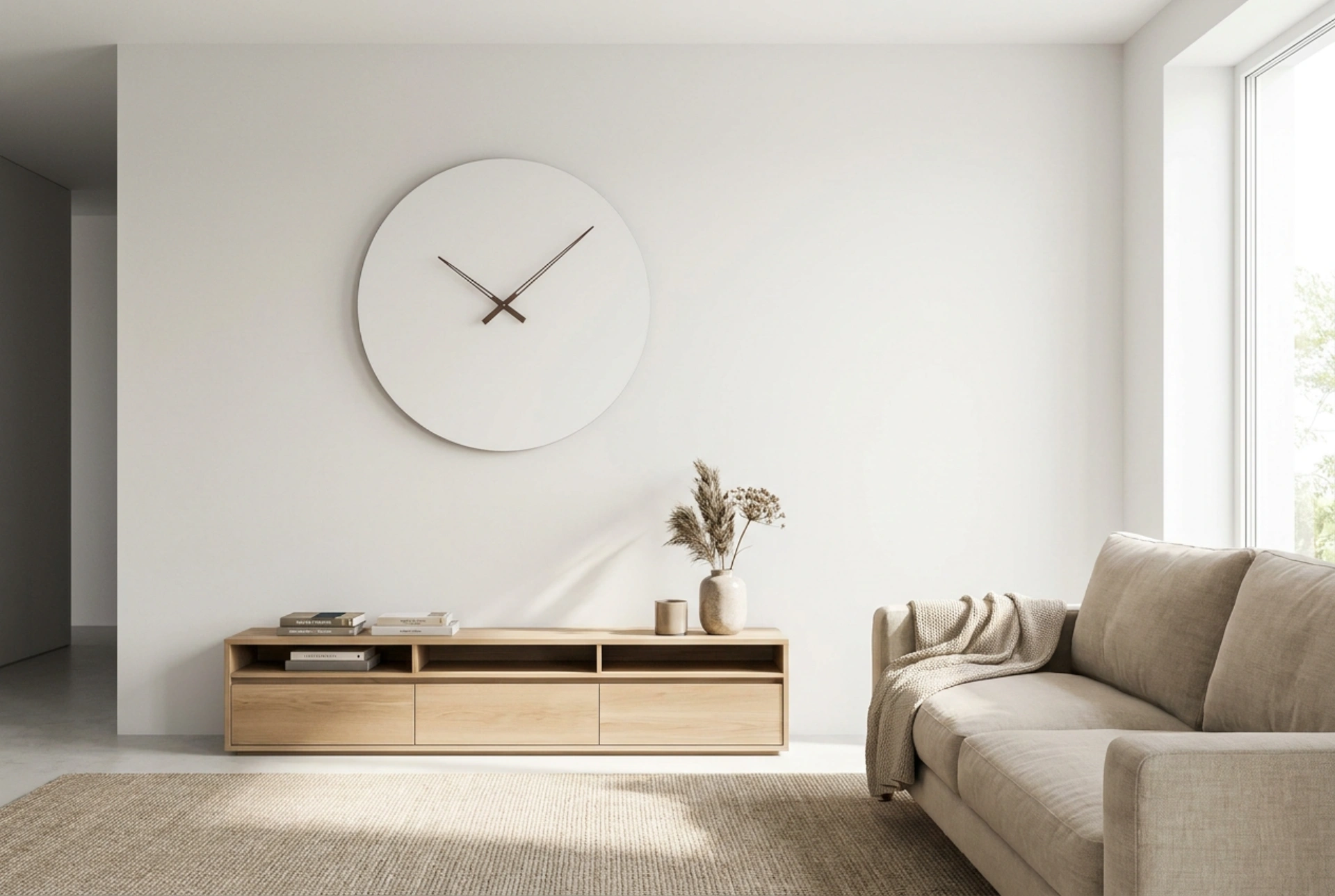
- Solid Face Clocks: These act as solid visual blocks. They are ideal for large, expansive walls that lack architectural details. The solid mass grounds the space but requires substantial negative space around it to prevent the wall from feeling compressed.
- Open-Dial or Skeleton Clocks: These models feature cut-out numerals and expose the wall behind them. Because the wall paint or wallpaper is visible through the clock, the visual weight is drastically reduced. This allows you to hang a larger diameter clock in a smaller room without suffocating the space.
The Rule of Thirds and Furniture Alignment
A common error is hanging a large clock in complete isolation without anchoring it to existing furniture. To create a harmonious composition, the clock must relate to the items below and beside it. Applying the principles of spatial scaling ensures the timepiece integrates seamlessly rather than looking like an afterthought.
When hanging a clock above a piece of furniture, such as a sideboard, console table, or sofa, aim for the clock’s diameter to measure between 50% and 60% of the width of the furniture below. For example, if your console table is 150 centimeters wide, a clock with a diameter of 75 to 90 centimeters creates a balanced, stable pyramid effect. Centering the clock precisely over the furniture piece aligns the vertical axes, satisfying the brain's natural desire for symmetry and structural order.
Calculating Hanging Height and Sightlines
The height at which a clock is mounted determines how it interacts with the room's users. Standard residential ergonomics dictate that the center of the clock should sit at average human eye level, which translates to approximately 145 to 150 centimeters from the floor. However, this rule must adapt to the primary activity in the room.
In a dining room or living room where occupants are primarily seated, the sightline drops. Positioning the clock slightly lower ensures it remains comfortable to view without causing neck strain. Conversely, in transition areas like hallways or entryways, a higher mounting point is appropriate. Additionally, you must maintain a buffer zone of at least 15 to 20 centimeters between the top of your furniture and the bottom edge of the clock to prevent a cramped, overlapping appearance.
Managing Negative Space and Room Lighting
Negative space—the empty area surrounding an object—is essential for defining the shape and importance of a large clock. Without sufficient negative space, a large clock makes a room feel cluttered and smaller than it actually is. As a rule of thumb, preserve a clear margin of at least 30 to 45 centimeters of empty wall space around the entire perimeter of the clock. This breathing room isolates the object, elevating its status to a deliberate design feature.
Furthermore, consider the physics of light within the room. A clock with a glass cover placed directly opposite a primary light source, such as a large south-facing window, will suffer from intense glare, rendering the face unreadable during peak daylight hours. To avoid this, position glazed clocks on walls perpendicular to windows, or opt for non-glare matte finishes and open-hand designs that interact gracefully with shifting natural light throughout the day.