

Selecting an indoor security camera requires a clear understanding of optical physics, data storage mechanics, and environmental limitations, rather than falling for bloated marketing feature sets. Focusing on core hardware specifications ensures reliable surveillance without unnecessary recurring costs or complex software ecosystems.
The Physics of Image Sensors: Resolution vs. Light Capture
When selecting an indoor security camera, the resolution specification is often used as a primary marketing tool. However, higher resolution does not automatically equate to clearer images. The critical factor is the relationship between the physical size of the image sensor (measured in fractions of an inch, such as 1/2.7" or 1/3") and the number of pixels packed onto it. A 4K sensor with a small physical footprint has microscopic pixels that capture very few photons, leading to digital noise and graininess in low-light indoor environments. For most indoor applications, a high-quality 1080p (2 Megapixel) resolution paired with a larger physical sensor delivers superior clarity, lower noise, and better dynamic range than a poorly optimized 4K sensor. This is because larger pixels collect more physical light, which is crucial in typical indoor lighting conditions where natural light is limited.
Storage Mechanics: Local MicroSD vs. Cloud Infrastructure
How a camera handles data storage dictates its long-term reliability and cost-efficiency. Local storage using high-endurance microSD cards (specifically those utilizing multi-level cell or MLC flash memory) is highly efficient. These cards are engineered to withstand continuous write-and-overwrite cycles, which are common in security applications. When selecting a camera, look for local storage capabilities that support continuous recording without a subscription. Local storage bypasses the latency, internet bandwidth consumption, and security vulnerabilities associated with cloud-only systems. Cloud storage often recompresses the video stream using aggressive codecs, which can degrade vital details like facial features in fast-moving sequences. Utilizing local H.265 compression protocols allows the camera to compress video file sizes by up to 50% compared to older H.264 standards, preserving precious card space without compromising optical fidelity.
Optical Engineering: Field of View and Lens Distortion
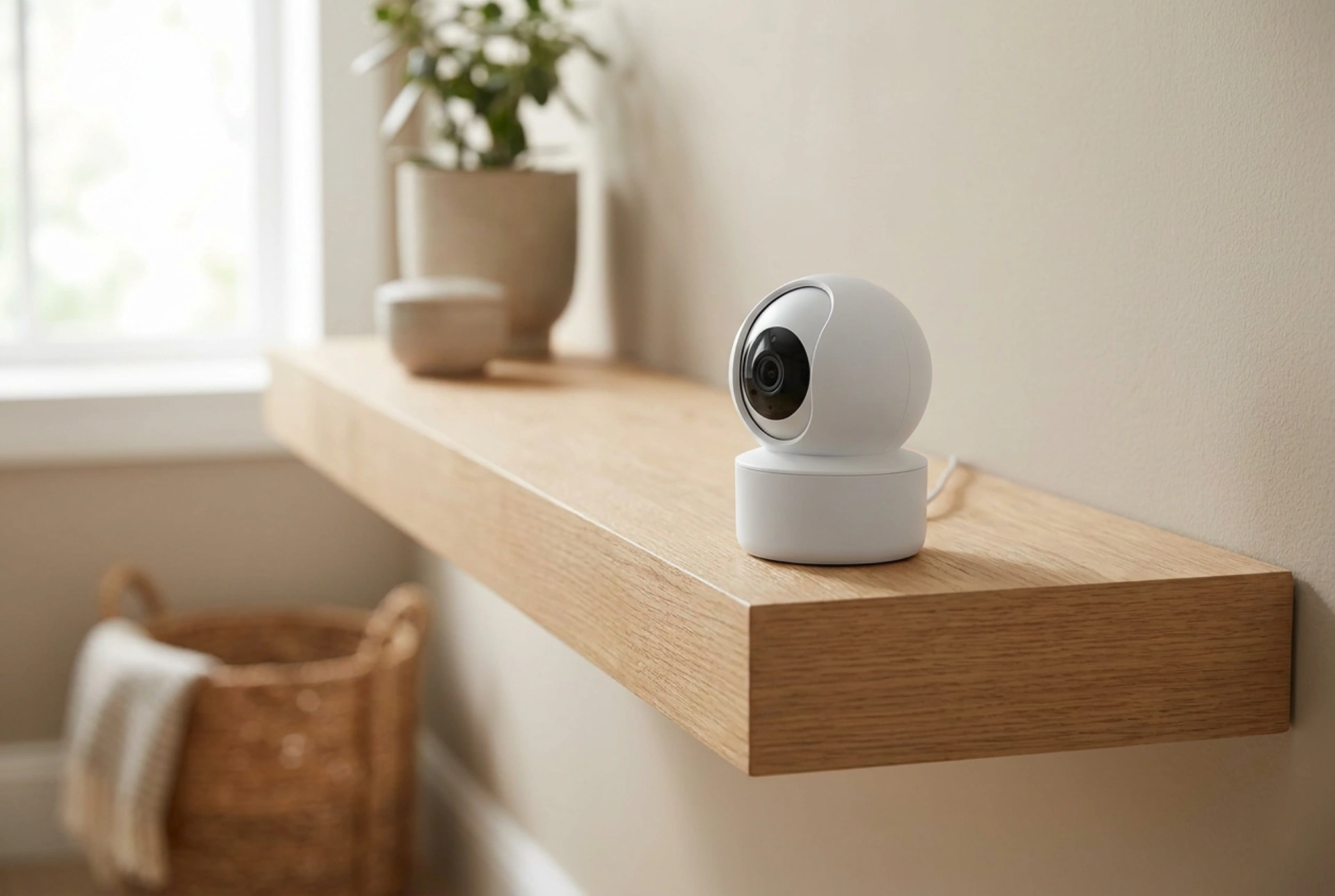
The focal length of the camera lens determines its field of view (FoV). A shorter focal length, such as 2.8mm, provides a wide-angle view of approximately 110 to 130 degrees, which is ideal for monitoring entire rooms from a single corner. However, wider angles introduce geometric barrel distortion, where straight lines appear curved near the edges of the frame. To avoid buying complex, mechanically vulnerable pan-and-tilt motorized cameras, strategically place a fixed wide-angle camera at an elevated corner. This utilizes the natural geometry of the room to cover maximum area with zero moving parts. Eliminating motors reduces mechanical wear, power consumption, and potential points of hardware failure. Additionally, fixed lenses maintain a consistent focus range, preventing the camera autofocus from hunting and blurring the image when dust or insects pass close to the lens.
Infrared Spectrum and Reflective Limitations
Indoor night vision relies on light-emitting diodes (LEDs) operating in the infrared (IR) spectrum, typically at wavelengths of 850nm or 940nm. The 850nm LEDs produce a faint, visible red glow but offer greater range and sensitivity for the camera's sensor. Conversely, 940nm LEDs are completely invisible to the human eye but have a shorter effective range. A critical physical limitation of IR night vision is reflection: if a camera is placed behind a glass pane pointing outside, the IR light will reflect off the glass directly back into the lens, blinding the sensor. For indoor spaces, ensure the camera allows you to disable the physical IR LEDs manually if you plan to rely on ambient low-light sources or external street lighting. This manual override prevents light washouts and maintains image usability in mixed lighting conditions.
Power Delivery: Battery-Powered vs. Constant Mains Supply
The choice of power delivery directly impacts the camera's operational capabilities and duty cycle. Battery-powered cameras are designed to remain in a low-power sleep state, waking up only when triggered by passive infrared (PIR) motion sensors. While convenient for wire-free installation, this mechanism introduces a critical wake-up latency, often missing the first few seconds of an event. Furthermore, in high-traffic indoor environments, frequent wake-ups drain the battery rapidly, degrading its chemical capacity over time. A mains-powered camera (utilizing a standard USB or low-voltage DC connection) allows for true 24/7 continuous video recording (CVR). This constant power supply allows the camera to run advanced, real-time edge detection algorithms directly on the device's processor without power conservation constraints.
Essential Hardware Selection Checklist
- Sensor Size: Opt for a larger sensor (e.g., 1/2.7" or 1/3") over sheer pixel count to ensure strong low-light performance.
- Local Storage: Verify the presence of a physical microSD slot supporting high-endurance, MLC-based cards.
- Compression Standard: Ensure the device supports H.265 compression to maximize local storage efficiency.
- Power Source: Prioritise continuous mains power (USB/DC) over batteries to enable continuous recording and zero latency.
- Aperture Rating: Look for a lens with a wide aperture (e.g., f/2.0 or lower) to allow more physical light to reach the sensor.