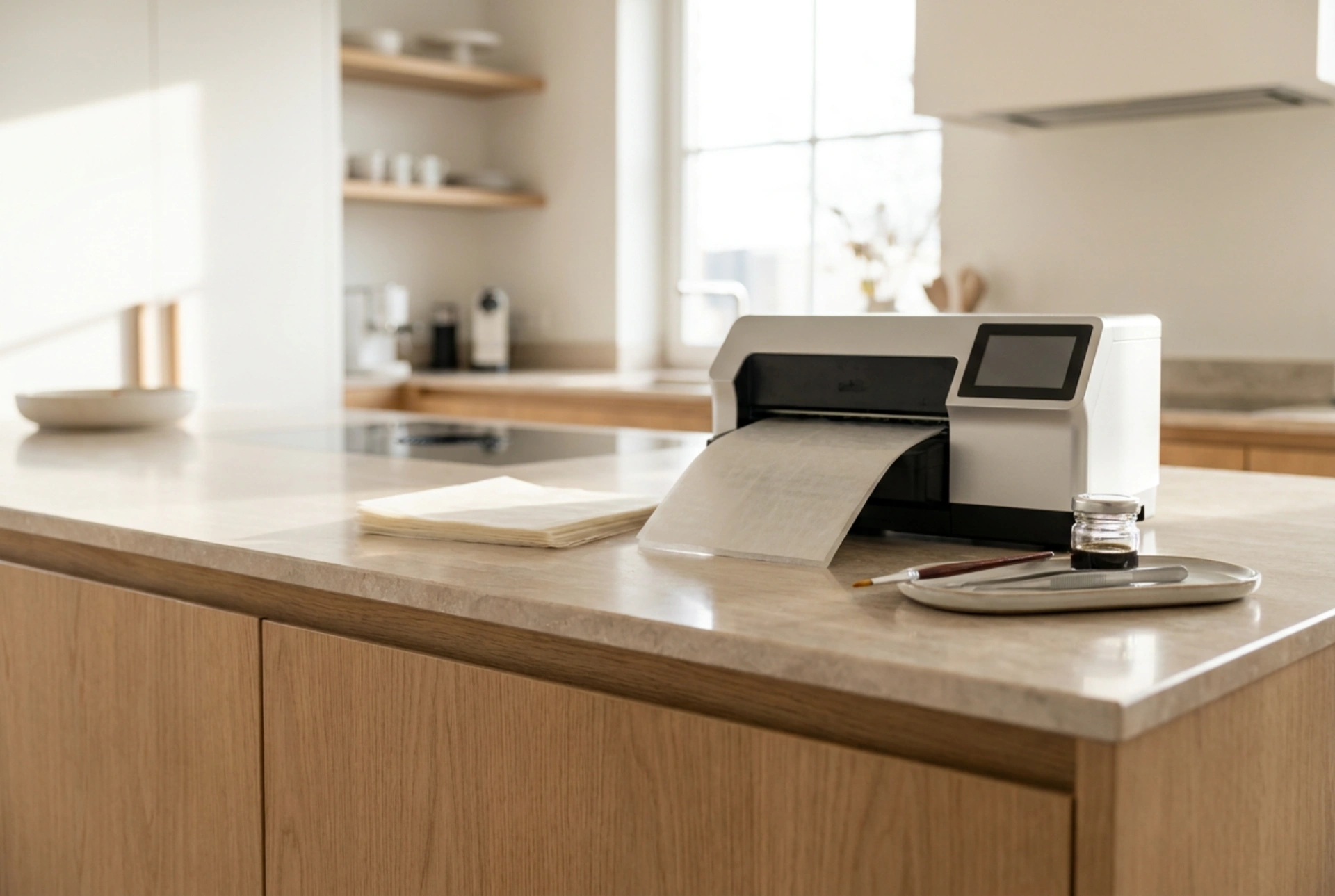


Operating an edible paper printer at home requires a precise understanding of material science, particularly how starch-based papers interact with moisture and how food-grade inks behave under pressure. Mastering this culinary printing technique relies on strict maintenance protocols and a clear grasp of humidity control to prevent printhead clogging and paper warping.
The Chemistry of Edible Mediums: Wafer vs. Icing Sheets
Before printing, you must select the correct edible medium based on its chemical properties. The two most common substrates are wafer paper and frosting sheets. Wafer paper is composed primarily of potato starch, water, and vegetable oil. It is highly hygroscopic, meaning it readily absorbs moisture from the surrounding environment. Because of its rigidity and low elasticity, it behaves similarly to traditional paper but is prone to curling when exposed to uneven humidity. Frosting sheets are thin layers of sugar, starch, and binders backed by a plastic carrier. They are highly flexible and yield vibrant, high-density prints because the ink pigments bind directly to the sugar molecules. However, frosting sheets are extremely temperature-sensitive; excessive heat will melt the lipid binders, causing the sheet to tear or stick to the carrier.
Edible inks are water-based solutions containing food-grade colorants and humectants such as glycerin or propylene glycol. Humectants are vital because they control the viscosity of the ink and retard water evaporation within the printhead nozzles, preventing instant drying and crystallization.
Mechanical Maintenance: Combating Ink Crystallisation
The single greatest challenge in home edible printing is nozzle clogging. Standard inkjet printers rely on fluids with low-viscosity, volatile inks. Edible inks, being rich in sugars and food dyes, have a higher viscosity and are prone to crystallization when exposed to air. If the printer remains idle for more than forty-eight hours, the water content at the nozzle tips evaporates, leaving behind solid dye residues that obstruct the microscopic channels.
To prevent this, implement a strict maintenance cycle. Run a nozzle test print at least twice a week using plain paper to keep the fluid moving through the system. If a clog occurs, do not force mechanical tools into the nozzles, as this will damage the delicate printing elements. Instead, submerge the printhead in a shallow bath of warm distilled water (approximately forty degrees Celsius). Distilled water is essential, as tap water contains minerals that form permanent scale deposits within the microfluidic channels. Allow the printhead to dry completely before reinserting it.
Environmental Controls and Feed Mechanics
The physical properties of starch and sugar sheets make them highly sensitive to ambient humidity. The ideal printing environment should be maintained at a relative humidity of forty to fifty percent. If the room is too dry, wafer paper loses its plasticising water molecules, becoming highly brittle and prone to cracking as it passes through the rollers. Conversely, excessive humidity causes the sheets to absorb water, expanding the starch fibers and leading to paper jams or ink smudging.
When feeding edible sheets, always handle them by the edges to prevent oils from your skin from transferring to the surface, which would create hydrophobic patches where the water-based ink cannot adhere. Feed the sheets one at a time through the manual bypass tray. This direct path minimises the bending angle, preventing the starch matrix of wafer paper from fracturing.
Application Physics: Preventing Moisture Dissolution
Applying the printed sheet to the cake is a process governed by moisture diffusion. Edible prints must never be placed directly onto highly hydrous surfaces, such as whipped cream. The high water activity in these toppings will cause water molecules to migrate rapidly into the starch or sugar sheet. This triggers rapid gelatinisation of the starch, causing the image to dissolve, bleed, and wrinkle within minutes.
To achieve a stable, long-lasting application, you must introduce a hydrophobic barrier or use low-moisture frostings. Anhydrous options, such as chocolate ganache or dense Swiss meringue buttercream, are ideal substrates. If you must apply the print to a moist surface, brush a microscopic layer of melted cocoa butter or vegetable shortening onto the reverse side of the printed sheet before application. This barrier prevents moisture from penetrating the print, preserving the resolution and structural integrity of your design.