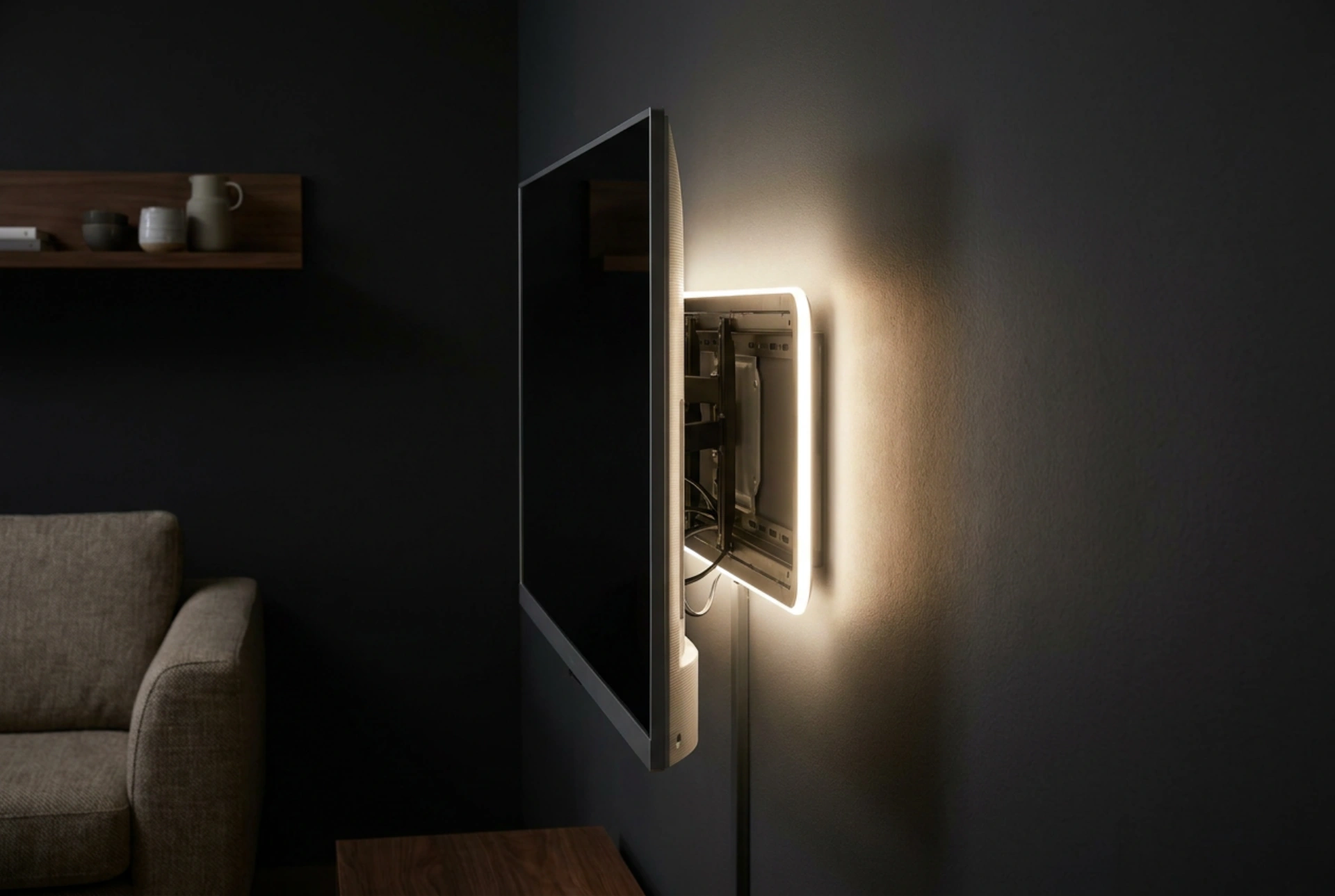


Positioning ambient LED lighting behind a television screen, known as bias lighting, reduces eye strain by stabilizing the pupillary light reflex in dark viewing environments.
The Biological Mechanism of Eye Fatigue
When viewing a bright display in a completely dark room, your eyes are subjected to a phenomenon called transient adaptation. The human pupil constantly adjusts its aperture based on the average luminance of the entire field of vision. A small, intense light source like a television screen surrounded by absolute darkness forces the iris to dilate to capture more light from the dark room, while simultaneously attempting to constrict to process the intense brightness coming from the screen. This continuous physical conflict fatigues the intraocular muscles, specifically the sphincter pupillae and the dilator pupillae, leading to headaches, dry eyes, and blurred vision. Introducing a consistent background light source resolves this conflict by raising the baseline ambient luminance, allowing the pupil to maintain a stable, mid-range state of constriction.
The Science of Color Temperature: Why D65 Matters
To ensure visual comfort and color accuracy, the background light must adhere to a specific spectral power distribution. In video production and display calibration, the standard white point is defined as D65, which corresponds to a color temperature of approximately 6500 Kelvin. Using an LED strip that matches this color temperature is crucial. If the bias light is too warm (for example, 2700 Kelvin, which is common in domestic halogen lamps), the brain adapts to this yellowish background. Consequently, the colors on the television screen will perceive as unnaturally cool and blue-tinted. Conversely, a background light that is too cool (above 7000 Kelvin) makes the screen appear dull and unnaturally warm. A true D65 light source maintains the neutral grey adaptation of your visual cortex, ensuring that colors are perceived exactly as the content creators intended.
Optimizing Light Diffusion and Wall Mechanics
The physical environment behind the screen plays an active role in how the light behaves. For optimal diffusion, the wall behind the television should ideally be painted a neutral matte gray or flat white. Highly reflective, glossy, or vibrant saturated walls will distort the color of the reflected light and create specular highlights that distract the eye. The television should be positioned roughly 10 to 25 centimeters away from the wall. This distance allows the light emitted from the rear-mounted LED strips to spread and overlap, creating a smooth gradient halo rather than harsh, distinct points of light. To achieve an even distribution, run the LED strip in a complete loop around the perimeter of the television frame, maintaining a consistent distance of about 5 to 10 centimeters from the outer edges.
Calibrating the Ideal Brightness Levels
Achieving the correct luminance is a precise process of optical balance. The brightness of the bias light should never exceed the perceived brightness of the television screen itself. Technically, the ambient light reflecting off the wall should be calibrated to approximately 10% of the peak white output of the television display. An easy manual calibration technique involves displaying a solid white or light-gray pattern on the screen and adjusting the LED dimmer until the wall behind the television matches the intensity of a medium-gray tone on the screen. The goal is to make the dark areas of the screen look deeper and richer without casting glaring light forward into your eyes, thereby enhancing the perceived contrast ratio of your display panel.
Operational Sequence for Setup
- Clean the rear chassis of the television thoroughly using isopropyl alcohol to remove dust and oils, ensuring a permanent bond for the adhesive backing.
- Apply the LED strips evenly, avoiding sharp bends at the corners by using flexible connectors or loop techniques.
- Power the LED controller via a USB port that cycles power with the television to automate the activation.
- Calibrate the brightness in your typical evening viewing conditions to ensure the pupil response remains balanced.