

Installing outdoor wireless security cameras requires balancing chemical energy storage, structural physics, and material science to ensure uninterrupted surveillance. Selecting the right power management system and understanding how environmental factors degrade materials are key to preventing premature device failure.
The Chemistry of Battery Power in Extreme Temperatures
Most wireless outdoor cameras rely on lithium-ion battery chemistry due to its high energy density. However, low winter temperatures present a significant chemical hurdle. As ambient temperatures drop below freezing, the viscosity of the liquid electrolyte inside the battery increases. This slows down the movement of lithium ions between the anode and the cathode, drastically increasing internal resistance. Consequently, the battery suffers a temporary loss in capacity and cannot deliver the necessary voltage, leading to rapid drainage or sudden shutdown.
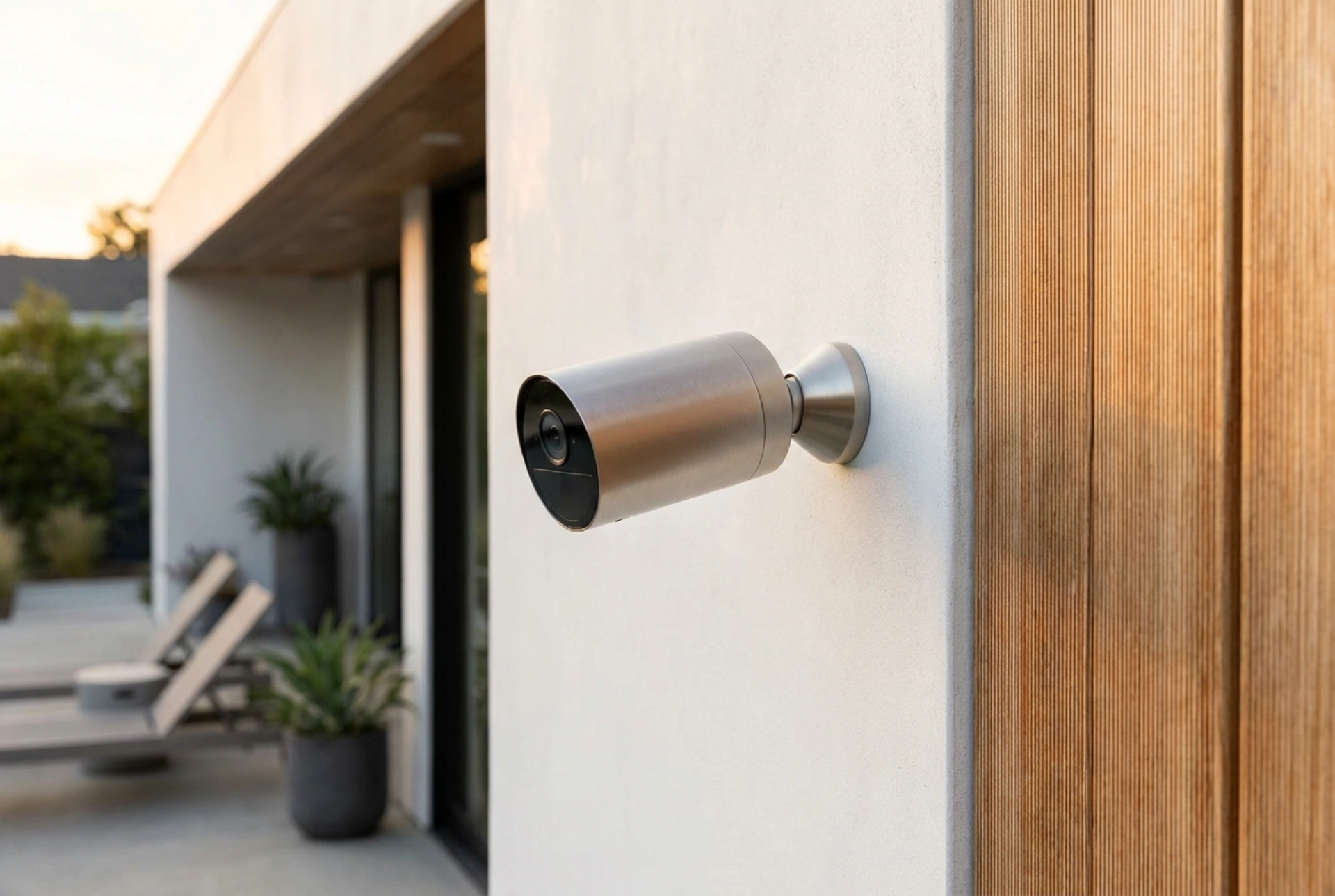
To mitigate this chemical bottleneck, choose cameras that utilise lithium iron phosphate cells or batteries rated specifically for sub-zero operation. When mounting, leverage thermal mass by securing the camera to structural elements that retain heat, such as brick or concrete walls, rather than exposed wooden posts. Furthermore, configure the device firmware to limit high-power functions like continuous infrared night vision or unnecessary motion-triggered floodlights during freezing nights to lower the current draw.
Optimising Solar Power and Energy Budgets
Integrating a small photovoltaic solar panel provides a continuous trickle-charge to the battery, but its efficiency depends entirely on physics and geometry. Solar panels generate electricity when photons knock electrons free from silicon atoms. The rate of this photoelectric effect depends on the angle of incidence. For maximum year-round energy capture, the panel must be angled relative to your latitude, typically your latitude plus fifteen degrees in winter to capture the lower sun.
Dust, pollen, and water spots create a physical barrier that scatters light and reduces efficiency. To prevent this, mount panels at an angle of at least fifteen degrees to allow rainwater to wash away particulate matter naturally. Additionally, ensure the connection point between the solar panel cable and the camera body uses a vulcanised silicone gasket to prevent capillary action from drawing moisture into the charging port.
Understanding Ingress Protection and Material Durability
Outdoor hardware must withstand dust, rain, and UV radiation. The Ingress Protection rating defines this resilience. An IP65 rating means the camera is completely dust-tight and protected against low-pressure water jets from any angle. IP66 offers protection against high-pressure water jets, which is vital in areas exposed to driving rain and heavy winds.
Beyond water ingress, solar radiation poses a threat to the camera housing. Standard plastics like ABS degrade under ultraviolet light, which breaks down polymer chains, causing the plastic to become brittle and crack. High-quality outdoor enclosures use UV-stabilised polycarbonate or powder-coated aluminium. For sealing, synthetic rubber gaskets made of ethylene propylene diene monomer are superior to standard silicone, as they offer exceptional resistance to ozone degradation and thermal expansion cycles.
Signal Attenuation and Mounting Physics
A wireless camera is only as reliable as its data link. High-frequency radio waves suffer from attenuation when passing through building materials. Solid brick, concrete, and double-glazed low-emissivity glass severely degrade the signal, while metal foil-backed insulation acts as a shield. To ensure a stable connection, mount the camera close to window panes without low-emissivity coatings, or install a dedicated external access point.
When physically mounting the unit, always create a drip loop on any external cabling. This involves curving the cable downward before it enters the camera body or the wall, forcing gravity to pull rainwater to the bottom of the loop where it drips harmlessly away, rather than running along the cable directly into the electrical connections.