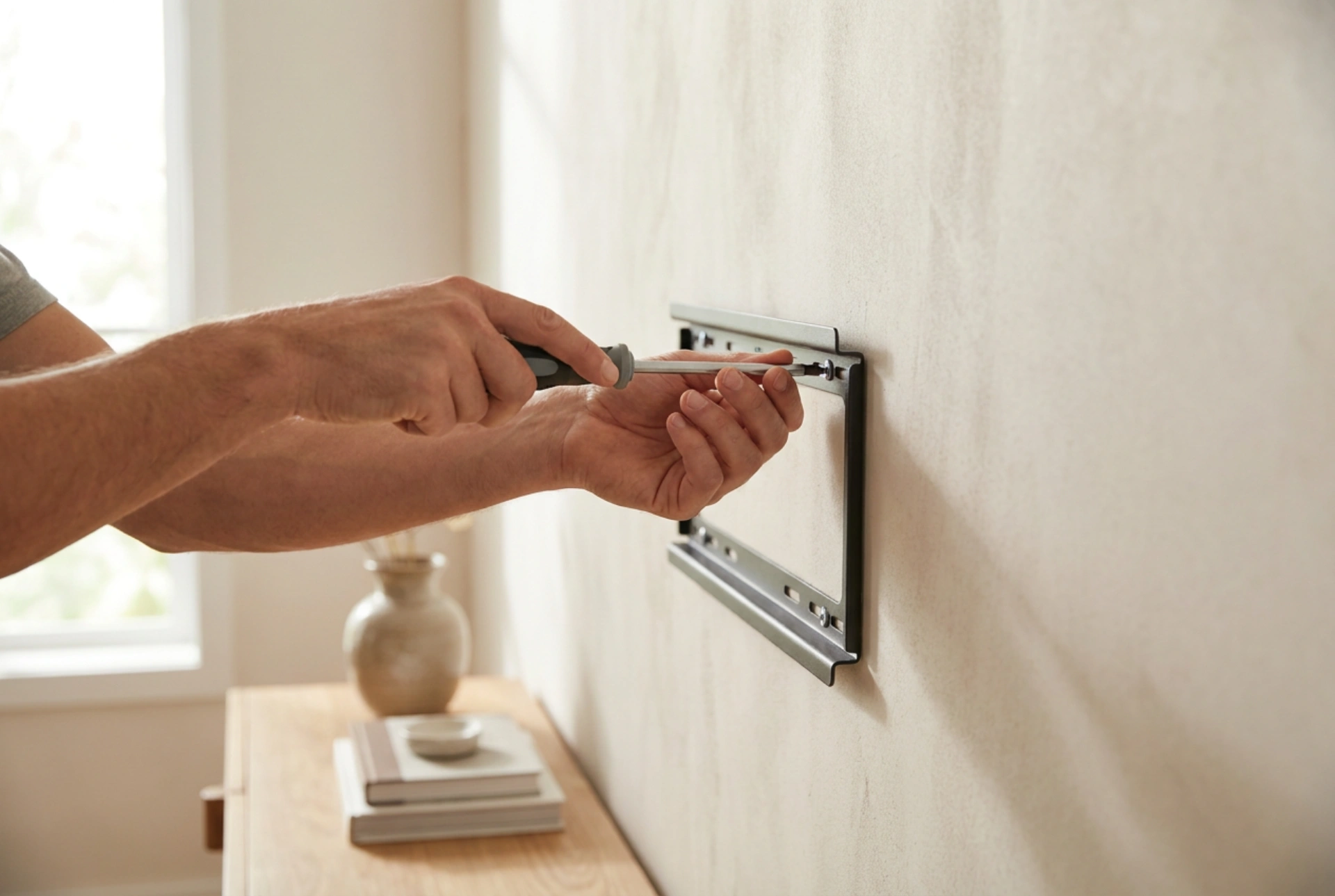


Mounting a flat-screen television on a wall is more than an aesthetic choice; it is a structural engineering task that requires balancing gravitational pull and shear forces against the load-bearing capacity of your specific wall material.
Understanding the Forces: Shear vs. Tension
When you attach a TV bracket to a wall, the assembly is subjected to two primary physical forces: shear force and tension. Shear force acts parallel to the wall, pulling the mount downwards due to gravity. Tension acts perpendicular to the wall, pulling the top anchors outward. This outward leverage increases significantly with articulated or full-motion cantilever mounts, which extend the television’s centre of gravity away from the wall. The choice of wall anchor and screw gauge must directly counteract these specific forces based on the density and cohesion of the wall material.
Solid Concrete and Brick Walls: Maximising Friction
Solid masonry walls, such as those made of concrete, dense brick, or stone, offer high load-bearing capacity but require specific mechanical anchors to secure a mount. In these materials, nylon expansion plugs or sleeve anchors are the standard. When a screw is driven into a nylon plug, it forces the plastic outward against the inner walls of the pre-drilled hole, creating immense friction. For heavy setups, concrete screws that cut threads directly into the masonry provide superior hold without creating expansion stress, which is crucial near wall edges. Always use a rotary hammer drill with a masonry bit matching the plug’s diameter precisely to prevent wobbling and subsequent anchor failure.
Drywall and Timber Studs: Finding the Structural Core
Drywall (plasterboard) alone possesses very low cohesive strength and cannot support the weight of a television under tension or shear. Therefore, the mount must be anchored directly into the underlying timber studs. Timber studs provide a solid, fibrous medium where wood screws can bite and hold securely. If a stud cannot be aligned with the bracket’s mounting holes, specialised hollow wall anchors, such as metal toggle bolts, must be used. Toggle bolts distribute the load over a wider surface area behind the drywall board by utilizing a spring-loaded wing mechanism. However, for full-motion mounts, stud mounting is non-negotiable, as the constant movement creates dynamic loads that will quickly degrade drywall-only anchoring points.
Aerated Concrete and Hollow Brick: Mechanical Interlocking
Modern buildings often feature lightweight aerated concrete blocks (breeze blocks) or hollow clay bricks. These materials present a challenge: they lack the dense core of standard concrete and contain large air pockets. Standard expansion plugs will fail because there is insufficient material to compress against. Instead, use universal or injection anchors. For hollow bricks, a mesh sleeve is inserted, filled with a two-part chemical resin, and then the threaded stud is pressed in. The resin flows into the brick's cavities, hardening into a solid mass that mechanically interlocks with the brick structure, distributing the load across a large internal surface area.
The Physics of Installation: Precision and Torque
Successful installation relies on strict adherence to a precise order of operations. First, use a reliable stud finder and bubble level to map the mounting zone; even a tiny deviation from horizontal will translate to a noticeable slant at the screen's edge. When drilling pilot holes, match the drill bit diameter exactly to the core diameter of the screw (excluding the threads) for wood, or to the outer diameter of the plug for masonry. Avoid overtightening the screws. Excessive torque can strip the threads in timber studs, crack nylon expansion plugs, or crush the gypsum core of drywall, instantly neutralizing the structural integrity of the anchor.