

Selecting a kitchen wall clock requires looking beyond mere aesthetics to understand how humidity, airborne grease, and temperature fluctuations affect delicate mechanical components. Choosing a truly moisture-resistant timepiece ensures long-term accuracy and prevents internal corrosion caused by the harsh culinary environment.
The Chemistry of Kitchen Humidity and Clock Mechanics
Kitchens are dynamic environments characterized by rapid changes in relative humidity and ambient temperature. When water boils, it transitions from a liquid to a gaseous state, creating steam. As this warm, moisture-laden air circulates, it naturally seeks cooler surfaces to deposit its thermal energy, resulting in condensation. If your wall clock is not properly sealed, this condensation penetrates the outer casing.
Once moisture enters the clock's movement, it initiates a series of destructive physical and chemical reactions:
- Galvanic Corrosion: Moisture acts as an electrolyte between different metals inside the battery compartment and quartz movement, leading to rapid corrosion, loss of electrical conductivity, and battery leakage.
- Dimensional Instability: Traditional clock dials made of paper, cardboard, or unprotected wood absorb airborne moisture, causing them to warp, swell, and potentially obstruct the physical sweep of the hands.
- Lubricant Degradation: Microscopic gears inside quartz movements rely on synthetic oils. High humidity and heat can emulsify these lubricants, increasing friction and causing the clock to lose time or seize completely.
Material Selection: Shells, Covers, and Backings
To withstand the daily onslaught of steam and aerosolized cooking fats, the physical components of the clock must be chemically inert and non-porous. Understanding the properties of different materials is key to making the right choice.
The Front Cover: Glass vs. Polymers
Always opt for tempered glass covers rather than acrylic or cheap plastics. Tempered glass is chemically stable, highly resistant to thermal shock, and scratch-resistant. Acrylic and other polymers tend to develop micro-scratches during cleaning, which quickly trap grease and dust, leading to a cloudy appearance. Furthermore, certain polymers can degrade and yellow when exposed to UV light and heat.
The Case: Metals and Plastics
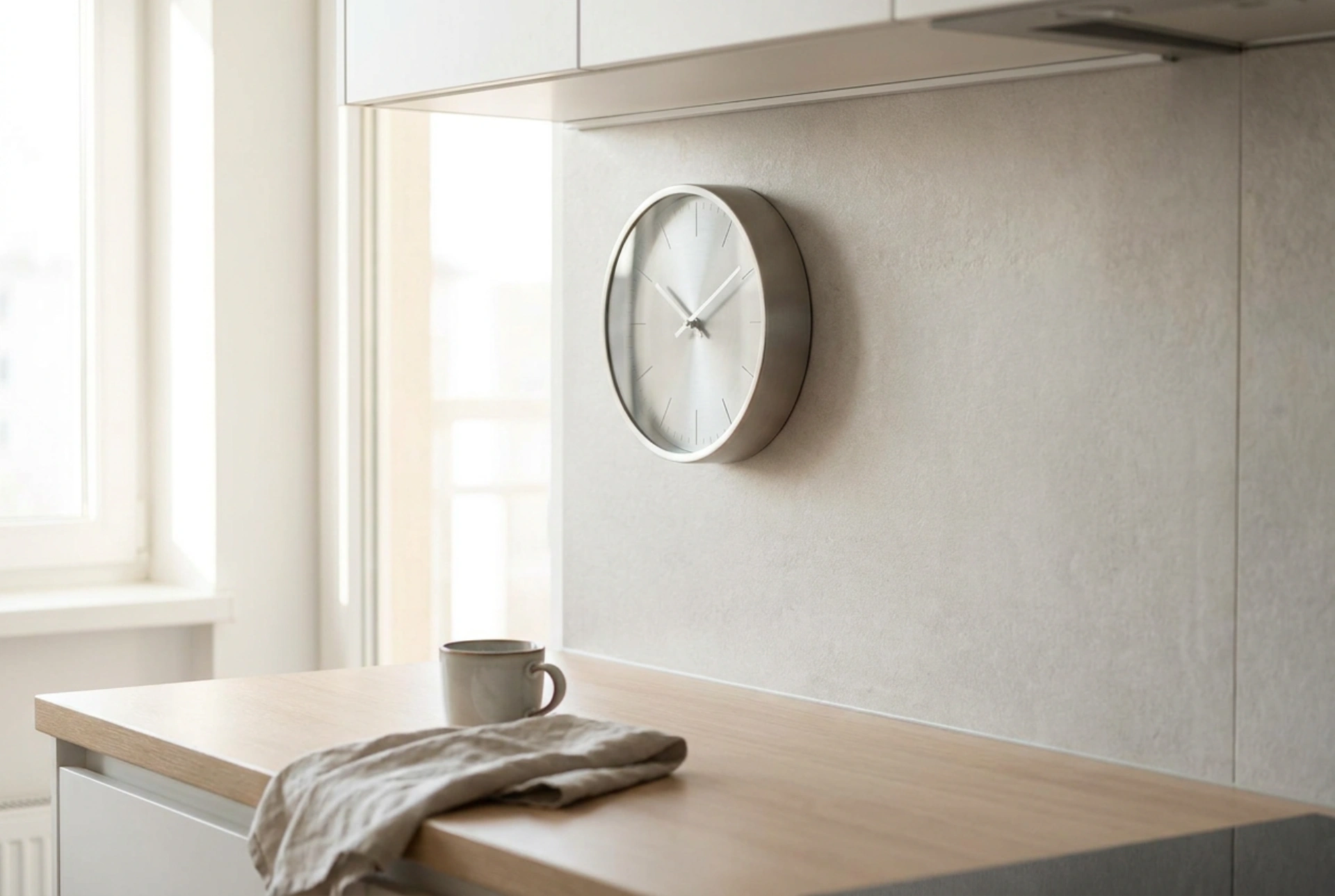
Avoid untreated ferrous metals, which are highly susceptible to oxidation. Instead, look for housings made from anodized aluminium or high-grade stainless steel. Anodized aluminium features a controlled oxide layer that prevents further corrosion, while stainless steel contains chromium, which forms a passive, self-healing film of chromium oxide to protect the underlying metal. If choosing plastic, high-impact ABS (Acrylonitrile Butadiene Styrene) is preferred for its dimensional stability and resistance to chemical cleaners.
Seals and Ingress Protection (IP) Ratings
The defining feature of a steam-resistant kitchen clock is its sealing mechanism. Standard indoor clocks rely on simple friction-fit backing plates, leaving ample space for air and moisture exchange. High-humidity environments demand a more robust barrier.
Look for clocks that feature integrated elastomeric seals, typically made of silicone or synthetic rubber. A continuous O-ring squeezed between the front glass, the housing, and the rear movement compartment prevents water vapor from penetrating. Ideally, look for clocks rated under the Ingress Protection (IP) system. While decorative clocks rarely carry high IP ratings, those rated IP44 or higher are designed to resist splashing water and micro-particles, making them perfect for kitchen installations.
Strategic Placement and Thermal Dynamics
Even the most durable moisture-resistant clock will benefit from smart physical placement. The rate of condensation is directly proportional to the temperature differential between the wall and the surrounding air.
- Avoid Thermal Hotspots: Never mount a clock directly above a cooktop, kettle station, or oven. The localized concentration of steam, heat, and airborne oils will overwhelm seals over time.
- Interior vs. Exterior Walls: Mount your clock on an interior partition wall if possible. Exterior walls are typically colder, which accelerates condensation on the clock's surface.
- Maintain Air Gap: Use small silicone bumpers on the back of the clock frame to create a small air gap between the clock and the wall. This facilitates air circulation, preventing moisture from pooling behind the unit.