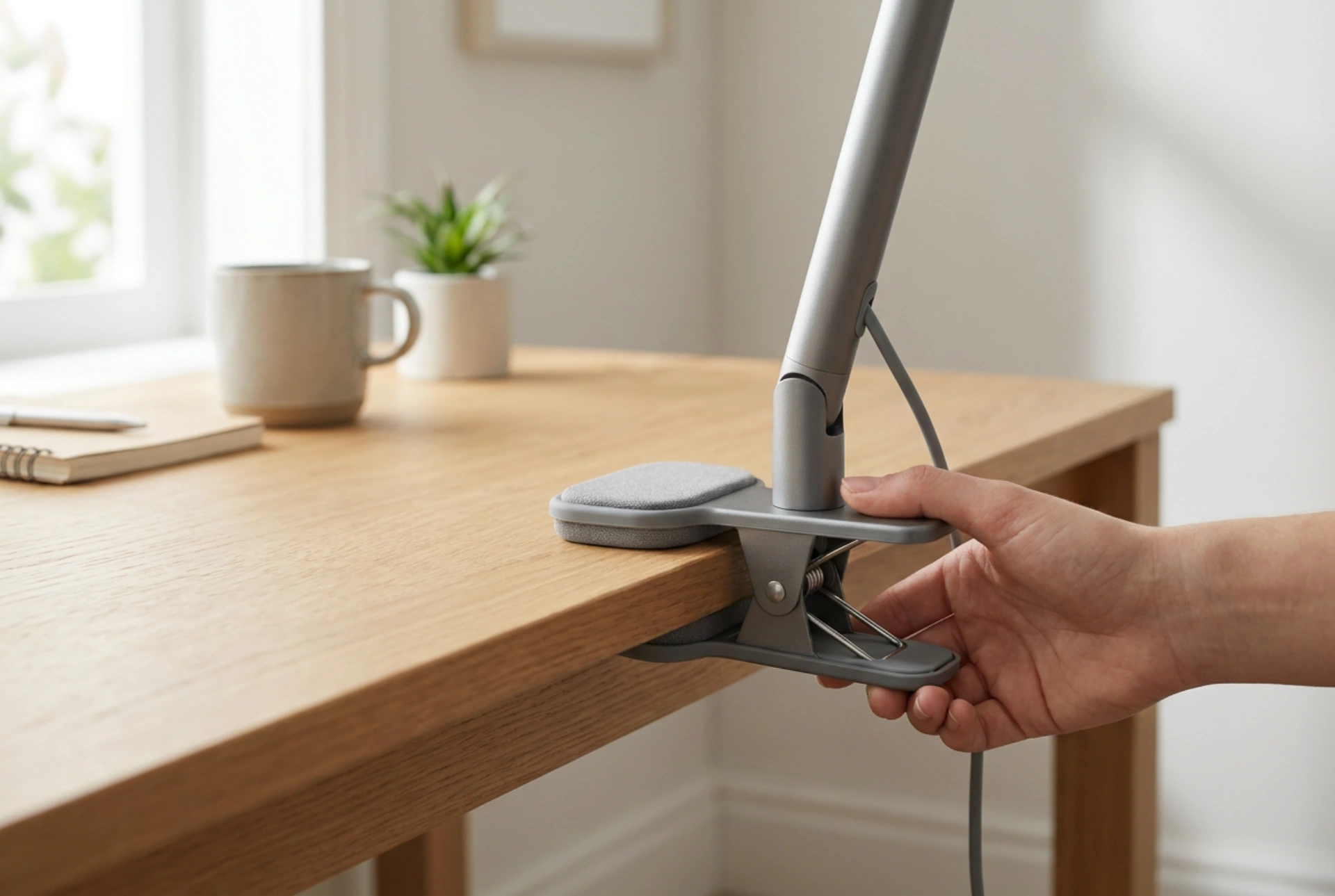


Securing a clip-on desk lamp requires more than just squeezing the spring; it depends on maximizing the static coefficient of friction and managing the gravitational torque exerted by the lamp arm.
The Physics of Clamping: Friction and Torque
A clip-on lamp remains stable when the static frictional force between the clamp pads and the mounting surface is greater than the gravitational pull acting on the lamp structure. The formula for static friction relies on two main variables: the normal force (the squeezing pressure exerted by the spring or screw mechanism) and the coefficient of friction of the contact materials. When a lamp tilts or slips, it is usually because the center of gravity of the lamp head is positioned too far from the clamping axis, creating a rotational force (torque) that overcomes the grip. To counter this, you must either increase the clamping force, use materials with a higher friction coefficient, or adjust the physical geometry of the lamp neck to reduce leverage.
Preparing the Contact Surface for Maximum Grip
Microscopic particles of dust, oils from skin contact, and polishing waxes dramatically lower the friction coefficient of wood, glass, and laminate desk edges. Before mounting your lamp, the surface must be thoroughly prepped. Clean the target area of the desk and the inner pads of the clamp using a mild degreaser or a solution of isopropyl alcohol (for non-sensitive finishes). This process removes invisible oily films, allowing the microscopic irregularities of the clamp pad to lock into the desk surface. Avoid using silicone-based polish or household cleaners that leave a wax residue, as these act as lubricants and increase the likelihood of the lamp sliding under its own weight.
Choosing and Installing High-Friction Interface Materials
Many standard clip-on lamps come with hard plastic or low-density foam pads that compress easily and lose their grip over time. Upgrading these pads is the most effective way to prevent slipping. High-density silicone rubber sheets or non-slip adhesive grip tapes are ideal interface materials due to their exceptional elastomeric properties. Under pressure, silicone deforms slightly to match the microscopic contours of both the desk and the clamp, significantly increasing the contact surface area. To install, cut small pieces of self-adhesive silicone padding or natural rubber sheet to match the dimensions of the clamp jaws, peel away the backing, and press them firmly onto the gripping pads. For highly delicate wood surfaces, dense wool felt can prevent scratching, though it offers slightly less lateral slip resistance than rubber or silicone.
Optimising Geometry and Center of Gravity
The positioning of the flexible neck or articulated arm of the lamp plays a crucial role in its stability. When the lamp head is extended far out to one side, it acts as a lever, multiplying the downward force on the opposite side of the clamp. To minimize this rotational stress, mount the clamp as close as possible to the area you need to illuminate, keeping the main support column vertical. If your lamp features a flexible gooseneck, shape it into an 'S' curve rather than a simple 'C' curve. An 'S' curve keeps the heavy lamp head directly above or closer to the vertical axis of the clamp, drastically reducing the tipping torque and keeping the normal force evenly distributed across both jaws of the clip.
Correct Attachment Techniques and Edge Alignment
When attaching the lamp, ensure that the entire surface area of the clamp jaws makes contact with the desk. Partial clamping—where the jaws hang slightly off the edge of the desk—concentrates the force on a smaller area, leading to material deformation and eventual slippage. If the desk edge is rounded or bevelled, a standard spring clamp may struggle to find a flat plane to grip. In these scenarios, you can temporarily clamp a flat, thin block of wood or dense rubber shim to the underside of the desk to create a square, parallel surface for the lamp to grip securely. Always compress the clamp fully before positioning it, and gently wiggle the mount to test its stability before releasing the spring pressure entirely.