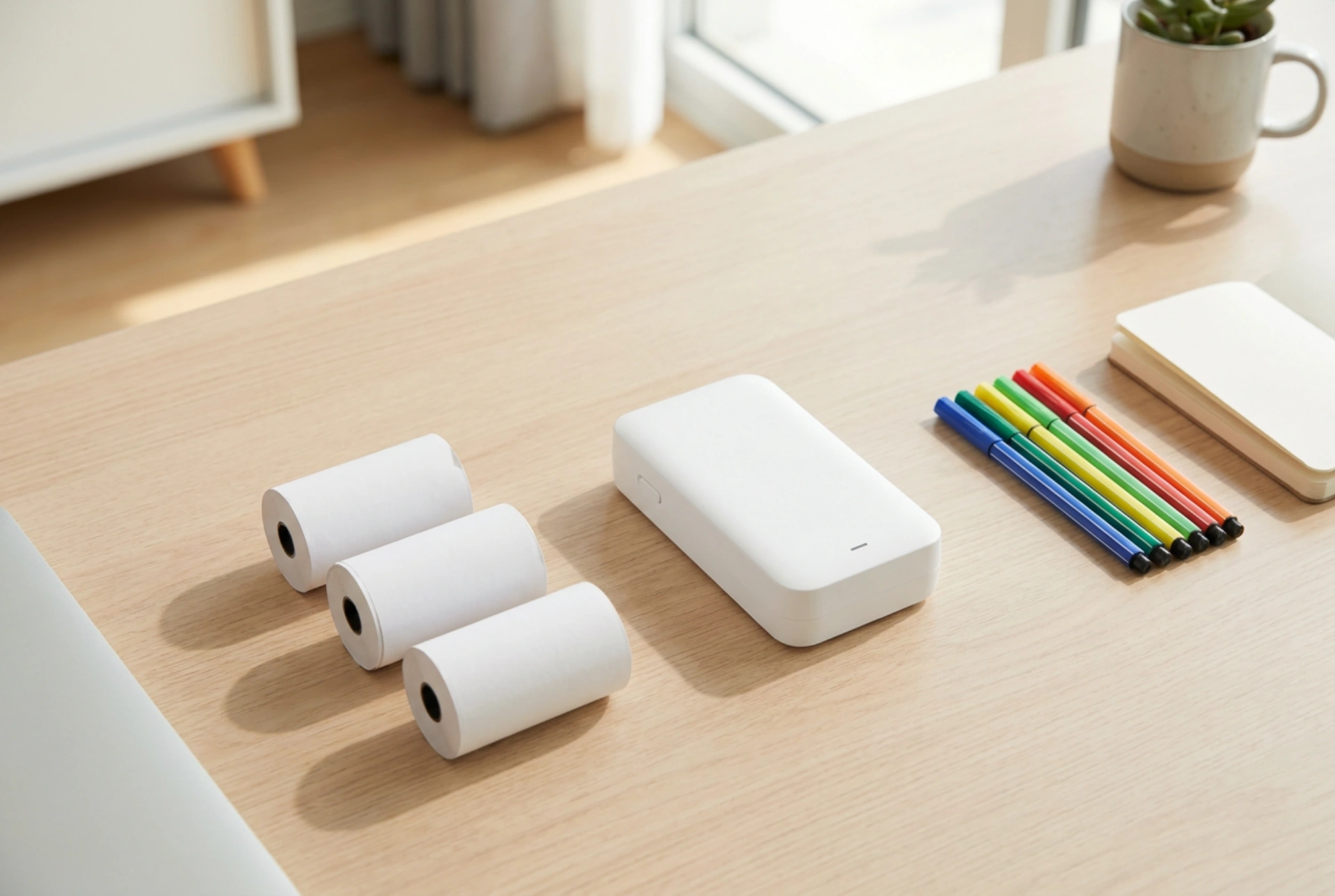


Miniature thermal printers have become a popular tool for children's creative projects, relying on localized heat transfer instead of liquid ink to render images. Understanding how thermal paper reacts to heat and handling it safely ensures a mess-free, educational, and completely secure crafting experience at home.
The Science Behind Inkless Printing
Unlike traditional inkjet printers that deposit liquid dye onto a surface, thermal printers use heat-activated paper to produce images. Inside the compact device, a micro-sized thermal print head containing tiny semiconductor resistors heats up in precise patterns. The magic happens entirely within the specialized paper coating.
Thermal paper consists of a base paper layer coated with an active mixture of a leuco dye, a developer, and a sensitizer matrix. Under normal room temperatures, these chemicals remain separated in a solid state. However, when the printer's thermal head applies heat (typically reaching between 70°C and 120°C for milliseconds), the sensitizer melts, allowing the colorless leuco dye and the acidic developer to merge. This molecular contact triggers a chemical reaction that alters the dye's molecular structure, shifting it from a transparent state to an intense, visible color—typically black or deep blue.
Selecting the Safest Materials: Understanding Phenols
When selecting paper rolls for children's activities, it is crucial to understand the chemical composition of the developer used in the thermal coating. Historically, Bisphenol A (BPA) and Bisphenol S (BPS) were widely used as color developers. Because these compounds can migrate from the paper surface onto the skin—particularly when hands are damp or oily—it is best to avoid them in environments where children play.
For safe home crafting, always opt for certified phenol-free thermal paper. These modern, family-friendly alternatives replace BPA and BPS with stable, non-hazardous organic compounds or urea-based developers. This simple material choice eliminates exposure to endocrine-disrupting chemicals while maintaining the same crisp print quality and mechanical performance.
Practical Handling and Storage Rules
Establishing straightforward habits during printing sessions keeps the activity clean and preserves the longevity of the printed creations. Implement these simple rules for handling and storage:
- Dry Hands Only: Ensure children dry their hands thoroughly before touching thermal paper. Moisture, hand creams, and natural oils can degrade the protective topcoat of the paper, leading to premature fading of the printed images.
- Keep Away from Heat Sources: Because the paper is heat-sensitive, storing prints near radiators, sunny window sills, or warm electronic devices will trigger a full-surface thermal reaction, turning the entire sheet black. Store completed projects in a cool, dry folder.
- Wash Hands After Play: As a general hygiene practice, children should wash their hands with soap and water after extended crafting sessions, reinforcing healthy habits.
Best Techniques for Colouring Thermal Prints
Many children enjoy personalizing their printed stickers and labels with color. However, thermal paper reacts sensitively to certain chemical solvents. Introducing the wrong coloring tool can dissolve the thermal layer and erase the printed image entirely.
Avoid alcohol-based markers and permanent pens. The solvent action of isopropyl alcohol breaks down the dye-developer complex, causing the black lines to bleed, blur, or fade into a pale grey. Instead, instruct children to use water-based felt-tip pens, colored pencils, or wax crayons. These mediums do not chemically react with the thermal coating, allowing kids to color their prints safely and vibrantly without ruining their hard work.