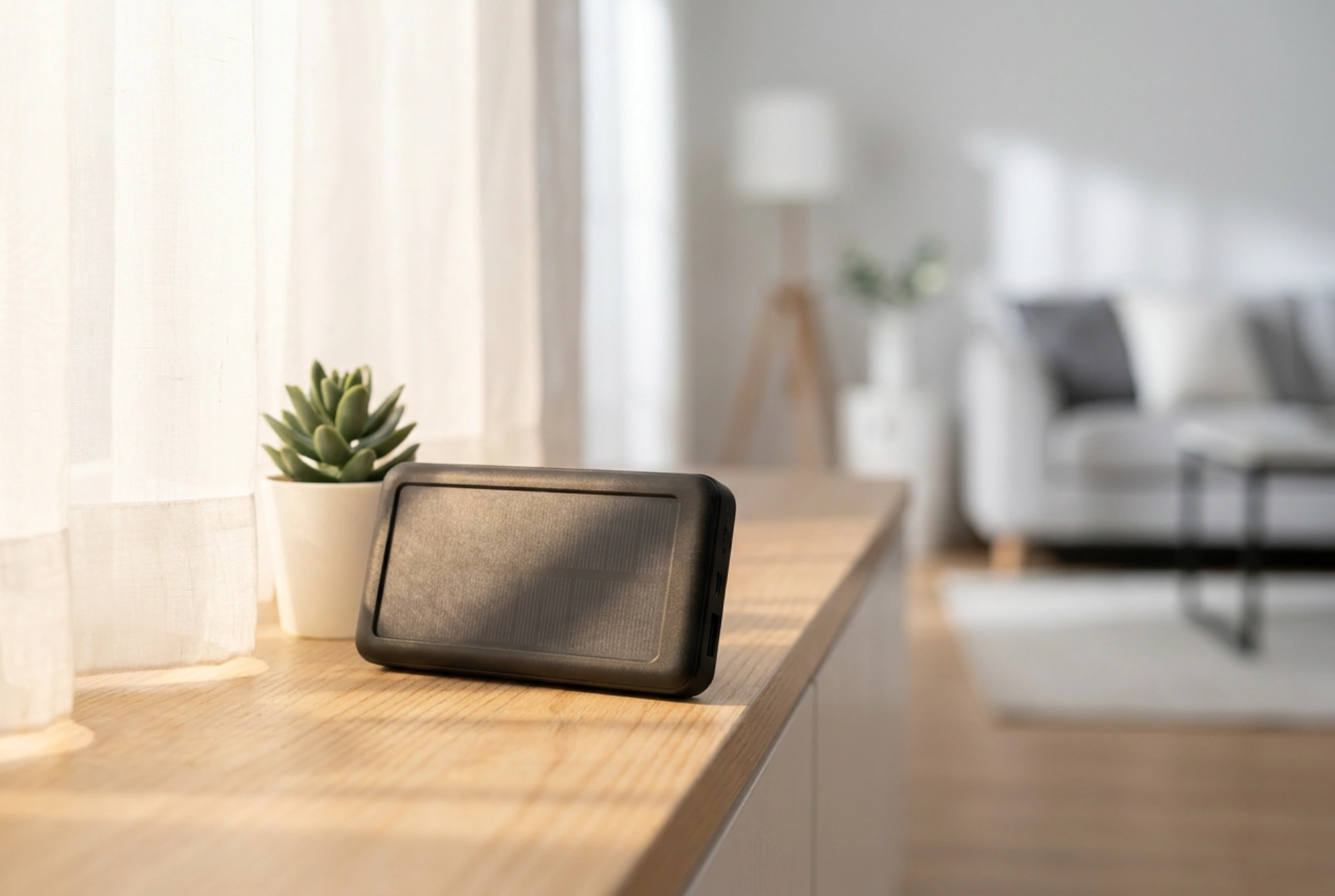


Charging a solar-powered power bank indoors may seem straightforward, but passing sunlight through window glass changes the physics of energy absorption. To get the most out of your portable solar charger inside the home, you must manage light refraction, panel angles, and battery temperature.
The Glass Barrier: How Windows Filter Solar Energy
Standard window glass is highly efficient at protecting home interiors, but it acts as a major barrier to solar panels. Modern double-glazed or triple-glazed windows often feature Low-Emissivity (Low-E) coatings designed to reflect infrared heat and block ultraviolet (UV) radiation. Since photovoltaic cells rely on specific wavelengths of light to excite electrons and generate electrical current, these protective window coatings can reduce the efficiency of your solar charger by 30% to 50% compared to direct outdoor exposure.
To mitigate this loss, identify the windows in your home that lack specialised coatings, or use older, single-pane windows if available. Additionally, even a thin layer of dust on either the windowpane or the solar panel surface will scatter incoming photons, further lowering energy conversion rates. Cleaning both surfaces with a simple mixture of distilled water and isopropyl alcohol before charging ensures maximum light transmission.
The Angle of Incidence: Aligning with the Sun
The efficiency of a photovoltaic panel depends heavily on the angle at which sunlight strikes its surface. According to the cosine law of solar radiation, energy absorption is maximised when light hits the panel at a perfect 90-degree angle (perpendicular). When light strikes at an oblique angle, the energy is spread over a larger surface area, reducing the intensity of the charge.
Because the sun’s path changes throughout the day, leaving a solar power bank flat on a horizontal windowsill is highly inefficient. Instead, use a simple prop or stand to tilt the device. For optimal year-round performance in the Northern Hemisphere, face the panel south and tilt it at an angle roughly equal to your local latitude. Adjust this angle slightly throughout the day to trace the sun's trajectory, ensuring the panel always faces the light source directly.
Thermal Management: Preventing Battery Degradation
A major challenge of charging a solar power bank on a sunny windowsill is the accumulation of heat. Portable power banks utilise lithium-ion or lithium-polymer batteries, which are highly sensitive to temperature. While the integrated solar panel requires bright sunlight, the battery pack beneath it degrades rapidly when exposed to temperatures exceeding 45°C (113°F).
The space between a window and a closed curtain can act as a greenhouse, trapping hot air and raising the device's temperature to dangerous levels. High heat not only reduces the immediate charging efficiency but can also cause irreversible capacity loss or swelling of the battery cells. To prevent thermal stress, place a small, heat-resistant barrier or shade over the battery section of the device while leaving the solar cells exposed to the light. Ensure there is adequate airflow around the unit by keeping nearby curtains open or using a small household fan to circulate air across the windowsill.
Optimising the Charging Sequence
To safely and efficiently charge your solar power bank indoors, follow this precise order of operations:
- Clean the surfaces: Wipe down both the windowsill glass and the solar panel with a microfibre cloth to remove dust, smudges, and pollen.
- Position for ventilation: Avoid placing the device directly on heat-conductive surfaces like metal windowsills. Use a wooden or cork coaster as an insulating base.
- Set the optimal angle: Prop the panel up at a 45-to-60-degree angle facing south to capture the most direct rays.
- Monitor temperature: Check the device periodically. If the casing feels hot to the touch, move it slightly back from the glass or introduce active ventilation to cool the battery cells.