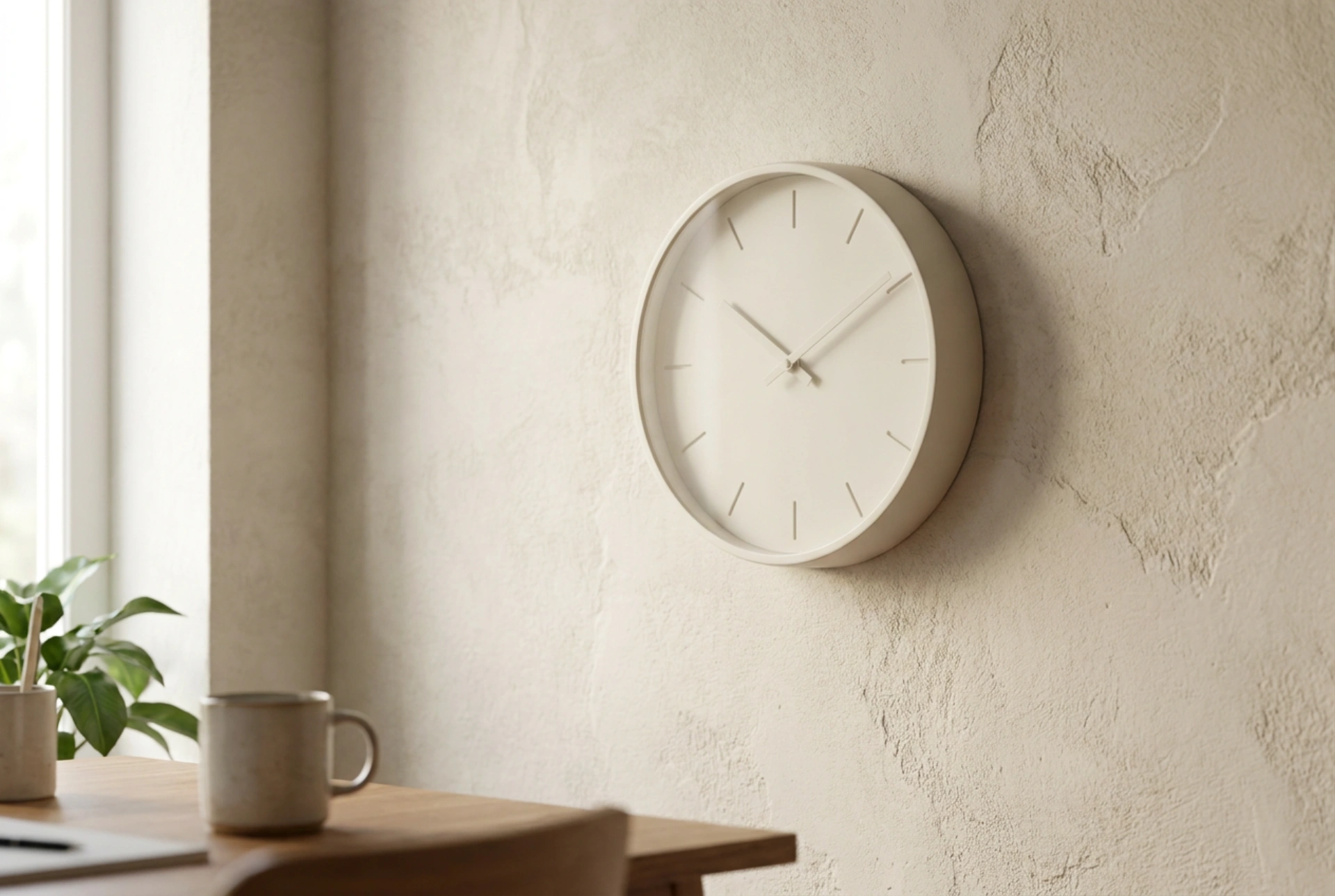


The constant, rhythmic ticking of a traditional wall clock is more than just a background sound; it is a repetitive auditory stimulus that actively competes for your brain's attention during periods of intense focus or deep sleep. Opting for a silent, sweep-movement clock removes this cognitive micro-stressor, fostering an environment optimized for neural recovery and deep concentration.
The Physics of Acoustic Disruption and Cognitive Load
Human hearing evolved as an early-warning system, designed to detect sudden changes in the environment rather than continuous, steady-state sounds. A ticking clock produces what is known as transient, intermittent noise. Unlike a continuous hum—which the brain easily filters out through a process called auditory habituation—the sharp, repetitive sound spike of a stepping clock hand resets the brain's attention mechanism every single second.
Each "tick" represents a rapid pressure wave that hits the eardrum, forcing the auditory cortex to process the stimulus. In a quiet study, this constant processing increases cognitive load. Even if you believe you have "tuned it out," your brain is actively expending metabolic energy to suppress the sound, which diminishes your working memory capacity and shortens your attention span during complex tasks.
How Ticking Disrupts Sleep Architecture
During sleep, the thalamus acts as a sensory gatekeeper, deciding which external stimuli are important enough to wake the conscious brain. While steady, low-frequency sounds can promote sleep, rhythmic, high-frequency transients like clock ticks are highly disruptive, particularly during the transition from light NREM (non-rapid eye movement) stage 1 sleep to deeper NREM stage 2 sleep.
During stage 2 sleep, the brain produces brief bursts of activity called sleep spindles, which help shield the cortex from external noises. A distinct, repeating acoustic spike can easily penetrate this barrier, causing micro-arousals. While these micro-arousals may not fully wake you up, they fragment your sleep architecture, preventing you from spending sufficient time in restorative slow-wave sleep and REM phases, leaving you feeling unrefreshed in the morning.
The Engineering of Silence: Stepping vs. Sweep Movements
To understand why traditional clocks tick, one must look at the internal mechanical movement. Standard quartz clocks utilize a stepping motor. Every second, an electronic pulse from the quartz crystal circuit drives a rotor to turn exactly 60 degrees. This rapid acceleration and sudden stop cause the plastic or brass gears to impact one another, transmitting kinetic energy through the clock casing, which acts as a miniature sounding board and amplifies the sound.
In contrast, silent clocks utilize a continuous sweep movement. Instead of stepping forward once per second, the motor runs at a much higher frequency (often several hundred times per minute), driving a train of finely pitched gears that glide smoothly without sudden starts and stops. This continuous motion distributes the mechanical energy evenly, eliminating the sharp impacts that produce the characteristic ticking sound.
Optimizing Acoustic Placement in Your Space
To maximize the benefits of a silent clock, its physical installation must also account for acoustic physics. Even a silent sweep clock can produce micro-vibrations that can be amplified depending on how and where the clock is mounted:
- Wall Material: Avoid mounting clocks directly onto hollow drywall or thin wooden panels without backing. These structures act as acoustic resonators, picking up micro-vibrations from the internal motor and amplifying them into the room. Solid brick, plaster, or concrete walls absorb these frequencies much more effectively.
- Decoupling: Use a small felt or rubber pad behind the clock body where it contacts the wall. This simple step decouples the physical housing of the clock from the wall surface, preventing the transfer of mechanical vibrations.
- Room Textures: Pair your silent clock with sound-absorbing materials in your study or bedroom, such as thick rugs, heavy drapes, or fabric-covered panels, which damp high-frequency reflections and lower the overall ambient noise floor.