

Monitoring a remote garden allotment presents unique physical challenges, primarily the absence of reliable mains electricity and local Wi-Fi networks. Implementing an effective security camera system requires a deep understanding of autonomous power systems, cellular data transmission, and low-power motion detection physics.
Powering the System: Photovoltaics and Battery Chemistry
To achieve complete energy independence, outdoor security cameras rely on a combination of photovoltaic panels and rechargeable batteries. The solar panel converts solar radiation into direct electrical current (DC) via the photovoltaic effect, which charges the internal storage cells. However, temperature fluctuations heavily influence battery chemistry.
Temperature and Ion Mobility
Standard Lithium-ion (Li-ion) batteries experience a sharp drop in ion mobility within the electrolyte when temperatures drop below freezing. This increases internal resistance and temporarily reduces the usable capacity of the battery. For optimal performance in cold climates, look for systems utilizing Lithium Iron Phosphate (LiFePO4) cells or batteries designed with integrated thermal regulation. These cells maintain a more stable voltage curve and survive more charge-discharge cycles without significant degradation.
Connectivity and Low-Power Standby States
Without a local router, communication depends entirely on cellular networks (LTE/4G). Because continuous data transmission consumes a high amount of electrical energy, autonomous cameras utilize aggressive power-management states. The camera remains in a deep sleep mode, shutting down the image sensor and high-power radio modules to conserve energy. Only a low-power microcontroller and the detection sensor remain active.
When triggered, the system wakes up, establishes a cellular handshake with the nearest base station, and transmits compressed video frames. Modern systems use highly efficient compression algorithms, such as H.265 video codecs, which reduce bandwidth consumption and power usage by up to 50% compared to older compression formats.
Detection Mechanisms: PIR Sensors vs. Optical Motion
Traditional motion detection works by comparing consecutive video frames pixel-by-pixel. This process requires the main image sensor and processor to run continuously, which drains batteries within days. To prevent this, off-grid cameras utilize Passive Infrared (PIR) sensors.
- Thermal Detection: PIR sensors do not analyze images; instead, they measure ambient infrared radiation (heat).
- False Alarm Prevention: When a warm object moves across the sensor\'s field of view, it creates a differential thermal signature across pyroelectric elements, ignoring non-thermal movements like swaying branches.
- Energy Conservation: This physical trigger generates a small electrical signal that instantly wakes up the main camera to record and send an alert, minimizing unnecessary power drain.
Weatherproofing and Physical Placement
Camera longevity depends heavily on its ingress protection (IP) rating and physical placement. An IP65 or IP66 rating ensures protection against dust penetration and high-pressure water jets. However, temperature shifts also cause air pressure differentials inside the camera housing, which can draw in moisture through microscopic gaps, leading to lens condensation.
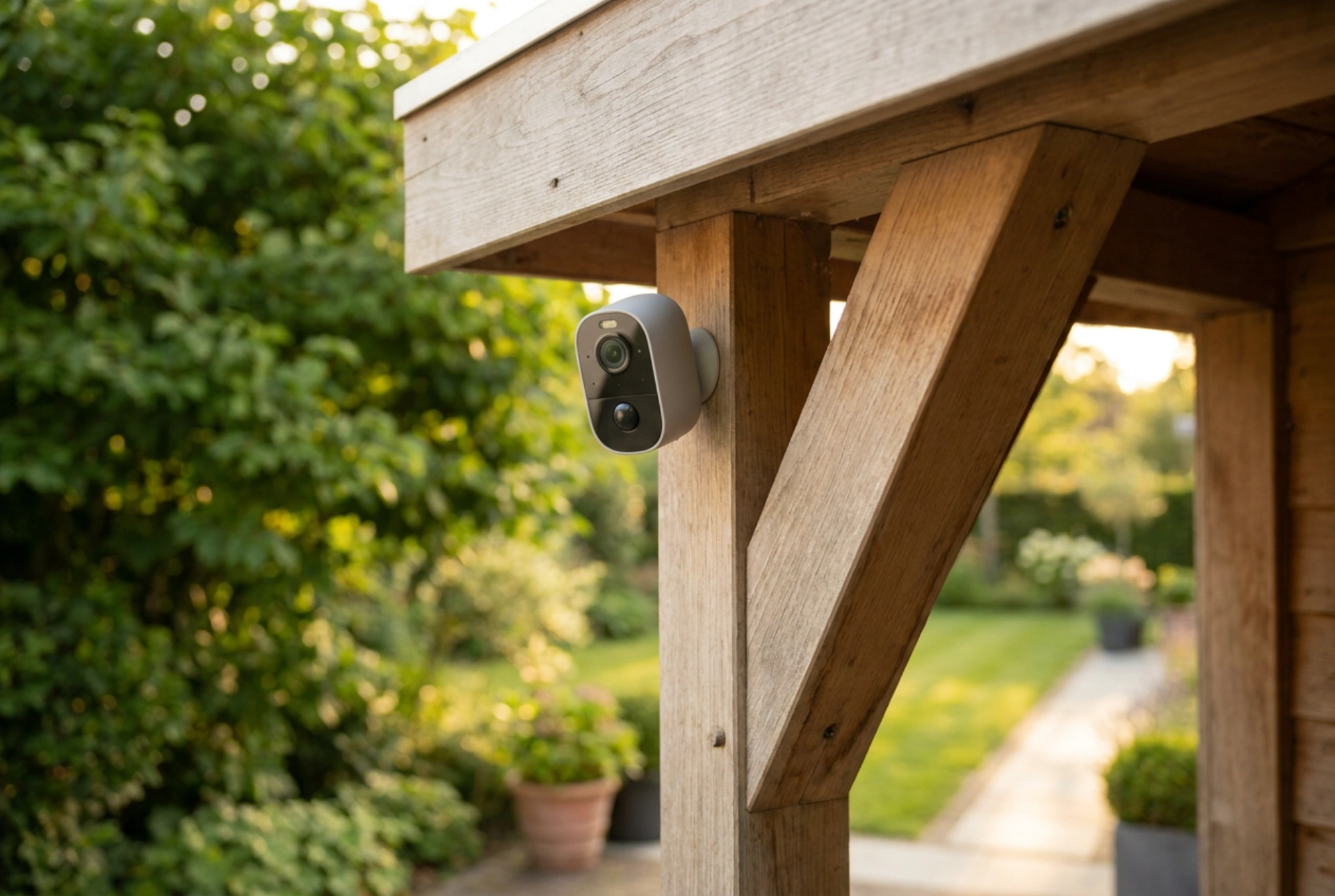
Placing the camera under a small physical eave or shield prevents direct rain exposure and reduces radiative cooling at night, minimizing the risk of dew formation on the glass lens cover. Angle the camera slightly downwards (roughly 15 to 20 degrees) to maximize the PIR sensor\'s lateral detection efficiency, as these sensors are far more sensitive to objects crossing their field of view than those moving directly toward them.