

Setting up reliable surveillance on a remote property or garden plot without a fixed broadband connection requires a strategic approach combining mobile telecommunications, autonomous power systems, and physical environmental protection.
Understanding Mobile Data Transmission and Antenna Physics
Without a fiber-optic or cable connection, cellular networks (LTE or 5G) serve as the primary conduit for data transmission. Security cameras designed for remote areas utilize integrated cellular modules that accept a SIM card. To ensure a stable connection, it is critical to understand signal propagation. Cellular signals travel via radiofrequency electromagnetic waves, which are prone to attenuation (weakening) by physical obstacles such as dense foliage, wet trees, and topographic rises.
To maximize signal strength, mount the camera or its external antenna as high as possible. Polarization is another key factor: cellular antennas are typically vertically polarized, meaning they should be aligned perfectly straight to match the orientation of the transmitter on the base transceiver station. If the signal is weak, utilizing a directional external antenna pointed precisely toward the nearest mast can concentrate the signal path, significantly reducing packet loss and power consumption of the internal modem during data transmission.
Power Management: Solar Dynamics and Battery Chemistry
Operating a security system off-grid requires a reliable power budget. Solar-powered cameras rely on small photovoltaic panels that convert solar irradiance into electrical energy. This process relies on semiconductor materials (usually silicon) that release electrons when exposed to photons, creating an electrical current. However, solar efficiency drops during overcast winter days, which means the storage system must be sized appropriately.
Lithium-ion or Lithium Iron Phosphate (LiFePO4) batteries are commonly used for energy storage. LiFePO4 batteries are highly recommended for outdoor use due to their chemical stability, longer life cycles, and superior performance in extreme temperatures compared to standard lithium-ion chemistry. At sub-zero temperatures, chemical reactions within standard batteries slow down, reducing available capacity. Therefore, insulating the battery housing or choosing cells rated for negative temperatures is essential. To prevent complete discharge, configure the camera to enter a low-power deep sleep mode, waking up only when triggered by physical events.
PIR Sensors and Local Storage Architecture
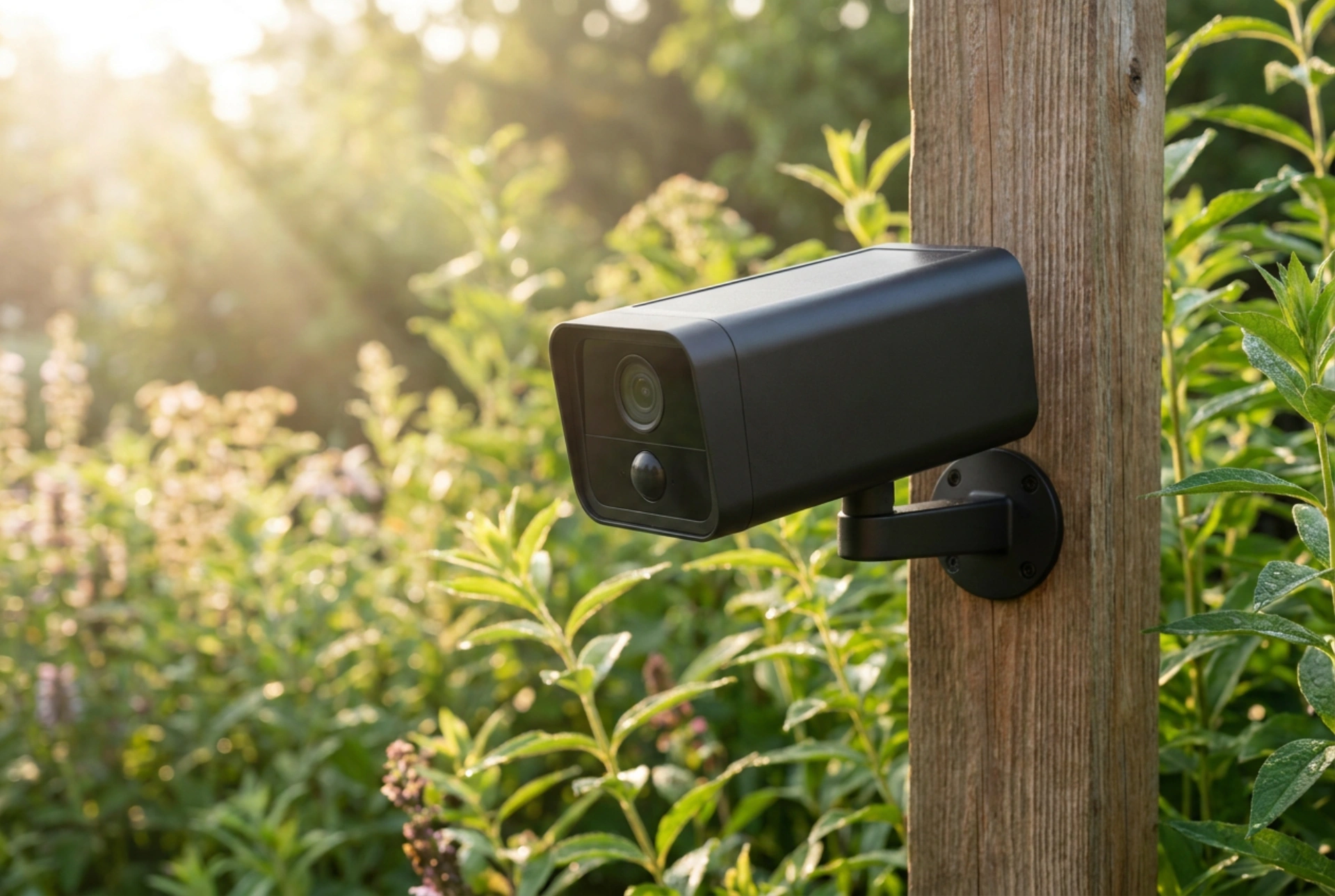
Continuous video recording consumes massive amounts of power and data. To mitigate this, remote surveillance relies on Passive Infrared (PIR) sensors for motion detection. PIR sensors detect changes in infrared radiation (heat energy) within their field of view. When a warm object, such as a person, moves across the sensor's zones, the sudden change in thermal energy triggers the camera to wake up, record, and transmit a clip. This is far more energy-efficient than software-based pixel-change detection, which requires the camera's image processor to run continuously.
For data storage, local recording onto a high-endurance microSD card is the most reliable method. These memory cards use NAND flash memory, which has a limited number of write cycles. For outdoor surveillance, you must use cards designated as 'High Endurance' (often utilizing Multi-Level Cell or single-level cell technology) that can withstand constant rewriting and extreme temperature fluctuations. Format the storage card using the exFAT or FAT32 file system depending on the device's requirements to ensure write operations do not corrupt during sudden power loss.
Environmental Shielding and Ingress Protection
Outdoor hardware must withstand dust, rain, and humidity. Look for devices with a minimum Ingress Protection rating of IP66. The first digit (6) denotes total protection against dust ingress, while the second digit (6) guarantees protection against high-pressure water jets. Thermal cycling—the transition between cold nights and warm days—creates a relative humidity gradient inside the camera housing, which can lead to condensation on the lens. To prevent this, place small silica gel packets inside the camera's weather-sealed compartment to absorb ambient moisture and prevent internal fogging.