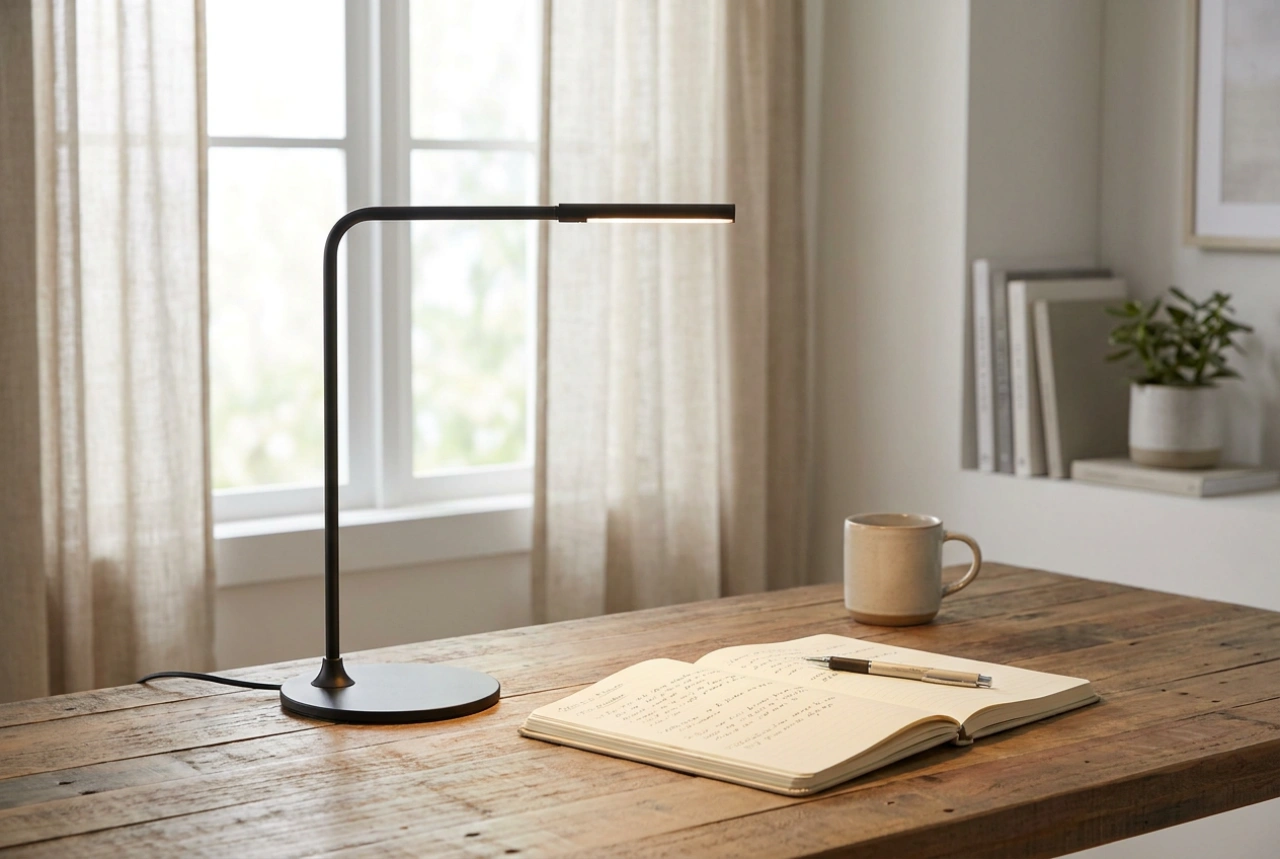


Positioning a bedside reading light involves balancing physical ergonomics, optical physics, and human biology to prevent eye strain and preserve sleep quality. The correct placement depends on your reading posture, the light’s beam angle, and how light reflects off printed or digital pages.
The Physics of Glare and the Angle of Reflection
When light hits a book page, it reflects. If the light source is positioned directly in front of or above your page, it causes specular glare—a harsh reflection that reduces contrast and forces your pupils to constrict, leading to rapid eye fatigue. To prevent this, apply the fundamental law of reflection: the angle of reflection equals the angle of incidence.
To keep reflected light away from your eyes, position the lamp slightly to the side and behind your shoulder. This ensures that light strikes the page at an angle and reflects forward, away from your line of vision. If you are right-handed, place the light on your left side to prevent your writing hand from casting shadows, and vice versa if you are left-handed.
Ergonomic Height and Distance Measurements
The spatial relationship between your eyes, the book, and the light source is critical. A reading light that is too high will spill ambient light across the entire room, while one that is too low creates a harsh, concentrated hotspot with high-contrast shadows.
- Eye-Level Alignment: Sit in your typical reading position against the headboard. The bottom rim of the lampshade or the light source itself should align horizontally with your eye level—typically between 50 and 60 centimetres above the mattress. This conceals the bare bulb from direct view while casting a broad cone of light onto your reading material.
- Lateral Offset: Position the light fixture approximately 25 to 40 centimetres to the side of your reading shoulder. This offset provides sufficient clearance for movement while keeping the light concentrated within your reading zone.
- Focal Distance: Keep the source within 1 metre of the page. Because light intensity decreases with the square of the distance (the inverse-square law), moving the lamp even slightly closer increases brightness exponentially without requiring a higher-wattage bulb.
Colour Temperature and Melatonin Synthesis
The light spectrum emitted by your bedside lamp directly influences your endocrine system. Natural evening light is warm and devoid of blue wavelengths, signaling the pineal gland to release melatonin, the hormone responsible for sleep onset.
Choose bulbs with a warm colour temperature between 2200 Kelvin and 2700 Kelvin. Cooler light (above 4000 Kelvin) contains high concentrations of blue light, which stimulates photoreceptors in the retina, suppressing melatonin production and disrupting your circadian rhythm. For reading, opt for a bulb with a High Colour Rendering Index (CRI of 90 or above) to ensure text contrast remains sharp and legible even at lower light levels.
Selecting and Directing Beam Angles
If you share a bed, controlling the spill of light is essential to avoid waking your partner. A highly directed beam prevents ambient light pollution across the room.
- Narrow Beam Angles: Use fixtures with adjustable heads or goose-necks that project a tight cone of light (30 to 40 degrees). This allows you to illuminate only the pages of your book.
- Opaque Shades: Avoid semi-transparent fabric or glass shades if you require targeted illumination. Solid metal, ceramic, or thick dark shades direct 100% of the light downwards, eliminating horizontal glare.