

Mounting a flat-screen television in a corner requires precise geometric calculations and an understanding of mechanical leverage to ensure both optimal viewing angles and structural integrity. Selecting the wrong cantilever bracket can lead to restricted screen movement or, worse, structural failure of the wall anchors under high torque.
The Geometry of Corner Mounting: Calculating Required Arm Length
When positioning a television in a 90-degree corner, the width of the screen is the primary limiting factor. A standard flat-screen TV sits parallel to the bracket plate when retracted, but to angle it across a corner, the bracket's articulating arm must extend far enough to clear the adjacent walls. To determine the minimum required arm length, you must apply basic trigonometry.
First, measure the total width of your television. If you wish to angle the TV at exactly 45 degrees across the corner, the distance from the corner vertex to the outer edge of the TV creates a right-angled triangle. Mathematically, the minimum extension of the cantilever arm must be at least half the width of the television, plus an extra 10 centimetres to allow for bezel thickness, cable connectors, and physical clearance during rotation. If the arm is too short, the outer edge of the television will collide with the side wall, preventing the screen from reaching the desired viewing angle.
The Physics of Leverage: Understanding Cantilever Torque
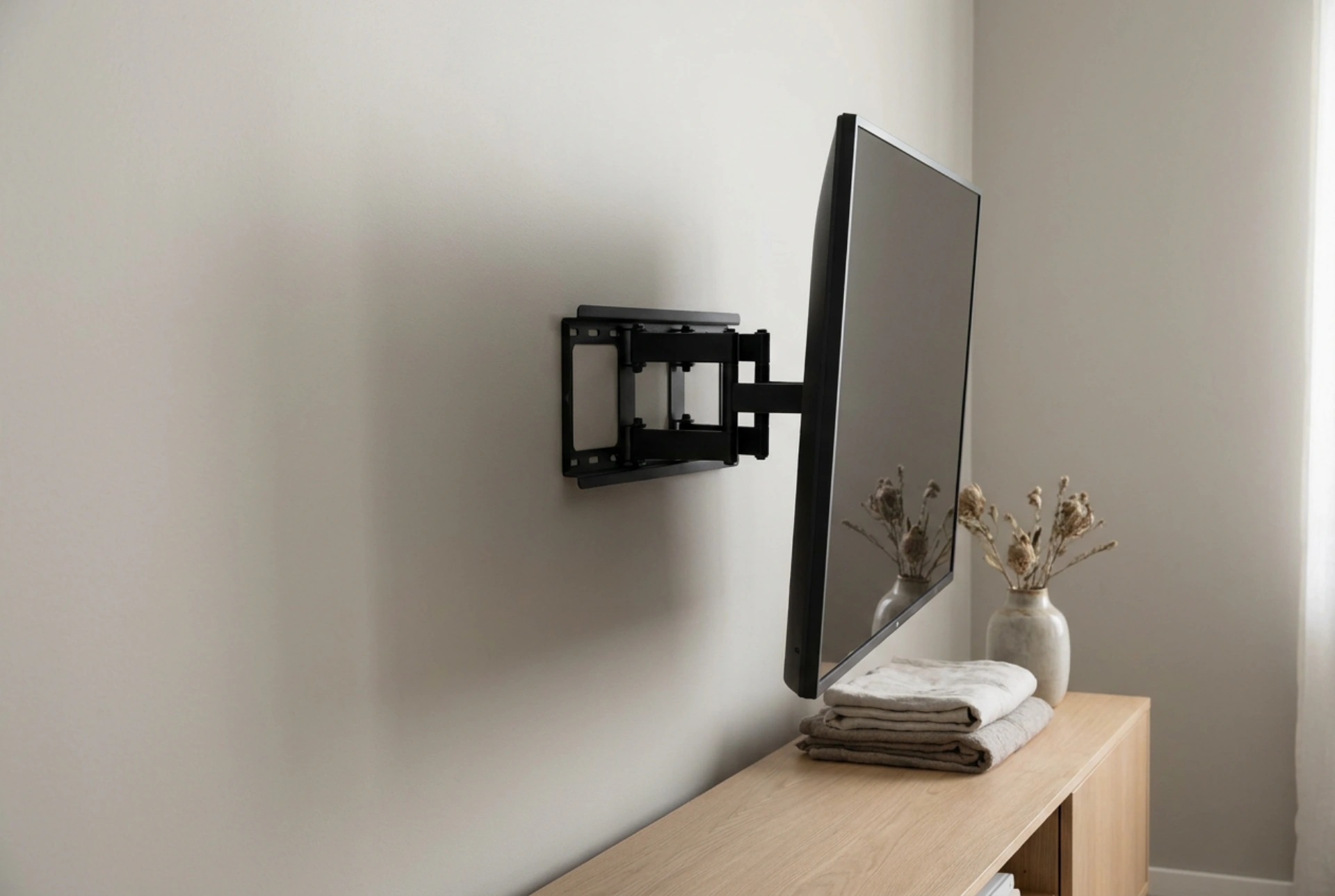
A cantilever TV bracket operates as a classic class-one lever. When the articulating arm is fully collapsed against the wall, the load (the television's weight) acts downwards close to the fulcrum (the wall mount plate), exerting primarily shear stress on the mounting screws. However, as you extend the arm outward into the room, the physics change dramatically.
Extending the arm increases the moment arm (the distance between the pivot point and the load), which exponentially increases the rotational force, or torque, applied to the wall plate. This torque attempts to pull the top screws out of the wall (tension force) while pushing the bottom of the plate into the wall (compression force). For example, a 20-kilogram television extended 50 centimetres on an arm exerts significantly more pulling force on the top wall anchors than the same television kept flush against the wall. You must always choose a bracket rated for at least 1.5 times the actual weight of your television to account for these dynamic forces when rotating the screen.
Wall Construction and Anchor Mechanics
The load-bearing capacity of your wall determines how the cantilever bracket must be anchored to withstand high rotational forces. Different materials react differently to tension and shear stresses:
- Solid Brick and Concrete: These materials offer excellent compressive strength. Heavy-duty expansion anchors or chemical rawlplugs should be used. The expansion anchor expands against the inner walls of the drilled hole, creating friction that resists the tension forces of the extended arm.
- Timber Stud Walls: A cantilever bracket should never be mounted directly into plasterboard alone. The mounting plate must be secured directly into the vertical wooden studs using heavy-duty lag screws. If the stud spacing does not align with your corner placement, a solid timber backing board must first be secured across multiple studs to distribute the load before attaching the bracket.
Material Selection and Structural Deflection
The material composition of the articulating arm directly influences its deflection rate. Under load, all cantilever arms experience minor structural deflection, commonly referred to as sag. High-tensile carbon steel offers a superior stiffness-to-weight ratio compared to cast aluminium, minimizing the vertical drop when the screen is fully extended. Heavy-duty steel dual-arm configurations distribute the weight across two parallel structural pathways, reducing lateral play and twisting when adjusting the viewing angle.
Degrees of Freedom and Tilt Adjustments
For corner installations, a full-motion bracket offers three axes of rotation: swivel (left-to-right panning), tilt (vertical angling), and rotation (levelling the screen horizontally). Because corner mounts are often installed slightly higher than standard wall mounts to clear furniture, a downward tilt of 5 to 15 degrees is essential to prevent vertical contrast degradation, particularly in screens sensitive to off-angle viewing. Furthermore, ensure the bracket features post-installation level adjustment, as even a minor deviation of one millimetre at the wall plate will translate into a highly visible slant across a large screen when fully extended.