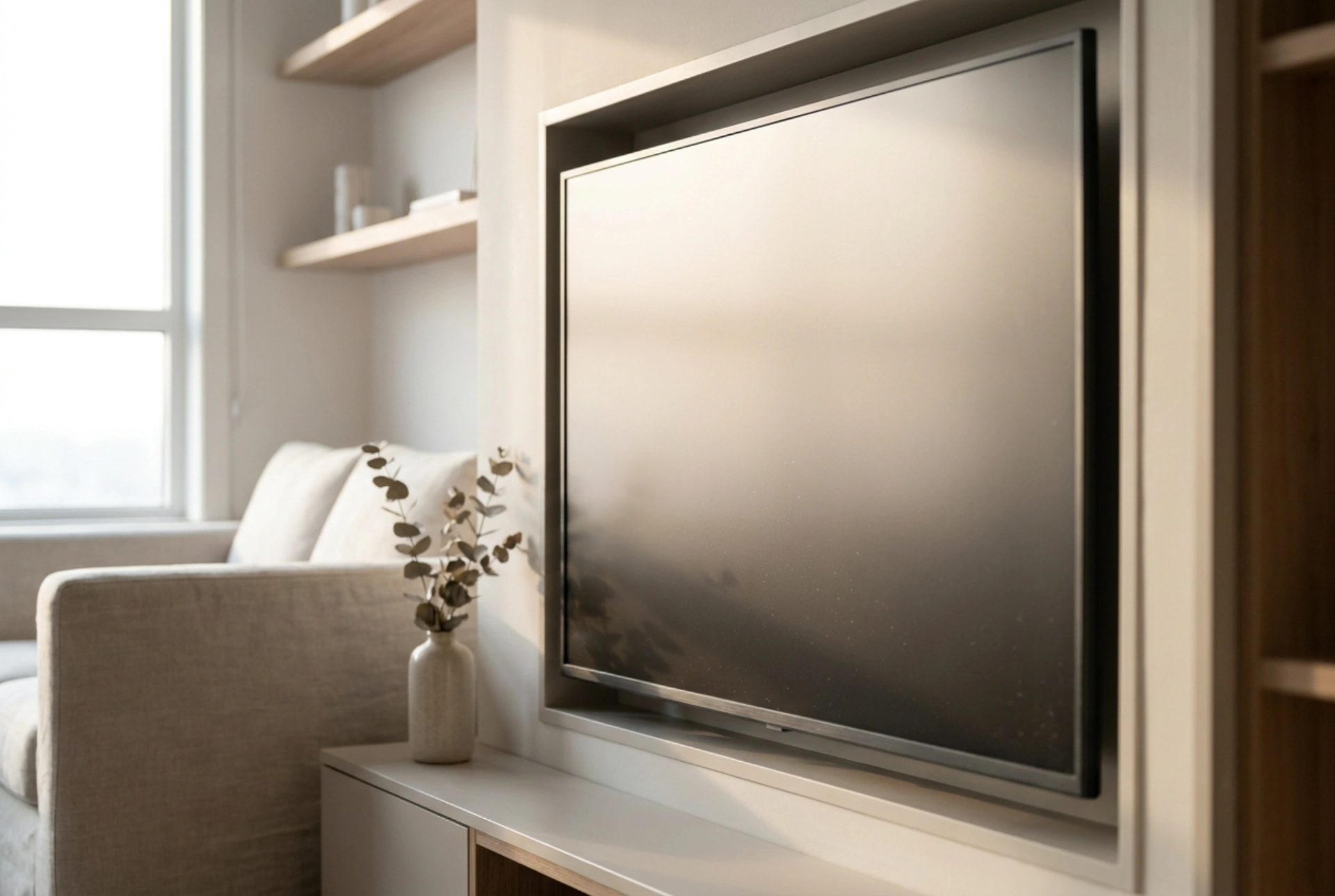


Selecting the right screen finish is a critical decision when optimizing your viewing experience, particularly in rooms subject to fluctuating or intense ambient light.
The Physics of Screen Reflections
To understand why a matte screen is effective, we must look at how light interacts with different surfaces. Standard glossy screens act like mirrors because of specular reflection. When incoming light hits a perfectly smooth glossy surface, it bounces off at the exact same angle it arrived. This creates a sharp, mirrored image of windows, lamps, and furniture directly on your television display.
A matte screen utilizes diffuse reflection. The surface of a matte panel is not perfectly smooth; it is engineered with microscopic textures or a specialized anti-reflective chemical coating. When light waves strike these microscopic irregularities, they scatter in multiple directions. Instead of reflecting a coherent, bright image of a light source back to your eyes, the light is dispersed widely, converting a harsh, distracting glare into a soft, barely noticeable haze.
Optimal Scenarios for Matte Displays
Matte screens offer distinct advantages in specific architectural and lighting setups. Recognizing these environments helps in making the right choice for your living space:
- Brightly Lit Living Rooms: Spaces featuring large, floor-to-ceiling windows or multiple glass doors suffer the most from daylight glare. Matte screens prevent these light sources from washing out the on-screen image.
- Opposing Light Sources: If your room layout requires placing the television directly opposite a window or a powerful artificial light fixture, a matte surface prevents the direct reflection of that source.
- Daytime Viewing: For households where the television is frequently used during midday hours, matte panels maintain visibility without the need to draw heavy blackout curtains.
The Optical Trade-Offs of Diffusion
While diffuse reflection solves the problem of glaring light sources, it introduces specific optical characteristics that you must consider. Because the micro-textured surface scatters incoming light, it also slightly scatters the light emitting from the pixels behind it.
This scattering can lead to a slight reduction in perceived contrast. In a dark room, the deep blacks on a matte screen may appear slightly gray or muddy compared to a glossy screen, which preserves the direct path of the emitted light. Additionally, colors might lose a fraction of their absolute vibrancy under close inspection. However, in any room with active ambient light, the contrast loss caused by a matte screen scattering light is significantly less than the contrast loss caused by a glossy screen reflecting a giant white window.
Maintenance and Cleaning Protocols
The microscopic physical structure of a matte screen requires a specific cleaning approach to prevent permanent damage to the anti-reflective layer:
- Avoid Harsh Chemicals: Never use cleaners containing ammonia, alcohol, or acetone. These solvents can dissolve the micro-textured chemical coatings, leaving permanent, shiny splotches on your screen.
- Dry Dusting First: Always use a clean, dry, ultra-soft microfiber cloth to remove dust. Apply minimal pressure, moving in consistent circular or linear paths to avoid pressing abrasive dust particles into the micro-textures.
- Damp Method Only for Smudges: For stubborn spots, slightly dampen the microfiber cloth with distilled water. The cloth must be barely damp, not wet. Wipe gently and immediately follow with a dry section of the cloth to prevent water spots.