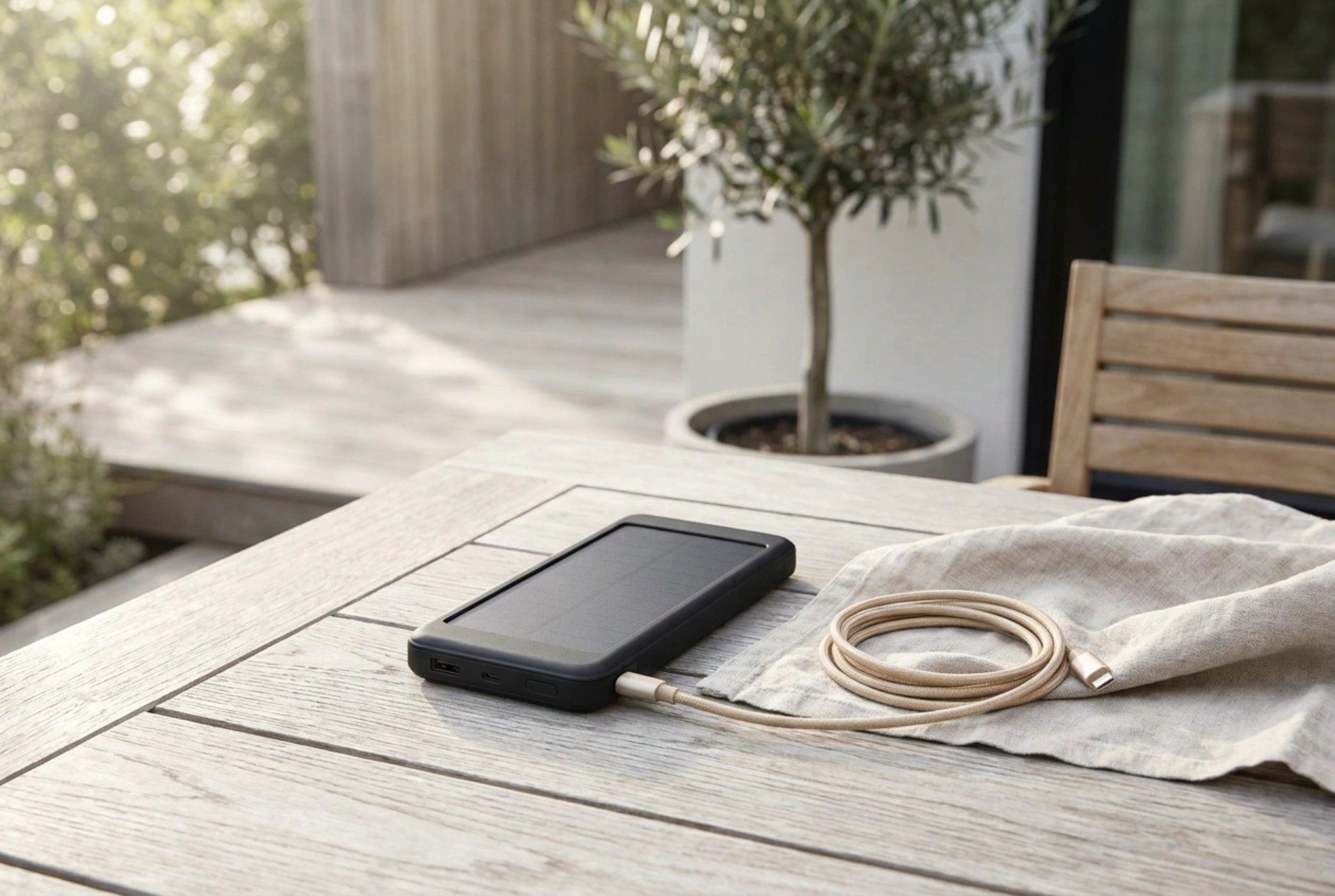


Maximising the efficiency of a solar power bank requires understanding the physics of photovoltaic energy conversion and proper battery maintenance.
The mechanics of solar charging and capacity
A solar power bank combines two distinct technologies: a photovoltaic panel and a lithium-polymer or lithium-ion battery. The solar panel converts light energy into electrical energy through the photovoltaic effect, where photons dislodge electrons in silicon cells, creating a current. However, due to the small surface area of portable panels, this process is naturally slow. The built-in solar panel is primarily designed for emergency topping-up rather than primary charging from empty. To use these devices efficiently, you should always pre-charge the battery to 100% using a standard wall outlet before leaving home, leaving the solar panel to sustain the charge level during outdoor exposure.
Optimising angle and sunlight exposure
The angle at which sunlight hits the photovoltaic cells directly dictates the energy output. For maximum efficiency, the solar panel must sit perpendicular to the sun's rays. Position the power bank at a 30 to 45-degree angle facing south (in the Northern Hemisphere) to capture the most direct solar radiation. Laying the device flat on the ground reduces efficiency by up to 30% because the light strikes the silicon cells at an oblique angle, causing more photons to reflect off the protective glass cover instead of penetrating the semiconductor material.
Managing temperature and thermal degradation
Lithium-based batteries are highly sensitive to temperature extremes. While solar panels require direct sunlight to generate electricity, the resulting heat can degrade the battery cells inside the unit. Operating temperatures above 45 degrees Celsius accelerate chemical degradation within the battery, permanently reducing its overall storage capacity. To prevent overheating, position the power bank so that the solar panel faces the sun while the battery housing itself is shaded, or place the unit on a surface that dissipates heat, such as stone or concrete, rather than heat-trapping materials like dark plastic or car dashboards.
Correct charging sequence for connected devices
To preserve energy, do not charge your mobile device while the power bank itself is actively charging under weak sunlight. This simultaneous charge-and-discharge process, known as pass-through charging, generates excessive heat and subjects the battery cells to high cycle stress. For optimal energy transfer, let the power bank accumulate solar energy undisturbed, and then connect your mobile device during shaded periods or in the evening. This separation of cycles protects the internal circuitry and ensures that energy is transferred at a stable, regulated voltage.