

Achieving immersive, cinema-quality sound in a standard living room depends more on acoustic physics and precise speaker placement than on purchasing expensive audio hardware.
The Physics of Sound in Shared Spaces
Sound travels in waves that interact constantly with your room’s physical boundaries. Hard surfaces like plasterboard, glass, and wooden floors reflect sound waves, creating unwanted echoes and phase cancellations. Conversely, soft furnishings absorb high frequencies. When positioning speakers in a multi-use living room, the goal is to balance these reflections while creating a cohesive soundstage where the audio aligns perfectly with the visual action on your screen.
The Core: Positioning the Front Soundstage
The front soundstage comprises the left, right, and center speakers. This trio handles the majority of dialogue, on-screen action, and directional panning effects.
- The Center Channel: This speaker is the anchor for dialogue. It must be positioned directly above or below your screen, precisely aligned with the middle of the display. To prevent sound reflections from muddying the voices, pull the center speaker forward so its front edge sits slightly proud of any TV cabinet or shelf.
- Left and Right Channels: These speakers create the stereo width. They should form an equilateral triangle with your primary listening position. If you sit 3 meters from the screen, the left and right speakers should also be 3 meters apart from each other. Angle them inward (toe-in) by roughly 15 to 20 degrees so the high-frequency drivers point directly toward your ears.
- Tweeter Height: For all three front speakers, the high-frequency drivers (tweeters) should ideally be at ear level when you are seated. If your center speaker must sit low, tilt it upward slightly using small acoustic foam wedges to point the sound waves toward your head rather than your knees.
Expanding to Surround Sound
Surround speakers add spatial depth, enveloping you in ambient environmental sounds and off-screen effects. In a standard 5.1 system, the surround channels are placed to the sides, not behind you.
- Lateral Placement: Position your side surround speakers between 90 and 110 degrees relative to your face-forward listening position. Placing them directly to the sides or slightly behind the sofa ensures a realistic transition of sound from the front to the back of the room.
- Elevation: Surround speakers should be mounted approximately 60 centimeters above seated ear level. This height prevents the sound from being blocked by furniture or the heads of people sitting next to you, creating a more diffuse and convincing ambient sound field.
Calibrating the Subwoofer and Managing Bass Waves
Low-frequency sound waves are non-directional but highly susceptible to the physical dimensions of your room. Placing a subwoofer directly in a corner causes a phenomenon called "boundary loading," which artificially boosts bass volume but results in muddy, imprecise sound.
To find the optimal spot, utilize the "subwoofer crawl" technique. Place the subwoofer temporarily in your main seat at head height, play a bass-heavy track, and crawl along the floor where you could realistically position the unit. Where the bass sounds tightest, punchiest, and least boomy is the scientifically optimal spot to place the subwoofer permanently.
Managing Room Acoustics and Reflections
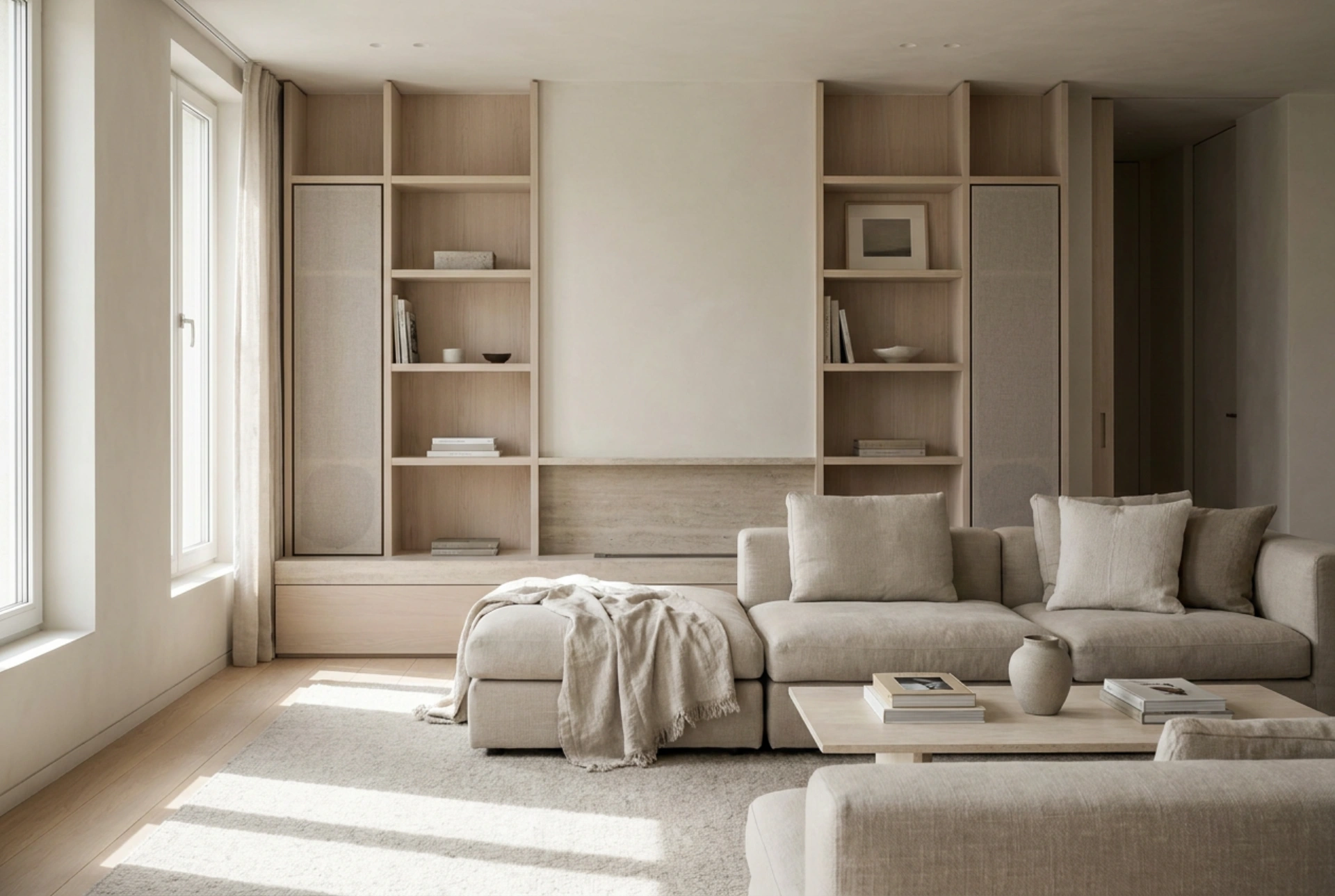
Even perfect speaker placement can be undermined by poor room acoustics. To maximize the performance of your positioned speakers without installing industrial acoustic panels, focus on strategic interior placement. Use thick rugs to dampen floor reflections between the front speakers and the seating area. Hang heavy curtains over large glass windows, and utilize bookshelves filled with varying-sized items as natural diffusers to break up harsh flutter echoes along bare side walls.