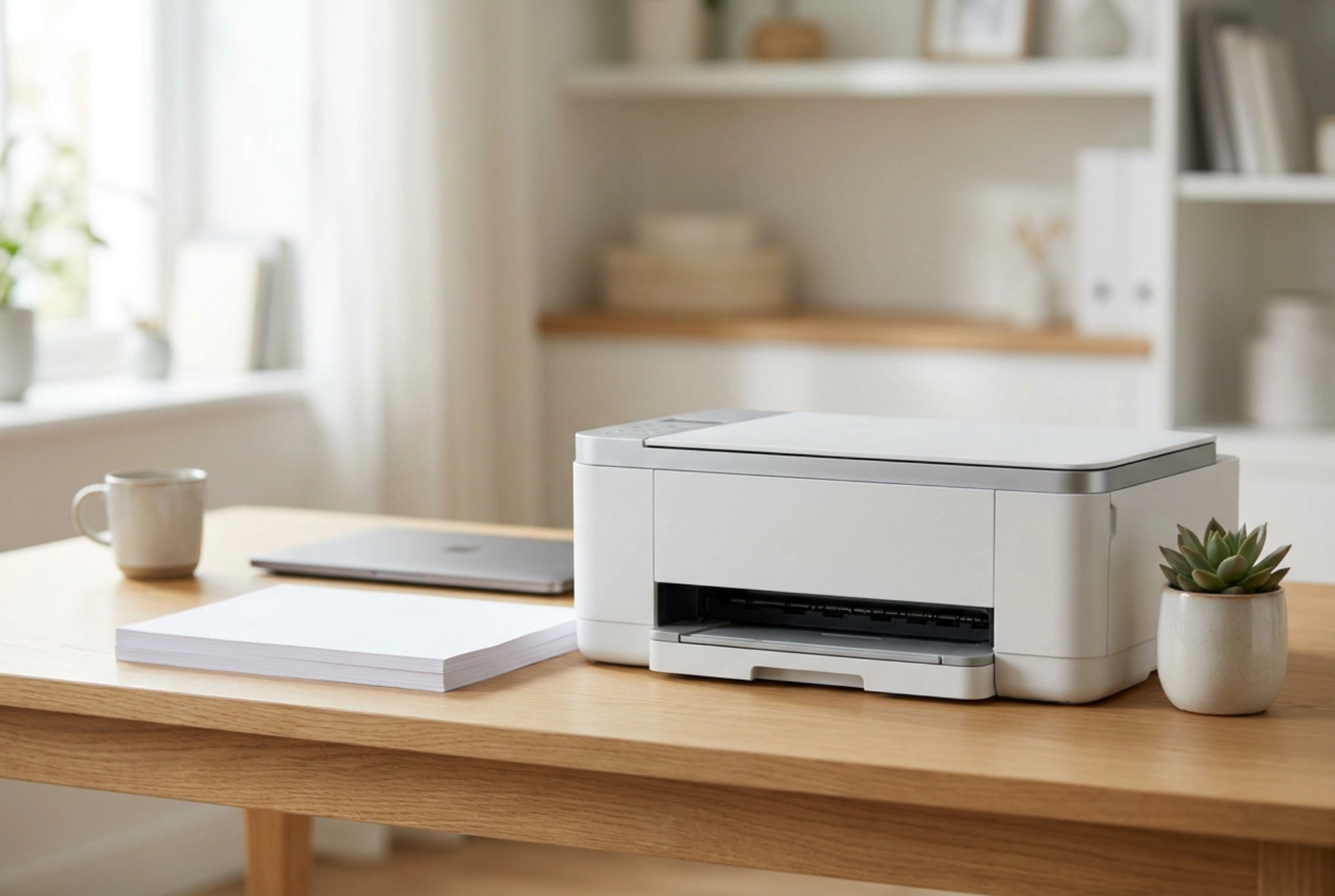


Choosing between a laser and an inkjet printer determines not just your initial equipment cost, but your ongoing maintenance efforts, print speeds, and long-term material expenses.
The Underlying Physics of Printing Technologies
To make an informed decision, it is essential to understand how these two devices bond colorant to paper. Inkjet printers rely on liquid chemistry. They use thermal or piezoelectric elements to force microscopic droplets of liquid ink through tiny printhead nozzles onto the page. This liquid is absorbed by the paper fibers. Laser printers, conversely, rely on electrostatics and thermodynamics. A laser beam draws an electrostatic image onto a photosensitive drum, which attracts dry toner powder (composed of plastic resins and color pigments). The drum transfers this powder to the paper, which then passes through a fuser assembly where heat and pressure melt the plastic, bonding it permanently to the surface.
The Chemistry of Ink Drying and Clogging
Liquid ink is highly susceptible to evaporation. When an inkjet printer sits idle for several weeks, the solvent in the ink dries out within the microscopic nozzles of the printhead, leading to clogs. Resolving this requires automated cleaning cycles that force significant amounts of expensive ink through the nozzles to dissolve the blockage, resulting in wasted material. Toner powder, being entirely dry, does not evaporate, degrade, or clog over time. A laser printer can remain unused for months and resume printing instantly with no loss in quality or wasted consumables. This chemical stability makes laser technology far more resilient for low-volume or sporadic users.
Paper Selection and Liquid Absorption
Because inkjet printers deposit liquid, the characteristics of the paper play a critical role in print quality. Standard copy paper is highly porous, causing liquid ink to spread along the fibers via capillary action, a phenomenon known as feathering. To achieve sharp text or vibrant graphics with an inkjet, you must use coated or treated papers that control liquid absorption. Laser printers are highly forgiving of paper quality. Because the toner is melted onto the page surface rather than absorbed, it yields crisp, sharp edges on almost any standard paper grade, including cheap copier paper, without feathering or bleeding.
Speed, Volume, and Cost Efficiency
The mechanical process of laser printing is inherently faster and more efficient for volume work. The laser sweeps across the drum rapidly, and the entire page is fused in one continuous motion. Inkjet printheads must physically travel back and forth across the width of the page, making the process significantly slower. When evaluating operating costs, laser printers offer a much lower cost per page. While toner cartridges have a higher initial purchase price than ink cartridges, their yield is exponentially larger, often printing thousands of pages compared to the hundreds of pages yielded by standard liquid ink cartridges.
How to Determine the Right Choice for Your Space
- Choose laser if: Your primary output is text documents, invoices, or shipping labels, you print sporadically, or you require fast, high-volume black-and-white output with zero risk of ink drying out.
- Choose inkjet if: You frequently print high-resolution photographs, require precise color blending on specialized photo paper, or have extremely tight space constraints that only a compact, low-profile device can accommodate.